| |
|
|
|
Case Report
| ||||||
| Penetrating Injury in the forearm caused by bird's beak | ||||||
| Taran Singh Pall Singh1, Thinesh Varan Subramaniam2, Thirumurugan Kurusamy3, Gopi Mathavan4 | ||||||
|
1Lecturer and Orthopedic Surgeon, University Sains Malaysia, Kubang Kerian, Kelantan, Malaysia.
2Medical officer in orthopedic department, Hospital Tuanku Ja'afar Seremban, Negeri Sembilan, Malaysia. 3Medical officer in orthopedic department, Hospital Tuanku Ja'afar Seremban, Negeri Sembilan, Malaysian. 4Orthopedic Surgeon, Hospital Tuanku Ja'afar Seremban, Negeri Sembilan, Malaysia. | ||||||
| ||||||
|
[HTML Abstract]
[PDF Full Text]
[Print This Article]
[Similar article in Pumed] [Similar article in Google Scholar] 
|
| How to cite this article |
| Singh TSP, Subramaniam TV, Kurusamy T, Mathavan G. Penetrating injury in the forearm caused by bird's beak. Int J Case Rep Images 2015;6(8):477–480. |
|
Abstract
|
|
Introduction:
Human injuries caused by animals are a relatively common entity in Malaysia. However, when the animal involved is a bird and its victim is a motorcyclist, it is rather unheard of. To our knowledge, this is the first reported case of a bird breaking its beak in the forearm of a motorcyclist resulting in a surgery to remove the deep-seated foreign body.
Case Report: A case of 21-year-old male who collided with a bird while riding motorbike. He presented with complaint of wound over the left forearm and foreign body sensation. It is associated with minimal pain and swelling. X-ray of left forearm showed bird's beak. Augmentin intravenous was started, wound debridement was done and the bird's beak is removed with the help of image intensifier under emergency operation. Puncture wound was left open for dressing. Conclusion: The presence of bird's beak in the forearm is more than a foreign body. Antibiotics selection should follow the animal bite guidelines in addition to foreign body removal and meticulous wound debridement to prevent infection. | |
|
Keywords:
Beak, Infection, Forearm, Antibiotics
| |
|
Introduction
| ||||||
|
Human injuries caused by animals are a relatively common entity in Malaysia. They usually arise from dogs, cats, snakes, monkeys and insects like bees and centipedes. Although there have been incidences of birds causing injuries to humans, it is almost unheard of for a bird to be involved in a motor vehicle accident [1][2] . In this paper, we report a case of an upper limb injury inflicted on a motorcyclist by a bird, which resulted in the bird's beak becoming a foreign body in the patients forearm. | ||||||
|
Case Report
| ||||||
|
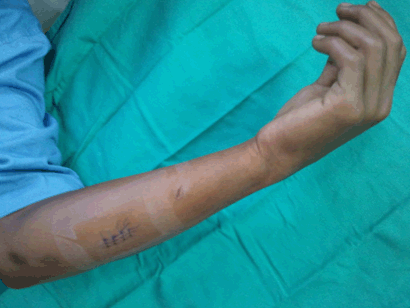
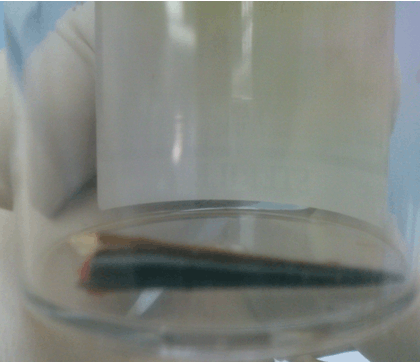
A 21-year-old male was referred to our orthopedic department from a peripheral hospital for a foreign body in his left forearm. The man was riding his motorcycle in his village area in the evening, when suddenly a bird collided into his left forearm. He managed to control his motorcycle and stop to the side of the road only to notice a puncture wound over the ulna aspect of the forearm with an object protruding from it. After he pulled out the object, he realized that it was one half of the bird's broken beak. At that point he could still feel something inside the flexor compartment of his left forearm. He could not however locate the bird to identify its type. The following morning he went to the nearest district hospital for further treatment. An X-ray was done and a faint foreign shadow was noted adjacent to the mid-shaft of the left ulna (Figure 1). His wound was dressed and he was administered an anti-tetanus toxoid (ATT) injection prior to referral. On assessment upon arrival at our center, there was a 1 cm puncture wound over the distal half of the left ulna region (Figure 2). He was able to flex and extend all fingers and the wrist, but with significant pain. There was some non-specific numbness on the ulna aspect of the forearm and hand distal to the puncture side, but there was no significant peripheral nerve deficit. Both the radial and ulna pulses were palpable. The patient was started on augmentin intravenous and prepared for emergency wound debridement and removal of bird's beak. With the help of an image intensifier, the beak was localized and removed. It was some 5 cm away from the entry point (Figure 3). The puncture wound was debrided and a separate incision was made to remove the beak (Figure 2). There was no major neurovascular damage noted. The puncture wound was left open for dressing. Patient completed the antibiotics for total duration of 7 days, intravenous for 2 days and oral for 5 days. The patient was discharged well with no early complications. | ||||||
| ||||||
| ||||||
| ||||||
|
Discussion
| ||||||
|
While it is relatively common for a foreign body to be retained following animal bites, especially with dogs, there has been no literature reporting this condition in relation to birds [3]. This case highlights a retained foreign body following a puncture wound, which is uncommon [4]. This is further complicated by the fact that the foreign body is a bird's beak, equating the wound to an animal bite. Hence, the management we used was based on established guidelines for animal bites. The patient was also very fortunate not to suffer a neurovascular injury as the wound and foreign body were very near the course of the ulnar nerve and artery. The role of radiographs and other imaging modalities e.g., ultrasound and image intensifier (although not pivotal in this case as the patient knew the remaining half of the beak was in situ), are essential in investigating and localizing a foreign body [4]. No specific guidelines exist recommending the culture of bite wounds [5]. However, it would have been interesting to find out the isolated organism's, although it would have not been conclusive. Unfortunately, no samples were sent for culture in this case. The patient was given an ATT injection as he was unsure of his tetanus immunization and the wound condition did not warrant tetanus immunoglobulin. The empirical antibiotics given were to cover gram positive, gram negative and anaerobic bacteria, as there is no established data on the microbiologic analysis for bird related injuries, unlike in dog and cat bites where Pasteurella, Staphylococcus and Streptococcus species are the most prevalent organisms [5]. The usage of prophylactic antibiotics was in view of the deep animal bite related puncture wound and the delayed duration in the patient's presentation. In this case, the original wound (entry point of foreign body) was left open for dressing post debridement. Although data are limited, animal bite related wounds are almost always managed by delayed primary or secondary closure [5]. A review article by Garbutt et al. concluded that animal bite wounds in the hand should be left open always, while non-puncture wounds elsewhere may be safely treated with primary closure after thorough debridement [6]. Unprovoked bird related injuries are almost unheard of. The sheer velocity (motorcycle and flying bird) and nature of the injury managed to completely break the beak from its base and propel deep into the forearm. Hence, although not routinely practiced, protective motorcycle riding gear usage is essential to avoid such injuries, as the effects may be even more devastating when riding at high speeds. | ||||||
|
Conclusion
| ||||||
|
Penetrating injury by bird's beak should be taken seriously and requires urgent removal. The adjunct usage of image intensifier is recommended to reduce operating time and soft tissue injury. A prophylactic broad spectrum coverage based on the local antibiotic guidelines is required to prevent infection. | ||||||
|
References
| ||||||
| ||||||
|
[HTML Abstract]
[PDF Full Text]
|
|
Author Contributions
Taran Singh Pall Singh – Substantial contributions to conception and design, Acquisition of data, Analysis and interpretation of data; Drafting the article, Revising it critically for important intellectual content, Final approval of the version to be published Thinesh Varan Subramaniam – Substantial contributions to conception and design, Acquisition of data, Analysis and interpretation of data, Drafting the article, Revising it critically for important intellectual content, Final approval of the version to be published Thirumurugan Kurusamy – Substantial contributions to conception and design, Acquisition of data, Analysis and interpretation of data, Drafting the article, Revising it critically for important intellectual content, Final approval of the version to be published Gopi Mathavan – Substantial contributions to conception and design, Acquisition of data, Analysis and interpretation of data, Drafting the article, Revising it critically for important intellectual content, Final approval of the version to be published |
|
Guarantor of submission
The corresponding author is the guarantor of submission. |
|
Source of support
None |
|
Conflict of interest
Authors declare no conflict of interest. |
|
Copyright
© 2015 Taran Singh Pall Singh et al. This article is distributed under the terms of Creative Commons Attribution License which permits unrestricted use, distribution and reproduction in any medium provided the original author(s) and original publisher are properly credited. Please see the copyright policy on the journal website for more information. |
|
|