| |
|
|
|
Clinical Image
| ||||||
| Diagnosis and management of two intrapelvic mislocated intrauterine contraceptive devices: A very rare case | ||||||
| Ritu Hooda1, Parul Bhugra1 | ||||||
|
1Department of Obstetrics and Gynecology, Pt. B.D. Sharma PGIMS, Rohtak, Haryana, India.
| ||||||
| ||||||
|
[HTML Abstract]
[PDF Full Text]
[Print This Article]
[Similar article in Pumed] [Similar article in Google Scholar] 
|
| How to cite this article |
| Hooda R, Bhugra P. Diagnosis and management of two intrapelvic mislocated intrauterine contraceptive devices: A very rare case. Int J Case Rep Images 2015;6(8):523–525. |
|
Case Report
| ||||||
|
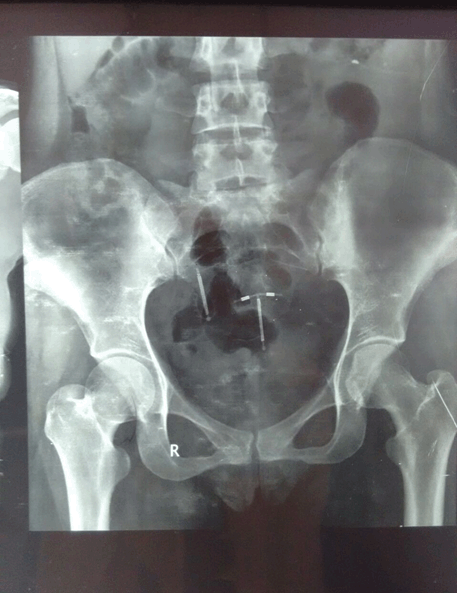
A 22-year-old female presented in the gynecology outpatient department of our institute with the chief complaint of pain in the lower abdomen for 1 month. The pain was constant, dull aching and non-radiating. The patient visited a private practitioner for pain abdomen and missed multiload thread. The practitioner prescribed analgesics and inserted a new intrauterine contraceptive device (IUCD) assuming the expulsion of prior IUCD. The pain worsened and patient came to our department. There was no history of fever, burning micturition or bowel upsets. General physical and systemic examination revealed no abnormalities. On speculum examination the string of Cu-T was not visualized at the cervical os. On per-vaginum examination uterus was tender, firm and mobile. Right fornix was also tender and thickened. Ultrasound and X-ray of abdomen showed the presence of two intrauterine contraceptive devices in the pelvis. The patient was taken up for hysterolaparoscopy. One IUCD was present in the omentum, other in the right adnexa, embedded in the adhesions. IUCDs were retrieved after breaking the adhesions. Postoperative period was uneventful and patient was discharged on fourth day. The patient was symptoms free on follow-up. | ||||||
| ||||||
|
Discussion
| ||||||
|
Intrauterine contraceptive device is a popular method of reversible contraception in developing countries due to its efficiency, low cost and non-interference with sexual activity. With increased use of IUCDs has come an increase in the number of related problems. The loss of the filament at the external os is a common problem. It may be due to, thread coiled inside, thread torn through, device expelled outside unnoticed by the patient, device pulled up by the growing uterus in pregnancy and device perforated the uterine wall and is lying in the peritoneal cavity. The most common symptoms of displaced IUCDs include abdominal pain and excessive bleeding. Uterine perforation is the most serious complication associated with displaced IUCD. Uterine perforation may further be associated with bowl perforation, mesenteric perforation, urinary bladder perforation, rectal strictures and rectovaginal fistula formation [1]. The location of misplaced IUCD can be demonstrated with abdominal X-ray, ultrasound, computed tomography (CT) scan hysterosalpingography and hysteroscopy. Ultrasound can detect the IUCD either in the uterine cavity or in the peritoneal cavity. It is preferred to radiography. Plain abdominal X-rays may be useful. X-ray will not only reveal the presence or absence of the device but also its existence outside the uterine cavity [2]. The examination is simple, fast and is quite inexpensive [3]. Abdominal CT scan may be used to better define the anatomical locations and relationship of the IUCDs with neighboring structures [3]. Hysteroscopy is useful not only to locate it but also for its retrieval. Valle and Freeman advocated hysteroscopy as a primary method for locating and removing IUCDs with missing threads so as to avoid unnecessary X-ray exposure and injuries due to blind manipulations [4] . Siegler et al, however, recommended preliminary investigations for confirming the presence of IUCDs in the uterus before hysteroscopy [5]. The removal of misplaced intrauterine IUCDs is preferably done with hysteroscopy. The advantages with the use of hysteroscopy are complete removal especially in old fragmented and embedded devices, minimum hospital stay, lesser discomfort and early recovery. Similarly, the removal of extrauterine IUCDs can usually be done by endoscopic procedures. The removal should be done as soon as the diagnosis is made. World health organization (WHO) also recommends the removal of misplaced IUCD because of potential damage to adjacent organs and because of medico-legal problems [1]. In patients in whom the laparoscopic removal is difficult due to its location, adhesion or contraindications of laparoscopy [6], laparotomy can be done in the same sitting. | ||||||
|
Conclusion
| ||||||
|
A missing string during gynecological examination is the first sign of an intrauterine or intra-abdominal contraceptive device (IUCD). In developing countries where follow-up evaluations are irregular or absent, regular follow-up for visible threads would help in earlier detection of misplaced IUCDs. If a missing thread is found during examination proper investigations for the cause and early removal of the IUCD can prevent major complications. | ||||||
|
References
| ||||||
| ||||||
|
[HTML Abstract]
[PDF Full Text]
|
|
Author Contributions
Ritu Hooda – Substantial contributions to conception and design, Acquisition of data, Analysis and interpretation of data, Drafting the article, Revising it critically for important intellectual content, Final approval of the version to be published Parul Bhugra – Analysis and interpretation of data, Revising it critically for important intellectual content, Final approval of the version to be published |
|
Guarantor of submission
The corresponding author is the guarantor of submission. |
|
Source of support
None |
|
Conflict of interest
Authors declare no conflict of interest. |
|
Copyright
© 2015 Ritu Hooda et al. This article is distributed under the terms of Creative Commons Attribution License which permits unrestricted use, distribution and reproduction in any medium provided the original author(s) and original publisher are properly credited. Please see the copyright policy on the journal website for more information. |
|
|