|

|
 |
|
Clinical Image
| ||||||
| A rare cause of acute pancreatitis: Groove pancreatitis | ||||||
| Yusuf Kayar1, Mehmet Yigit2, Iskender Ekinci3, Kenan Ahmet Turkdogan2 | ||||||
|
1Department of Gastroenterology, Bezmialem Vakif University, Istanbul, Turkey.
2Department of Emergency Medicine, Bezmialem Vakif University, Istanbul, Turkey; 3Department of Internal Medicine, Bezmialem Vakif University, Istanbul, Turkey. | ||||||
| ||||||
|
[HTML Abstract]
[PDF Full Text]
[Print This Article]
[Similar article in Pumed] [Similar article in Google Scholar] 
|


| How to cite this article |
| Kayar Y, Yigit M, Ekinci I, Turkdogan KA. A rare cause of acute pancreatitis: Groove pancreatitis. Int J Case Rep Images 2015;6(3):184–186. |
|
Case Report
| ||||||
|
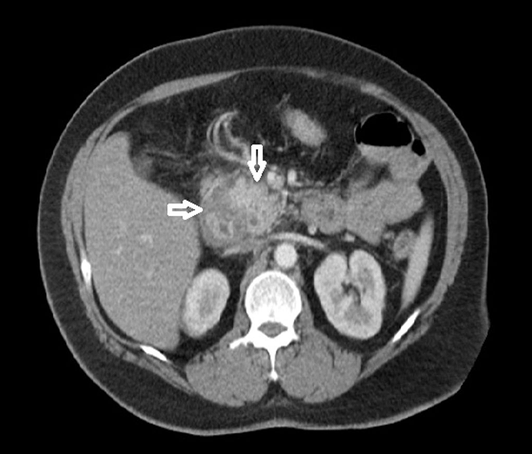
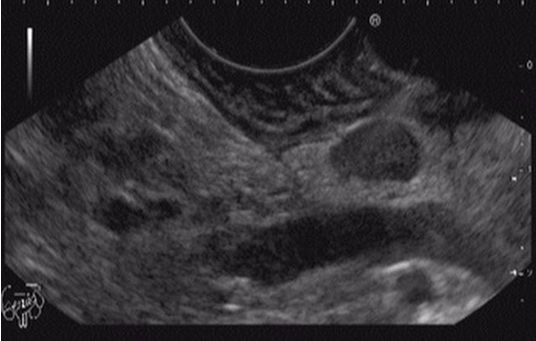
A 44-year-old female was admitted to emergency department with abdominal pain that starts 2 days ago and gradually increases after meals. She has no history of alcohol consumption but she smoked one pack of cigarettes daily for twenty years. Epigastric tenderness was revealed on physical examination. Laboratory examination showed leukocytosis, elevated serum levels of amylase and lipase (20.0x10³/µL, 697 IU/l and 893 IU/l, respectively). A contrast enhanced computerized tomography scan of the abdomen showed swelling of the pancreatic uncinate, thickening of the distal segment of the second part and proximal segment of third part of the duodenum (Figure 1). Peripancreatic fluid was also seen. Upper gastrointestinal endoscopy revealed an edematous, reddish raised duodenal mucosa and stenosis of the descending part of the duodenum. Histological examination of biopsy obtained from duodenal mucosa revealed hyperplastic Brunner's glands and malignancies were excluded. Thickening of the duodenal wall, a pancreatic head compatible with pancreatitis and peripancreatic adenopathies were observed on endoscopic ultrasound examination (Figure 2). These findings appeared consistent with the diagnosis of groove pancreatitis. The patient was treated conservatively with fluid replacement (200 cc/h ringer lactate), analgesics (0.5 mg fentanyl 2x1) and proton pump inhibitors (40 mg pantoprazole 1x1). On the second day leukocyte, amylase and lipase levels of the patients started to decrease (13.4x10³/µL , 286 IU/l and lipase is 334 IU/l, rerspectively) were decrease. On third and fourth day, all laboratory examinations were in normal range. On day fourth the patient was totally healed and discharged with recommendations. | ||||||
|
| ||||||
|
| ||||||
| ||||||
|
Discussion
| ||||||
|
Groove pancreatitis is a segmental form of chronic pancreatitis that affects the 'groove area' which is defined as the area between the head of pancreas, duodenum and common bile duct and it is often diagnosed in 40 to 50-year-old alcoholic men [1]. But the incidence of groove pancreatitis in younger individuals and women is considerably lower [2]. Brunner's gland hyperplasia gives rise to the stasis of the pancreatic juice in the dorsal pancreas additionally the viscosity changes of the pancreatic fluid due to the excessive alcohol consumption and/or smoking. These changes lead to pancreatitis in the groove area [1]. Also the cause of this condition can be a history of gastrectomy, a gastroduodenal ulcer, biliary diseases and the presence of anatomic abnormalities which causing minor papilla dysfunction [3]. Subsequent clinic manifestations may occur in groove pancreatitis; abdominal pain, postprandial vomiting, weight loss, nausea and vomiting and jaundice. The stenosis of the second part of the duodenum due to thickening and scarring of the duodenal wall and cystic changes in the thickened duodenal wall are the pathological findings of the groove pancreatitis. On microscopic examination, thickened submucosa and muscle layers secondary to fibrosis and Brunner's gland hyperplasia are seen [3]. Upper gastrointestinal endoscopy reveals stenosis secondary to edema and an inflamed and polypoid appearance in the descending part of the duodenum. The radiological images generally show a mass between the pancreatic head and duodenum. Endoscopic ultrasonography shows smooth tubular stenosis of the common bile duct without abnormality of the main pancreatic duct [4]. Although these findings suggest groove pancreatitis, a biopsy should be done to rule out malignancy. Conservative therapy including the cessation of smoking / alcohol consumption, recovery of pancreatic function and analgesics or surgical treatment comprising pancreaticoduodenectomy and pylorus-preserving pancreaticoduodenectomy can be preferred in the treatment of the groove pancreatitis but surgery is often recommended to exclude malignancy [3] . | ||||||
|
Conclusion
| ||||||
|
Groove pancreatitis is a rare cause of acute pancreatitis and it should be kept in mind because it can mimic the pancreatic adenocarcinoma. Clinical signs may improve with conservative treatment but a surgical procedure should be preferred with suspicion of malignancy. | ||||||
|
Acknowledgements
| ||||||
|
We would like to acknowledge the patient who kindly allowed us to publish her history. | ||||||
|
References
| ||||||
| ||||||

|
[HTML Abstract]
[PDF Full Text]
|
|
Author Contributions
Yusuf Kayar – Acquisition of data, Analysis and interpretation of data, Revising it critically for important intellectual content, Final approval of the version to be published Mehmet Yigit – Acquisition of data, Revising it critically for important intellectual content, Final approval of the version to be published Iskender Ekinci – Substantial contributions to conception and design, Acquisition of data, Analysis and interpretation of data, Revising it critically for important intellectual content, Final approval of the version to be published Kenan Ahmet Turkdogan – Acquisition of data, Analysis and interpretation of data, Revising it critically for important intellectual content, Final approval of the version to be published |
|
Guarantor of submission
The corresponding author is the guarantor of submission. |
|
Source of support
None |
|
Conflict of interest
Authors declare no conflict of interest. |
|
Copyright
© 2015 Yusuf Kayar et al. This article is distributed under the terms of Creative Commons Attribution License which permits unrestricted use, distribution and reproduction in any medium provided the original author(s) and original publisher are properly credited. Please see the copyright policy on the journal website for more information. |
|
|
|
About The Authors
| |||
| |||
| |||
| |||
| |||