| |
|
|
|
Clinical Image
| ||||||
| Usefulness of three-dimensional computed tomography reconstruction of incisional hernia for planning laparoscopic hernia repair | ||||||
| Hiroto Kayashima1, Takashi Maeda1, Noboru Harada1, Teruyoshi Ishida1 | ||||||
|
1MD, Ph.D, Department of Surgery, Hiroshima Red Cross Hospital and Atomic Bomb Hospital, 1-9-6 Senda-cho, Naka-ku, Hiroshima 730-8619, Japan.
| ||||||
| ||||||
|
[HTML Abstract]
[PDF Full Text]
[Print This Article]
[Similar article in Pumed] [Similar article in Google Scholar] 
|
| How to cite this article |
| Kayashima H, Maeda T, Harada N, Ishida T. Usefulness of three-dimensional computed tomography reconstruction of incisional hernia for planning laparoscopic hernia repair. Int J Case Rep Images 2015;6(3):181–183. |
|
Case Report
|
|
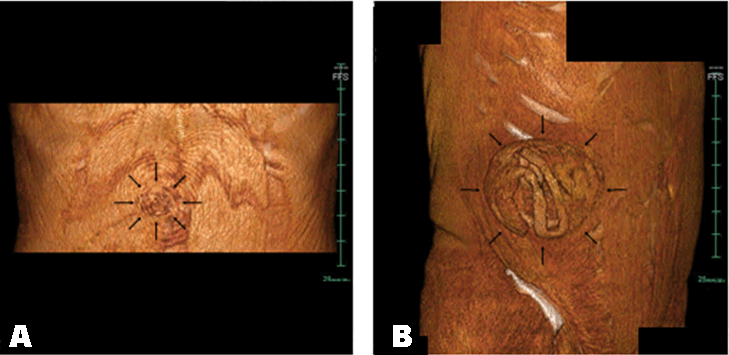
We report on two incisional hernia's cases in which preoperative three-dimensional computed tomography (3D-CT) reconstruction images were very useful for planning their laparoscopic surgeries. Patient 1 was a 78-year-old male who had been performed partial hepatectomy for hepatocellular carcinoma with J-shaped incision two years before and developed a midline incisional hernia. The preoperative 3D-CT using SYNAPSE VINCENT (Fuji Photo Film Co. Ltd., Tokyo, Japan) showed the defect measuring 4.3×2.9 cm (Figure 1A). The laparoscopic incisional hernia repair was performed. Intraoperative hernia size was 4.3 × 2.8 cm. We repaired the defect with 12.0×12.0 cm ParietexTM Optimized Composite Mesh (Nippon Covidien Inc., Tokyo, Japan). The patient tolerated the procedure well with no complication. Patient 2 was a 64-year-old male who had received central bisegmentectomy for hepatocellular carcinoma two years before and presented with a large incisional hernia of the lateral aspect of the right subcostal incision, and the content of hernia was almost intestines. The hernia size was 14.8×12.9 cm measuring by the preoperative 3D-CT (Figure 1B) and the actual intraoperative hernia size was 15.0×13.0 cm. We performed a laparoscopic incisional hernia repair with 20.0×15.0 cm ParietexTM Optimized Composite Mesh and the patient was discharged without any complication and hernia recurrence is not occurred at this time. |
|
|
|
Discussion
|
|
Incisional hernia is a frequent complication of laparotomy that occurs in up to 11% of surgical abdominal wounds and in up to 20% of patients who develop postoperative wound infections [1]. Since the first report in 1993, laparoscopic incisional hernia repair has led to improved results with a low recurrence rate of 4.2%, with an impressive conversion rate of only 2.4%, and enterotomy rate of 1.8% [2]. Recent report about the comparison between laparoscopic and open incisional hernia repair demonstrated that the incidences of wound infection (2.8% versus 16.2%) and the rates of wound drainage (2.6% versus 67.0%) were significantly lower in the laparoscopic group and there were no significant differences in the incidences of hernia recurrence, postoperative seroma, hematoma, bowel obstruction, bleeding, and reoperation [3]. Laparoscopic approach of incisional hernia repair is based on two technical principles: a hernia gate that is not closed and the proper sized mesh placed intraperitoneally. Therefore, accurate measurement of hernia size is important for preoperative choice of patch size. Some papers reported that 3D-CT reconstruction could identify abdominal wall defects and hernia contents more clearly compared with plain CT scans, and that diagnosis of hernia was easy based on 3D-CT [4]. Recent 3D-CT reconstruction software represents a marked improvement and is capable of displaying 3D-CT images within a few minutes using a single click. In fact, the 3D-CT images of our two cases could clearly display abdominal wall defects and directly obtain hernia sizes in a short time. Briefly, 3D-CT reconstruction images are more useful to display abdominal wall defects, to know if the hernia gate is not closed, and to obtain hernia size than ordinary CT. There is a general consensus on the patch size that extends 3 cm or 5 cm beyond the edges of hernia, therefore, we chose 12.0×12.0 cm mesh for Patient 1. In subcostal incisional hernias, it had been reported that the close proximity to the xiphoid process and the costochondral structures hindered adequate coverage of the defect, and the role of laparoscopic approach was still controversial because of its low prevalence, however, recent reports described that the laparoscopic approach was a safe and effective treatment for non-midline incisional hernias [5]. Therefore, the large right subcostal incisional hernia of Patient 2 was repaired by laparoscopic approach using 20.0×15.0 cm mesh. Although the patient was discharged without any complications, there is a need for a careful follow-up. |
|
Conclusion
|
|
Three-dimensional computed tomography reconstruction of incisional hernia can be displayed within a few minutes and calculate the hernia size with considerable accuracy. It is of great use for planning the laparoscopic approach for incisional hernia repair. |
|
References
|
|
|
[HTML Abstract]
[PDF Full Text]
|
|
Author Contributions
Hiroto Kayashima – Substantial contributions to conception and design, Acquisition of data, Analysis and interpretation of data, Drafting the article, Revising it critically for important intellectual content, Final approval of the version to be published Takeshi Maeda – Analysis and interpretation of data, Revising it critically for important intellectual content, Final approval of the version to be published Noboru Harada – Analysis and interpretation of data, Revising it critically for important intellectual content, Final approval of the version to be published Teruyoshi Ishida – Analysis and interpretation of data, Revising it critically for important intellectual content, Final approval of the version to be published |
|
Guarantor of submission
The corresponding author is the guarantor of submission. |
|
Source of support
None |
|
Conflict of interest
Authors declare no conflict of interest. |
|
Copyright
© 2015 Hiroto Kayashima et al. This article is distributed under the terms of Creative Commons Attribution License which permits unrestricted use, distribution and reproduction in any medium provided the original author(s) and original publisher are properly credited. Please see the copyright policy on the journal website for more information. |
|
|