| |
|
|
|
Case Series
| ||||||
| Giant cell tumor of bone: Report of three cases with unusual locations | ||||||
| Nimisha Batra1, Virinder Mohan2 | ||||||
|
1MBBS, Resident, Department of Radio-Diagnosis & Imaging, Subharti Medical College, Meerut, Uttar Pradesh (West), India.
2MBBS, MD, (Radiology), Ph.D, (Radiology), FICR, Director-Professor, Department of Radio-Diagnosis & Imaging, Subharti Medical College, Meerut, Uttar Pradesh (West), India. | ||||||
| ||||||
|
[HTML Abstract]
[PDF Full Text]
[Print This Article]
[Similar article in Pumed] [Similar article in Google Scholar] 
|
| How to cite this article |
| Batra N, Mohan V. Giant cell tumor of bone: Report of three cases with unusual locations. Int J Case Rep Images 2014;5(11):748–751. |
|
Abstract
|
|
Introduction:
Giant Cell tumor (GCT) is an uncommon neoplasm. The tumor typically affects the ends of long bones and involvement of flat bones of pelvis and greater trochanter is extremely rare.
Case Series: In this case series, three cases suspected of having GCT on the basis of their characteristic radiological findings have been reported. However, they presented at unusual locations, i.e., ilium and greater trochanter of femur. Two of the cases were males and one was female. These patients presented with pain localized to the affected region, were examined clinically and relevant investigations were done. Clinical history, clinical examination, laboratory investigations and imaging findings have been discussed in detail. The patients were on follow-up and radiological diagnosis of GCT was confirmed by histopathology. Conclusion: The aim of this case series is that GCT at not so common locations can be diagnosed on the basis of their characteristic radiological findings and computed tomography scan is the choice of investigation to see the expansile nature of the lesion. | |
|
Keywords:
Giant Cell tumor (GCT), Uncommon GCT, Unusual GCT, Bone
| |
|
Introduction
| ||||||
|
Giant cell tumor (GCT) is a mostly benign and an uncommon neoplasm of bone of uncertain origin that accounts for approximately 4–5% of all bone tumors [1]. As previously described, 80% of GCTs have a benign course with a local recurrence rate of 20–50%. The tumor typically affects the ends of long bones, most commonly the distal femur, proximal tibia, distal radius, and proximal humerus in that order. Involvement of the flat bones of the pelvis or the greater trochanter is extremely rare [2] [3]. The purpose of this presentation is to report three radiologically diagnosed and histologically proven cases of GCT at unusual locations. | ||||||
|
Case Series
| ||||||
|
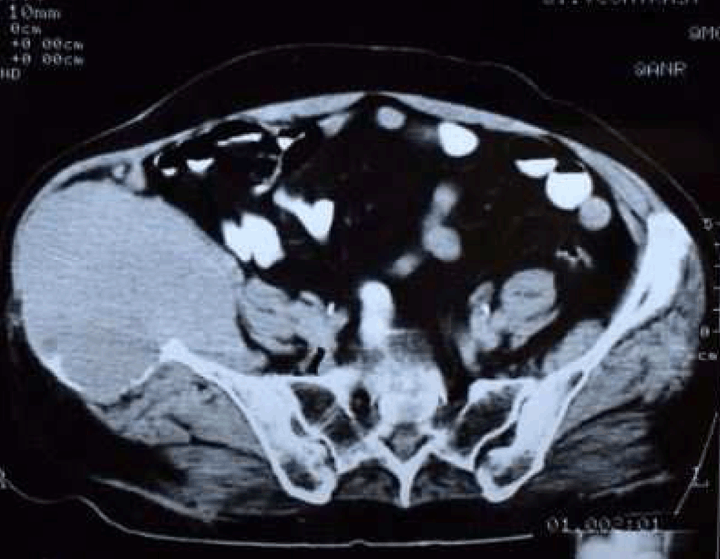
Case 1: A 55-year-old female was admitted in the surgical services with the chief complaints of lower abdominal pain and mass in the right iliac fossa since one month. The pain was continuous, diffuse, dull aching with no radiation to the back, shoulder, or groin. There was no history of fever, vomiting, loose stools, constipation or abdominal injury. On general examination the pulse and blood pressure were within normal limits. There were no pallor, clubbing, cyanosis, icterus, lymphadenopathy and edema. Local examination revealed a soft tissue mass in the right iliac fossa with localized tenderness. The mass was firm, non-mobile and had indistinct borders. There was no evidence of redness, rise in temperature or engorged vessels over the swelling. Abdominal examination was unremarkable with normal bowel sounds. Laboratory investigations revealed hemoglobin level of 10 g/dL. The rest of the investigations were unremarkable. With the clinical diagnosis of a right iliac fossa lump, the patient was sent for computed tomography (CT) scan of the lower abdomen which revealed an expansile lytic lesion involving the right iliac wing, causing cortical thinning but no breach in the cortex. There were no matrix calcifications. The lesion was associated with a large soft tissue component (Figure 1). The characteristic features of the bony lesion were suggestive of GCT of the right iliac bone, which was confirmed on histopathology. | ||||||
| ||||||
|
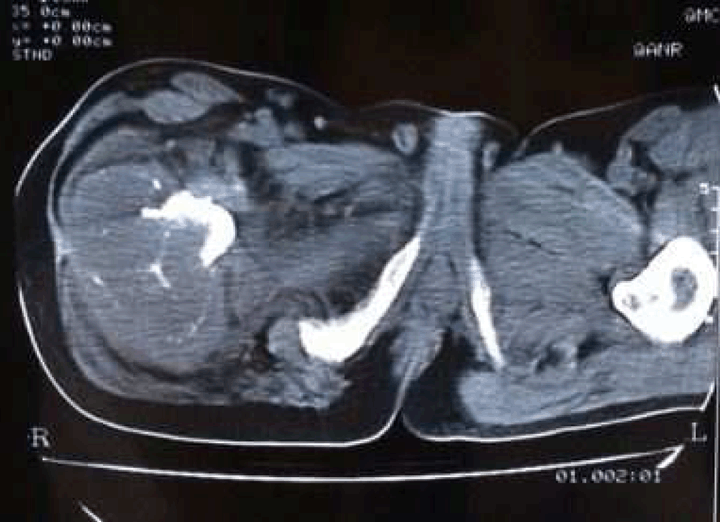
Case 2: A 49-year-old male was admitted in the orthopedic services with chief complaint of pain and swelling over the right upper thigh region. The patient had difficulty in walking. The right lower extremity was in spontaneous abduction and external rotation. There was no history of trauma or any other relevant history. The general physical examination was unremarkable. On local examination, there was a tender swelling over the right thigh in the region of the greater trochanter. The skin over the swelling was normal in color and temperature. Laboratory investigations were unremarkable. X-ray right hip joint revealed a lytic, expansile lesion of the greater trochanter, with cortical destruction and thinning of the cortex (Figure 2). There were no sclerotic margins or periosteal reaction. The lesion was associated with a large soft tissue mass. Computed tomography scan of right upper thigh revealed a large expansile lesion of the greater trochanter causing cortical thinning and breach in the cortex and associated with soft tissue swelling (Figure 3). A Radiological diagnosis of GCT of the greater trochanter was confirmed on histopathology. | ||||||
|
| ||||||
|
| ||||||
| ||||||
|
Case 3: A 45-year-old male presented with the chief complaints of pain and mass in left flank since last two months. The pain was continuous and dull aching in nature with no radiation. However, pain increased while walking. There were no associated complaints of fever, loose stools, constipation or abdominal injury. General physical examination was normal and local examination revealed a hard, non-tender, non-mobile swelling with smooth margins. The skin over the swelling was normal in color and temperature. Laboratory investigations were reported normal. X-ray pelvis revealed a large lytic expansile lesion with few septations and well defined margins arising from the left ilium showing typical "soap bubble" appearance (Figure 4). Rest of the pelvic bones appeared normal. Radiological diagnosis of GCT of left ilium was confirmed by histopathology. | ||||||
| ||||||
|
Discussion
| ||||||
|
Giant cell tumor is also known as osteoclastoma. It is an aggressive lesion of bone characterized by highly vascular tissue containing proliferating mononuclear stromal cells and numerous uniformly distributed giant cells of the osteoclast type [4]. It typically occurs in young and middle aged adults after the growth plate closes. Its frequency decreases in the later decades of life, and it is extremely rare in patients over 70 years of age [1]. The majority of these lesions (60%) occur in long bones, and mostly all are localized to the articular end of the bone. The most common sites include the proximal tibia, distal femur, distal radius, and proximal humerus [4]. GCT may rarely occur in flat bones or apophysis, which is an epiphyseal equivalent. However, when this happens, the lesion is less likely to demonstrate the classic appearance of a lytic lesion with a well-defined, non-sclerotic margin. Only few cases of Trochanteric location have been found as reported by Lichtinger (2004) and Gebhardt (2005) [5] [6] [7]. In a series of 70 giant cell tumors by Shankman et al. (1988), only two occurred in ischium, two occurred in ilium and none in the pubis. Overall, approximately 4% of all GCTs occur in innominate bones [1]. In the pelvis, the ilium is the most frequent site of giant cell (excluding the sacrum) [1]. Balke et al. (2009), in their case series of 20 patients of giant cell tumors of pelvic bone over a period of 20 years found only nine cases involving the ilium [8]. In another series of seven patients of GCT of innominate bones by Kattapuram et al. (1996), only one case involving the ilio-sacral region was identified [9]. Giant cell tumor of the pelvic bone mostly occurs in third or fourth decade of life with a clear female predilection [2]. Giant cell tumor may occur in the skull or pelvis secondary to Paget disease. The bones of the hands and feet are uncommon locations, with a prevalence of less than 2% [10]. Multicentric GCT has been reported in less than 1% of cases, with lesions often located in the distal extremities. Lung metastasis have been reported in 1–6% of cases. Rarely, GCT may undergo malignant transformation. This may occur as a result of differentiation of the primary tumor or secondary to prior radiation therapy. The overall prevalence is less than 1% [5]. Clinical symptoms in patients with solitary lesions are non-specific. These include pain, local swelling and limitation of range of motion in the adjacent joint [4]. Giant cell tumor of bone is characterized radiographically as an expansile lytic lesion with well defined margins. It may extend beyond the cortex. Most tumors demonstrate absence of a sclerotic border (unless the tumor has been presented for a long time), a lack of periosteal reaction, and the absence of calcified or ossified matrix [1]. The GCT of pelvic bones are generally lytic and are associated with large soft tissue mass which resembles an aggressive lesion demonstrating increased vascularity [9]. Computed tomography is the best modality to show the expansile nature of the tumor, while magnetic resonance imaging scan is superior in showing the soft tissue extension [2]. When a giant cell tumor occurs in unusual locations in elderly individual, it may easily be confused radiographically with expansile metastatic disease, plasmacytoma, malignant fibrous histiocytosis, or fibrosarcoma [11]. However a slow growing lesion with expansion and typical location with or without associated soft tissue mass in the above described clinical setting is almost diagnostic of the disease. The treatment of choice of GCT involving pelvic bones is curettage with or without resection and/or with adjuvant therapy such as cryotherapy, phenol, or polymethylmethacrylate (PMMA) to minimize the incidence of recurrence [2] [7]. Reconstructive surgery using a bone allograft after complete resection have been reported [6]. In advanced cases of aggressive lesions and extensive soft tissue involvement, wide resection even up to the extent of amputation may be necessary for complete cure [2]. | ||||||
|
Conclusion
| ||||||
|
Giant cell tumor (GCT)is an uncommon, benign tumor of the bone. Pelvic GCT is not commonly encountered. However, when an expansile, lytic lesion with cortical thinning and destruction is seen associated with a large soft tissue component, a radiological diagnosis of GCT can be made. The ilium is the most commonly affected among pelvic bones. Computed tomography is the investigation of choice to see the expansile nature whereas magnetic resonance imaging scan shows soft tissue extension. | ||||||
|
References
| ||||||
| ||||||
|
[HTML Abstract]
[PDF Full Text]
|
|
Author Contributions:
Nimisha Batra – Substantial contribution to concept and design, Acquisitin of data, Drafting the article, Revising it critically for important intellectual content, Final approval of the version to be published Virinder Mohan – Substantial contribution to concept and design, Acquisition of data, Revising it critically for important intellectual content, Final approval of the version to be published |
|
Guarantor of submission
The corresponding author is the guarantor of submission. |
|
Source of support
None |
|
Conflict of interest
Authors declare no conflict of interest. |
|
Copyright
© 2014 Nimisha Batra et al. This article is distributed under the terms of Creative Commons Attribution License which permits unrestricted use, distribution and reproduction in any medium provided the original author(s) and original publisher are properly credited. Please see the copyright policy on the journal website for more information. |
|
|