
  |

|
 |
|
Clinical Image
| ||||||
| A case of polyostotic fibrous dysplasia leading to multiple deformities | ||||||
| Nilufer Ozdemir Kutbay1, Banu Sarer Yurekli1, Fusun Saygili2 | ||||||
|
1Endocrinology Specialist, Ege University Faculty of Medicine, Department of Endocrinology and Metabolism, Izmir, Turkey.
2Endocrinology Specialist, Professor, Ege University Faculty of Medicine, Department of Endocrinology and Metabolism, Izmir, Turkey. | ||||||
| ||||||
|
[HTML Abstract]
[PDF Full Text]
[Print This Article]
[Similar article in Pumed] [Similar article in Google Scholar] 
|


| How to cite this article |
| Kutbay NO, Yurekli BS, Saygili F. A case of polyostotic fibrous dysplasia leading to multiple deformities. Int J Case Rep Images 2014;5(10):734–736. |
|
Case Report
|
|
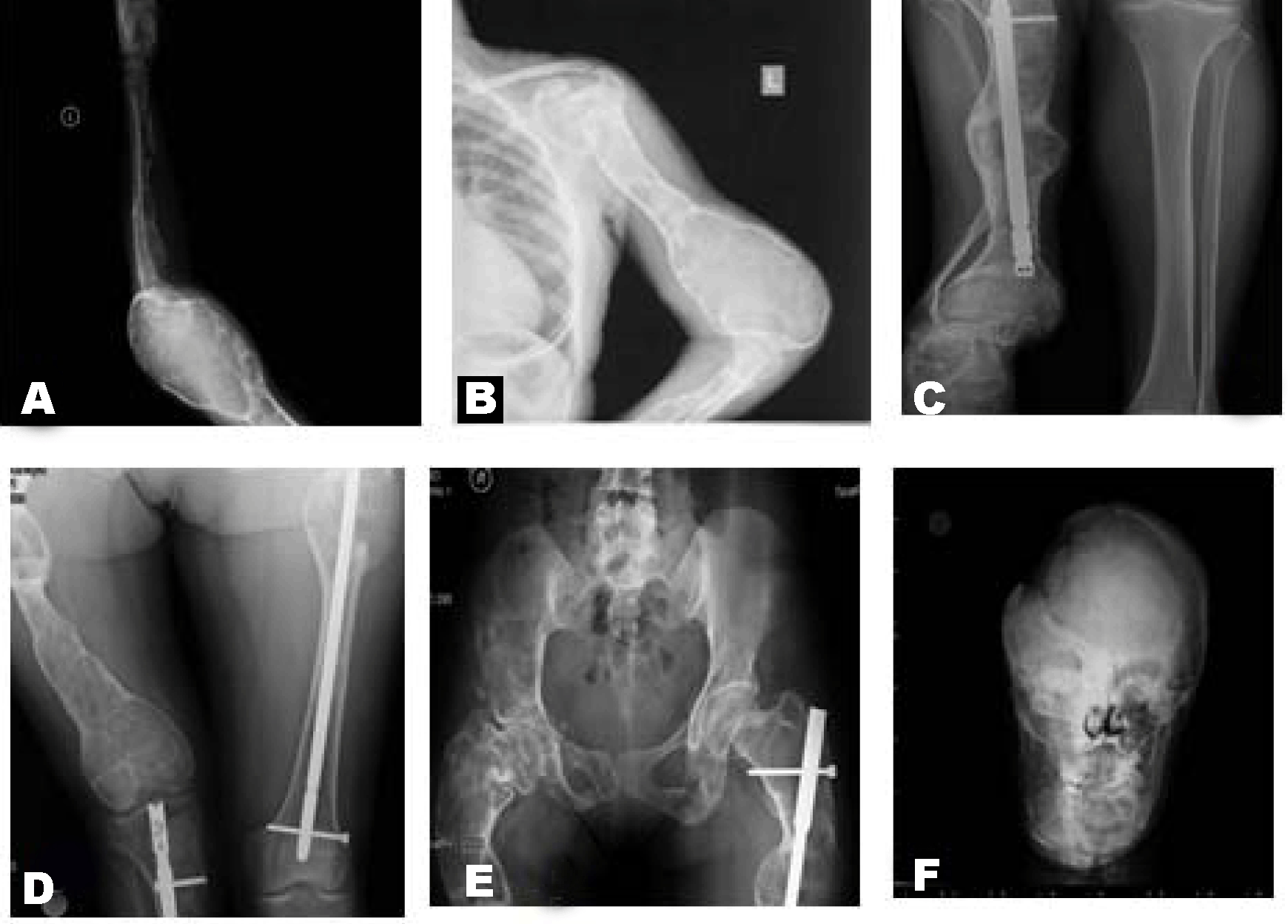
A 21-year-old female was referred to our hospital with the facial deformities. She had pathological fracture of right femur when she was two years old. Histopathological diagnosis was fibrous dysplasia. Recurrent fractures had occured at left arm and left hip (Figure 1A-E). There were intramedullary nails at right tibia and left femur (Figure 1C-E). The deformities of extremities were shown in Figure 1A-E. There was a scene of expansion of distal humerus related to cystic change of bone (Figure 1A-B). In Figure 1C-D, there were severe bowing deformity of long bones, tibia and femur, respecitvely. There was shortening of bones of tibia, fibula and femur. Fibula was hypoplastic (Figure 1C). Lytic lesion at the iliac bone was seen in Figure 1E. There were deformities of mandible and other craniofacial region. Heterogenous sclerotic changes of the calvarial bones related to fibrous dysplasia was occured in Figure 1F. There was no aeration in right maxillary and frontal sinuses. There was predominant expansion and sclerotic changes of right orbita (Figure 1F). She had underwent operations beacause of the compression of cranial nerves and facial deformity. Besides, pamidronate was administered intravenously (consecutive 3 days, total 180 mg) as medical therapy. The patient had recovered from her symptoms with bisphosphanate treatment. Improvement in bone turnover markers was observed with treatment but there was no change in radiographic appearance. |
|
|
|
Discussion
|
|
Fibrous dysplasia (FD) is a rare disease leading to increased bone resorption due to abnormal fibroblast proliferation and defective osteoblast differentiation. As it can be asymptomatic, FD can also cause bone pain, deformity and compression symptoms. Fibrous dysplasia can present itself in either a monostotic form, with involvement of one bone site, or a polyostotic form which includes multiple bone sites. Monostotic forms comprise 70–80% of FD and rest of FD mostly consists of polyostotic forms [1]. Fibrous dysplasia has a predilection for certain bones including the femur, tibia, ribs, pelvis, and craniofacial bones. Radiologically, FD lesions have a lytic appearance and are characterized by thinning of the cortex with a 'ground glass' matrix and can be confirmed by a biopsy of the bone lesions [2]. It is not uncommon for FD to be a silent disease, and some patients are asymptomatic; but when symptoms are present, they most often include bone pain, headache, bone deformities and asymmetry of the face, proptosis, diplopia, and pathological fractures, the latter especially during childhood. In our case, there were recurrent fractures of long bones in childhood period but not in later adolescent period. Involvement of craniofacial site occurs in 25% of FD patients. Facial involvement can cause both facial asymmetry and compression for the anatomic structures located near to the affected bone [3]. |
|
Conclusion
|
|
Fibrous dysplasia is a rare disease presenting with bone deformities. As treatment option, surgery is indicated for the correction of deformities, management of fractures and relieving the symptoms of compression. |
|
References
|
|

|
[HTML Abstract]
[PDF Full Text]
|
|
Author Contributions
Nilufer Ozdemir Kutbay – Substantial contributions to conception and design, Acquisition of data, Analysis and interpretation of data, Drafting the article, Revising it critically for important intellectual content, Final approval of the version to be published Banu Sarer Yurekli – Acquisition of data, Drafting the article, Revising it critically for important intellectual content, Final approval of the version to be published Fusun Saygili – Acquisition of data, Drafting the article, Revising it critically for important intellectual content, Final approval of the version to be published |
|
Guarantor of submission
The corresponding author is the guarantor of submission. |
|
Source of support
None |
|
Conflict of interest
Authors declare no conflict of interest. |
|
Copyright
© 2014 Nilufer Ozdemir Kutbay et al. This article is distributed under the terms of Creative Commons Attribution License which permits unrestricted use, distribution and reproduction in any medium provided the original author(s) and original publisher are properly credited. Please see the copyright policy on the journal website for more information. |
|
|
|
About The Authors
| |||
| |||
| |||
| |||


