| |
|
|
|
Review Article
| ||||||
| Aversion for case reporting by major medical journals: A trend towards perfect dichotomy | ||||||
| Segun Adeoye | ||||||
|
MD, MS, Attending Physician, Hospital Unit, University of Pittsburgh Medical Center (UPMC), Horizon, Greenville, PA, USA.
| ||||||
| ||||||
|
[HTML Abstract]
[PDF Full Text]
[Print This Article]
[Similar article in Pumed] [Similar article in Google Scholar] 
|
| How to cite this article |
| Adeoye S. Aversion for case reporting by major medical journals: A trend towards perfect dichotomy. International Journal of Case Reports and Images 2014;5(5):323–328. |
|
Abstract
|
|
Introduction:
This case report introduces the traditional form of medical literature. It chronicles the contributions made by landmark case reports in the times of old as well as in the present.
Review: The author details the current case report publishing-aversion by major medical journals, and attempts to explain the rationale. The article describes the impact of evidence-based medicine and journal impact factor protection as facilitators of the "discrimination" against case reporting. The paper analyzes the case report acceptance policy of 20 medical journals across the whole spectrum of impact factors and identifies interesting patterns. The author chronicles the proliferation of case reporting journals and identifies the trend towards a perfect dichotomy in medical publishing. Conclusion: In concluding, the author gives his take on the many issues raised while proposing potential solutions. | |
|
Keywords:
Case report aversion, Case studies, Impact factor, Medical journal publishing
| |
|
Introduction
| ||||||
|
The cornerstone of the incremental medical knowledge in the times of old was the fervor of early physicians to publish case reports. Case reporting is the traditional way of publishing novel diagnosis and treatments, report adverse effects or unique clinical successes or medical break through. They also serve the backbone of medical education. [1] Many landmark medical advances were documented as case reports: Broca described aphasia complicating left hemispherical lesion, Tillet and Sherry described the use of fibrinolytic agents to complement antibiotic therapy treatment of empyema, Thomas Addison, and Harvey Cushing's reported Addison's disease and Cushing syndrome, respectively. Marcintyre authored the first description of multiple myeloma and Barnard; the world's first heart transplant. All these and many more case reports revolutionized medicine in one way or another. The testament to the fact that the goodness of old time case reporting remains undiluted in the present time is evident in some relatively recent landmark case reports and series: identification and characterization of the West Nile virus (1999) and SARS-CoV virus (severe acute respiratory syndrome-Corona virus) (2002) in New York and Guandong Province (Southern China), respectively after case series reported epidemic pattern of unknown etiology, as well as steroidogenic acute regulatory (StAR) protein mutations in adrenal steroid hormone production from a case series on six patients. [2] These landmark case report opened new scientific avenues and pushed the frontiers of medicine to levels unimaginable. The times have changed however, with developments in research methodology and biostatistics ushering in an era where there appears to be contempt for this traditional way of medical reporting. The major medical journals accept <5% and 15–25%, [3] respectively of case report and original research article submissions for publication (even higher for review articles). One motivation for publishing preference for original research and review article is the need to maintain or improve journal impact factor. It is also fair to infer that perhaps a much larger number of case reports relative to original research and review article submissions may partly contribute to the publication rate disparity. While case reporting provides a complete descriptive of a case-specific encounter, emphasizing uniqueness and interesting clinical caveats, research articles provide answers to well-focused diagnostics or therapeutic questions, by exploiting large samples to reduce bias and robust statistical tests to confirm or refute significance of findings. The two reporting forms are at opposite ends of the spectrum of medical literature, each with unique applicability and appealing to different audience. The intent of this article is not to victimize research or review articles, rather to vindicate case reports. | ||||||
|
Advent of evidence-based medicine (ebM) and evidence ranking scales
| ||||||
|
Most appear to have joined the bandwagon of EBM faithfuls. There has been for some time now, a call to adopt only diagnostics and interventions with proven effectiveness. Widely accepted scales for ranking evidence of levels for diagnostics and interventions includes: the United States Preventive Task Force (USPTF), the United Kingdom National Health Service (UK-NHS) and GRADE Working Group. Physicians preferential choose diagnostics and therapies with superior evidence ranking unless there exist preclusive practice-, patient- or cost-related factors. Medicine, as it is today is increasingly protocol-driven, guidelines are reflective of evidence rating of competing diagnostics or interventions. The rationalization is that more effective and safer interventions receive higher evidence ranking. It is the expectation that diagnostic considerations and therapeutic options are vetted, and assigned rankings based on accrued objective evidence obtained from research and clinical experience. The type and source of evidence also impacts ranking, for example evidence from randomized clinical trials (RCTs) and systematic reviews receive higher evidence rankings than that from a consensus of expert panels or from case reports: with case report accorded anecdotal evidence level status (a fore-runner evidence needful of confirmatory testing), well favored for documenting idiosyncrasies, ambiguities, novelties, and provocateurs. The reliability on the superior ranking of evidence obtained from RCTs has been called to question too many a time in the recent past. Notably, the rather shocking finding that medical management of coronary artery disease is not inferior to percutaneous coronary interventions, except in cases of myocardial infarction. That there are many more reversals of evidence obtained from RCTs is evident in the writings of Prasad et al. in three landmark publications: "A Decade of Reversals: An Analysis of 146 Contracted Medical Practices", [4] "The Frequency of Medical Reversals" [5] and "Reversals of Established Medical Practices: Evidence to Abandon Ship". [6] Many such reversals and retractions have origins in case reports and series. This is not to say that case report is infallible, for it is, especially as it is reliant solely on accurate description, impression and reasoning provided by the author, absent the check and balance inherent in large study sample sizes, significance levels and p-values. | ||||||
|
Discrimination Against case reporting by Major Medical Journals
| ||||||
|
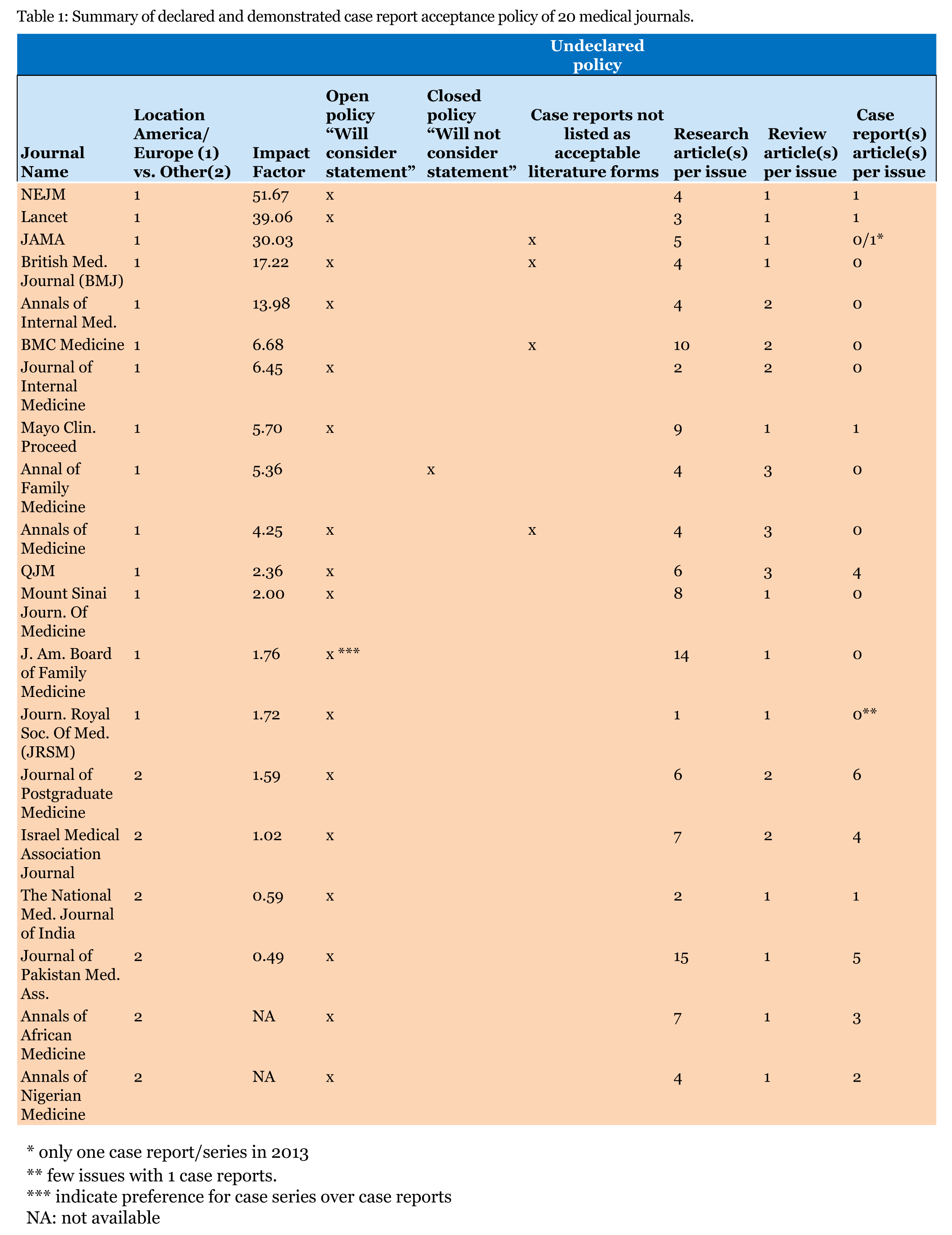
The publication of case reports by major medical journals is dwindling by the day. There appears a concerted effort by these journals to stifle the already faltering case reports market. Many of these journals report 0–5% [3] publication rates for case reports, the Annals of Family Medicine clearly state on their website that they do not usually publish case reports. [7] If the current trend continues, we run the risk of attaining perfect dichotomy in medical publishing. The main reason offered by major medical journals for not publishing more case reports is the fact that case reports have a lower evidence ranking and are less impactful when compared to original research and review articles. The impetus for this is the euphoria for EBM as well as the wielded power of statistical analysis (our addiction to p-values). In rejection correspondence to authors of case reports, editors commonly cite space limitations in print journals relative to volume of submissions as a reason for manuscript rejection. Others yet state that the manuscript is not novel enough or does not expand medical knowledge well beyond what is already known. An interesting comment in one rejection letter read- "a manuscript's intent to raise the level of suspicion of clinicians for certain rare or re-emerging conditions does unfortunately not provide sufficient priority to consider publication". [3] Many such letters conclude advising the author to consider publishing elsewhere; some even go further by suggesting submission to clinical journals dedicated to the publication of case reports. [3] In an analysis of 20 medical journals of the whole spectrum of impact factors, three case report acceptance policy patterns were identified: (Table 1) an open policy to consider case reports and series (with one- Journal of American Board of Family Medicine, declaring preference for case series over case reports); a declared policy not to consider case reports or series; and an unclear policy of not listing case reports and series in the list of acceptable article types. The top-tier journals (with the highest impact factor) have an open declared case report acceptance policy but appear to have less open demonstrated policy. This is evident in a 1:>3 published case report: research article ratio. Surprisingly, the next-tier of journals have an even much less balanced case report: research article ratio: BMJ, Annals of Internal Medicine, BMC Medicine, Journal of Internal Medicine and the Annals of Family Medicine and Medicine being absolutely case report publishing averse, with most of these having declared an open policy to case reporting on their websites. The BMC Medicine and Mount Sinai Journal of Medicine are research and translational research-specific journals, by virtue of their declared niches, are absolutely case report averse. It is not surprising the Journal of Postgraduate Medicine has the most demonstrated open policy to case reporting with case report: research article ratio of 1:1. This is reflective of the popularity of case reporting amongst physicians in residency training. Medical journals located outside the Americas and Europe appear to be more receptive to case reporting. I do not intend to play jury or advocate for these editorial decisions, but will state unequivocally that case reporting does not necessarily have to report new disease entities, rather it may present interesting caveats on already existing entities, especially atypical presentations, unique pathogenesis, unusual associations and unconventional interventions. | ||||||
| ||||||
|
The Advent and Proliferation of Dedicated Medical Case Report Journals
| ||||||
|
The past two decades has witnessed the proliferation of medical case report journals, notable mentions are the Journal of Medical Case Reports (JMCR), Journal of Medical Cases (JMC), International Medical Case Reports Journal (IMCRJ), and the International Journal of Case Reports and Images (IJCRI). The impetus for this unprecedented proliferation was the need to cater for "disenfranchised" case reporters who felt shut out by the major medical journals. That these case report journals saw the need and cashed in is evident in the mission statements of some of these journals detailed on their websites. No better description is provided than the acknowledgements on IJCRI website. "The IJCRI was born of necessity to provide authors with a forum where they are welcome to submit reports of unusual cases and atypical presentation of common cases. In recent years, many international journals with a print version have stopped accepting case reports for publication. There is always a tough competition between review articles and case reports for very limited page-space in the print version of the journals. In this competition "case report" invariable lose. As a consequence, it has become very difficult to publish interesting and unusual cases in international, peer-reviewed journals. This lack of publishing opportunities for authors was the motivation for us to start IJCRI [8]. The journal caters for the needs of residents and fellows as they take baby steps in scholarly publishing (often case reporting). [8] Absent PubMed indexing, many case report journals use open access publishing to ensure the journal reach a wider audience, they increase reader access through email notifications, maintain an active presence on social networking sites, and use press releases to general and scientific press. [9] Furthermore, they achieve high volume publishing rates through frequent and high speed publishing. Some even permit "early view articles" and offer availability for free full text articles immediately upon publication. [7] That these strategies are yielding dividends is evident in the greater reader access and improved author-reported satisfaction. | ||||||
|
MY TAKE
| ||||||
|
I appreciate all forms of medical reporting and believe in the true spirit of inclusiveness in medical literature. I am encouraged by recent proliferation of case reporting journals. These journals continually strive for PubMed indexing, receive fewer journal citing and by extrapolation, lower impact factors (IF). Defenders of this index purport that the impact factor is a reflection of journal significance, affected solely by journal article citing, but I see a more multifactorial influence: the confluence of journal citing as well as editorial policies and strategies to increase its impact factor like skimming for review articles (with higher potential for citation) and aversion for case reports. It is not news that physicians and researchers in the third world, as well as residents and fellows in all-worlds, are lacking in sponsorship for original research. Little wonder they have to rely on case reporting as an avenue to share experiences through authorship. It is my opinion that shutting out case reports from the major medical journals not only denies subscribers to these journals the benefits of appreciating the case uniqueness, individuality and the completeness available in case reports, but is in itself, true discrimination against third-world physicians, as well as up-coming residents and fellows in all-worlds, who now have limited options to showcase their scholarly work. These physicians have to resort to collaborations with more privileged institutions and colleagues abroad to access research funding and a path to publishing with the "big-boys" medical journals. I make the following propositions. Firstly, the major medical journals may consider increasing its allocation for and publication of case reports to meet the needs of readers and as well as to be more inclusive in its authorship base. They can achieve this by increasing journal issue size or maintain current issue size while increasing relative space allocation for case reports. Another approach currently being used by some journals is to run a case report-sympathetic version in parallel with the main journal. For example, the Journal of the Royal Society of Medicine (JRSM) uses the JRSM-Short Reports [10] version to increase case reporting, well amongst other intentions. Perhaps a perfect dichotomy (absolute case report-averse versus absolute case reporting journals) is the Utopian state of medical publishing, however, this is acceptable only when there exist enough case report journals to accommodate the volume of case reports seeking publication. Secondly, PubMed should increase its indexing of case report journals to accord them equal access to readership and potential for citing as it does for research and review article-leaning journals. Thirdly, present the controversy surrounding the validity of impact factors, [11] a revised computation method that attempts to correct the inequality in the grading of the impact of research/review article- learning journals and case report journals should be implemented. Let us not compare apples with oranges. Perhaps the way to go may be the creation of a modified impact factor scale for case report journals. I see no reason why an IF of 51.7 is reported for the NJEM [12] while the reputable, BioMedCentral published, JMCR reports a mere 0.36. [9] Authors and readers should understand the caveats in the computation of IF and appreciate why case report journals fair badly. Fourthly, governments and institutions of third world countries should invest in medical journals of their own, one that meet the needs of its physicians, researchers and scientists. Graduate medical programs should collectively consider managing medical journal like the McGill Journal of Medicine, a medical student-managed journal. Oversight organizations like the specialty boards and the Committee of Interns and Residents (CIR) may help in this regard. Fifthly, beyond scapegoating major medical journals for their aversion for case reports, the general medical academic community and accreditation agencies should right the decade-long injustice in medical academia, of denying academic credits to authors for case reporting. The academic rigors involved in putting together a case report (many include rigorous literature review sections) is worth some scholarly recognition even if such award is less than is accorded research papers and review articles. Perhaps, referencing case reports as case studies may be the first step in the redemption process. I suggest 0.5 credit equivalence recognition for case reporting. In concluding, I call on the spirit of legendary Sir Richard Hutchinson to reaffirm his petition of 1958: "From too much zeal for the new (randomized clinical trials) and contempt for what is old (case reports), from putting knowledge (statistical analysis and significance) before wisdom (clinical experience and significance), science (statistical significance) before art (clinical uniqueness and significance) and cleverness (p-values) before common sense (personal experience detailed in case reports); Good Lord, deliver us". [13] | ||||||
|
Conclusion
| ||||||
|
I appreciate the limited space in print-journals as well as I recognize the large volume of case reports seeking publication. What I fail to comprehend is the rather miscalculated, business-sense informed, case report aversion by major medical journals. Case reporting has earned its place in the annals of medical literature: many medical breakthroughs hinged on its shoulders. It is an old and trusted method of medical reporting. The founding fathers of medicine believed in it, I will believe in it too. | ||||||
|
References
| ||||||
| ||||||
|
[HTML Abstract]
[PDF Full Text]
|
|
Author Contributions
Segun Adeoye – Substantial contributions to conception and design, Acquisition of data, Analysis and interpretation of data, Drafting the article, Revising it critically for important intellectual content, Final approval of the version to be published |
|
Guarantor of submission
The corresponding author is the guarantor of submission. |
|
Source of support
None |
|
Conflict of interest
Authors declare no conflict of interest. |
|
Copyright
© 2014 Segun Adeoye et al. This article is distributed under the terms of Creative Commons Attribution License which permits unrestricted use, distribution and reproduction in any medium provided the original author(s) and original publisher are properly credited. Please see the copyright policy on the journal website for more information. |
|
|
|
About The Author
| |||
| |||