
  |

|
 |
|
Case Report
| ||||||
| Familial myelinated nerve fibres with proliferative vitreoretinopathy | ||||||
| Mehra A1, Safia H Ahmed2, Carpi Akikio Olali1, Ahmed S1, Gupta M1 | ||||||
|
1Department of Ophthalmology, Pilgrim Hospital, Sibsey Road, Boston PE21 9QS, United Kingdom.
2Royal Blackburn Hospital, Department of Ophthalmology, Haslingden Road, Blackburn, Lancashire, BB2 3HH, United Kingdom. | ||||||
| ||||||
|
[HTML Abstract]
[PDF Full Text]
[Print This Article]
[Similar article in Pumed] [Similar article in Google Scholar] 
|


| How to cite this article |
| Mehra A, Ahmed SH, Olali CA, Ahmed S, Gupta M. Familial myelinated nerve fibres with proliferative vitreoretinopathy. International Journal of Case Reports and Images 2014;5(5):370–372. |
|
Abstract
|
|
Introduction:
To report a rare case of familial myelinated nerve fibres with vitreoretinal complications.
Case Report: A three and half-year-old boy with reduced vision (right 6/60, left 6/12) was found to have extensive bilateral myelinated nerve fibres with similar lesion in the parent. The child later developed vitreous hemorrhage in the left eye and examination confirmed localized proliferative vitreoretinopathy. Conclusion: This is probably the first reported case of familial myelinated nerve fibres with proliferative vitreoretinopathy, vitreous hemorrhage and bilateral amblyopia. Our case and the few other reported familial ones suggest a dual pattern of occurrence of the myelinated retinal fibres; sporadic and genetic. | |
|
Keywords:
Myelinated fibres, vitreoretinopathy, Familial, Amblyopia, Vitreous hemorrhage
| |
|
Introduction
| ||||||
|
Myelinated retinal nerve fibres which occur in 1% of the population are often localized in a segment of the retina and have no effect on vision. [1] We report a rare case of familial myelinated nerve fibres with vitreoretinal complications. | ||||||
|
Case Report
| ||||||
|
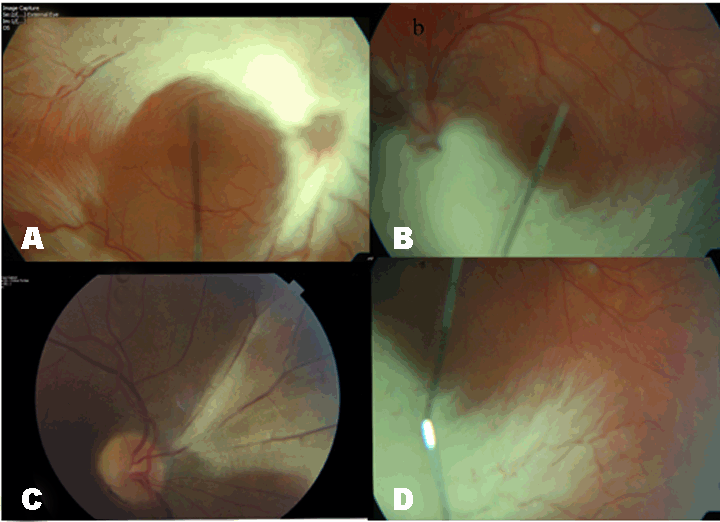
A three and half-year-old boy was referred because of reduced vision noticed during routine pre-school screening. He was otherwise well, but his uncle had tuberous sclerosis and grandmother retinitis pigmentosa. His unaided visual acuity was 6/60 in the right eye and 6/12 in the left and fundus examination revealed extensive myelinated nerve fibres along the superior and inferior arcades and involving the optic disc in the right eye and almost total myelination of the nerve fibres on the inferior half of the left eye. (Figure 1A-B) The anterior segment structures were normal in both eyes. He was refracted and the following prescription given; Right eye -3.0/+1.50 @ 90° and left eye -1.0/+2.75 @ 80°. An initial subnormal electroretinogram was found to be normal a year later and he has had no problems seeing at night or tuberous sclerosis features. However, the mother was also examined and found to have myelinated nerve fibres between 1.30 and 4 o'clock in right eye. (Figure 1C) The patient was kept on annual review but in December 2006, he complained of seeing white spots in his eyes. His corrected visual acuity was 6/24 in the right eye and 6/12 in the left and dilated fundoscopy revealed extensive vitreous condensation with bands and localized traction in the left eye. There was, however, no retinal tear. In July 2010, he developed vitreous hemorrhage in that left eye and examination confirmed localized proliferative vitreoretinopathy in the inferior-nasal quadrant. (Figure 1D) No active intervention has been initiated as there has since been slow regression of the abnormal vessels and clearing of the hemorrhage. | ||||||
| ||||||
|
Discussion
| ||||||
|
Myelinated nerve fibres usually seen as incidental finding in routine clinics are benign and stationary in most cases though some are associated with complications such as telangiectasia, capillary congestion, neovascularization and recurrent vitreous hemorrhage. [2] [3] [4] Bilateral involvement was documented in 7.7% of autopsy cases and common associations include asymmetric myopia, amblyopia, Von Recklinghausen disease and Gorlin's syndrome and craniosynostosis. [5] [6] [7] There are very few reported cases of familial myelinated retinal nerve fibres in literature. [8] [9] In our patient, the mother similarly had bilateral involvement though less extensive. The patient presented with reduced vision and the lesions later complicated in the form of proliferative vitreoretinopathy. The mechanism of retinal ischemia and secondary vascular changes is not known. Minning and Davidorf [4] suggested that the myelinated nerve fibres may induce mechanical disruption of retinal vasculature. Myelinated nerve fibres on account of increasing diameter and metabolic activity compete for available oxygen in tissue causing relative ischemia. When the inner retinal ischemia occurs, the mechanism of neovascular activity is the same as in the other retinal vascular diseases such as retinal vein occlusion and diabetic retinopathy, possibly due to the release of angiogenic factors like vascular endothelial growth factors (VEGF). Generally, the vitreous hemorrhage is self-limiting. Rubeosis was not a reported complication. Although experience with laser treatment is limited, it does help in regression of neovascularization. Aberrant myelinated retinal nerve fibres are thought to form because of failure to prevent oligodendrocyte lineage cells from passing through the lamina cribrosa or optic nerve head. Astrocytes in the lamina cribrosa have been postulated as specialized, acting as a barrier through the orientation and number of their glial filaments. [10] However, it is not known how inheritable defect could affect this process. This is probably the first reported case of familial myelinated nerve fibres with proliferative vitreoretinopathy, vitreous haemorrhage and bilateral amblyopia. | ||||||
|
Conclusion
| ||||||
|
Our case and a few other reported familial ones suggest a dual pattern of occurrence of the myelinated retinal fibres; sporadic and genetic. There is thus the need for further study to elucidate the inheritance pattern if any in the familial form. | ||||||
|
References
| ||||||
| ||||||

|
[HTML Abstract]
[PDF Full Text]
|
|
Author Contributions
Mehra A – Substantial contributions to conception and design, Acquisition of data, Analysis and interpretation of data, Drafting the article, Revising it critically for important intellectual content, Final approval of the version to be published Safia H Ahmed – Analysis and interpretation of data, Revising it critically for important intellectual content, Final approval of the version to be published Carpi Akikio Olali – Analysis and interpretation of data, Revising it critically for important intellectual content, Final approval of the version to be published Ahmed S – Analysis and interpretation of data, Revising it critically for important intellectual content, Final approval of the version to be published Gupta M – Analysis and interpretation of data, Revising it critically for important intellectual content, Final approval of the version to be published |
|
Guarantor of submission
The corresponding author is the guarantor of submission. |
|
Source of support
None |
|
Conflict of interest
Authors declare no conflict of interest. |
|
Copyright
© 2014 Mehra A et al. This article is distributed under the terms of Creative Commons Attribution License which permits unrestricted use, distribution and reproduction in any medium provided the original author(s) and original publisher are properly credited. Please see the copyright policy on the journal website for more information. |
|
|