| |
|
|
|
Case Report
| ||||||
| A case of brucella endocarditis of the native aortic valve | ||||||
| Aydin Rodi Tosu1, Şerafettin Demir2, Murat Selçuk1, Mustafa Kemal Avşar3 | ||||||
|
1MD, Van Education and Research Hospital, Department of Cardiology, Van, Turkey.
2MD, Adana Public Hospital, Department of Cardiology, 01270, Adana, Turkey. 3MD, Taksim German Hospital, Department of Cardiovascular Surgery, 34433, Siraselviler Street, Beyoglu, Istanbul, Turkey. | ||||||
| ||||||
|
[HTML Abstract]
[PDF Full Text]
[Print This Article]
[Similar article in Pumed] [Similar article in Google Scholar] 
|
| How to cite this article |
| Tosu AR, Demir S, SelSelçukuk M, Avsar MK. A case of brucella endocarditis of the native aortic valve. International Journal of Case Reports and Images 2014;5(4):307–310. |
|
Abstract
|
|
Introduction:
Brucella endocarditis is a rare but severe complication of brucellosis. Although it is observed in less than 2% of the brucellosis cases, it is the main cause responsible for up to 80% of infection-related deaths in brucellosis.
Case Report: Herein, we present a case of Brucella endocarditis that developed on a native aortic valve. The diagnosis was proven by positive blood cultures and isolation of Brucella melitensis from the excised valve. Conclusion: Although endocarditis associated with brucella infection is rare, it may be more frequently observed in the regions where brucellosis is endemic. Therefore, especially in these regions, Brucella endocarditis must be considered during the diagnosis of infective endocarditis. | |
|
Keywords:
Brucella endocarditis, Aortic valve, Brucella melitensis
| |
|
Introduction
| ||||||
|
Brucellosis is a zoonotic disease caused by bacteria from the genus Brucella and widely observed around the world. [1] Since it can involve every organ or tissue, no specific clinical diagnosis is possible and it can lead to various complications that can affect multiple systems. Although endocarditis is rarely observed, it is also the complication that leads to the highest mortality rates by brucellosis. In literature, the frequency of endocarditis related to brucellosis has been reported to be under 2%. [1] [2] Therefore, this agent must be considered in cases of infective endocarditis in regions where brucellosis is endemic. | ||||||
|
Case Report
| ||||||
|
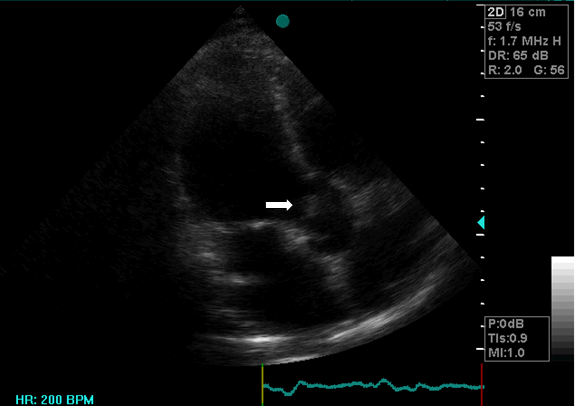
A 43-year-old male was presented to our clinic with the complaints of fever, had recent history of trichiniasis, malaise, and pain in the knee and waist regions for the last three weeks. According to the patient history, he was diagnosed with brucellosis four months ago and was under medical treatment. The patient was a farmer and stock-breeder from a village. During his physical examination, his blood pressure 90/55 mmHg, peak pulse 102 bpm, and body temperature was 38.5°C. His respiratory sounds were normal and he had a 2/6 cardiac systolic ejection murmur at right 2.intercostal space. There was no sign of organomegaly and other systemic examinations were normal. The laboratory tests revealed the following results: hemoglobin 10.9 mg/dL, hematocrit 33.2%, leukocytes 14.400, thrombocytes 225.000, sedimentation rate 76 mm/hour, and CRP 178 mg/L. The transthoracic echocardiography indicated and an ejection fraction of 62% and a mobile vegetation (mean/max gradient 32/54 mmHg) on the right coronary cusp of the aortic valve. The aortic valve had a diameter of 23x17 mm, which pointed out an aortic stenosis. (Figure 1) The patient was admitted to the cardiology clinic with the pre-diagnosis of infective endocarditis and started on a regimen of gentamicin (160 mg/day) and vancomycin (2 g/day). When the standard brucellosis agglutination test indicated a 1/1280 (+) result, gentamicin and vancomycin were replaced with rifampicin (600 mg/day), doxycycline (200 mg/day) and trimethoprim/sulfamethoxazole (TMP-SMX) (320/1600 mg/day) based on the diagnosis of brucellosis endocarditis. Also, Brucella melitensis growth was observed in the three blood cultures. The transesophageal echocardiography performed on the fifth day of the treatment indicated minimal decrease in the dimensions of the vegetation with continued aortic stenosis. Based on the cardiovascular surgery consultation, the patient was taken to surgery. During the surgery, after a median sternotomy was performed, the cardiopulmonary by-pass was initiated and blood cardioplegia was administered under a medium-deep hypothermia. The aortotomy revealed 1 cm vegetation in the right coronary cusp. Severe stenosis was observed in the valvular area and all three cusps showed thickening and loss of mobility, which were especially apparent in the right coronary cusp. The valve was excised together with the vegetation and replaced with a Nr. 23 St. Jude prosthetic valve. During the postoperative period, the patient showed a normal recovery. Brucella melitensis growth was observed in the culture of the excised valve. No complications occurred in the wake of the successful surgery. The pathological examination of the excised valve also indicated Brucella melintesis growth. During the postoperative follow-up of the patient, his fever was reduced and his laboratory findings were improved. After the second postoperative month, the treatment was continued with rifampicin and TMP-SMX until the sixth month. During the control visit at the first postoperative month, the infection was observed to subside and the transesophageal echocardiography indicated no vegetation. The patient, who was implanted a normal functional prosthetic aortic valve, is currently under monitoring and remains asymptomatic. | ||||||
| ||||||
|
Discussion
| ||||||
|
Although brucellosis is widespread throughout the world, it is a zoonotic disease endemic to the Mediterranean countries and the Middle East. [3] It is transmitted through direct contact with animals or environments infected through the excrements of infectious animals. [3] [4] Among the bacteria of the genus Brucella, B. melitensis has the highest rate of virulence and causes the most severe disease. [1] [4] The patient history had revealed that the patient was involved in stock breeding and was already diagnosed with brucellosis four months ago. In patients with B. melitensis infection, osteoarticular (sacroiliitis), genitourinary (epididymo-orchitis in men) and neural (meningitis) involvement is frequently observed. [1] In brucella endocarditis, aortic valve involvement is frequently observed and endocarditis is the most common cause of death. [5] [6] Endocarditis is a complication which may be overlooked during the course of brucellosis unless it is specifically considered. The diagnosis of infective endocarditis due to brucellosis is based on the epidemiological factors, clinical findings, serologic tests, blood culture and echocardiography. [1] [2] [3] [4] [5] [6] [7] [8] Echocardiographic examination is a noninvasive method which may be helpful both in the diagnosis of infective endocarditis and in the decision for surgery. Echocardiography is a method that also reveals the valvular structure and the presence of any masses such as abscesses or vegetation. [9] [10] [11] Various antibiotics including tetracyclines, doxycycline, trimethoprim/sulfamethoxazole, rifampin and streptomycin can be effectively used for the treatment of brucellosis endocarditis. The antibiotic regimen should include multiple types of antibiotics over a few weeks. [3] [12] Although the related literature recommends only medical treatment in brucella endocarditis, the general treatment approach also involves surgery subsequent to the medical treatment. [3] [8] [9][13] The suggested duration of the postoperative antibiotic treatment is between 1 month and 1 year. [14] In our patient, the diagnosis was based on the clinical observation, positive serology tests, observation of the vegetation on the aortic valve through echocardiography and the detection of Brucella melitensis growth in more than one blood culture as well as the excised valve. In spite of the antibiotherapy, only minimal reduction was observed in the vegetation during the transesophageal echocardiography performed on the fifth day. Since the patient's symptoms did not show any improvement, he was referred to surgery. The two blood cultures obtained with one week interval at the end of the first surgical month and incubated for four weeks showed no bacterial growth. The postoperative antibiotherapy was continued until the sixth postoperative month. No relapses occurred during the six month follow-up period of the patient. | ||||||
|
Conclusion
| ||||||
|
Although endocarditis associated with brucella infection is rare, it may be more frequently observed in the regions where brucellosis is endemic. Therefore, especially in these regions, brucellosis endocarditis must be considered during the diagnosis of infective endocarditis. | ||||||
|
References
| ||||||
| ||||||
|
[HTML Abstract]
[PDF Full Text]
|
|
Author Contributions
Aydin Rodi Tosu – Substantial contributions to the conception and design, Acquisition of data, Drafting the article, Revising it critically for important intellectual content, Final approval of the version to be published Şerafettin Demir – Substantial contributions to the conception and design, Acquisition of data, Drafting the article, Revising it critically for important intellectual content, Final approval of the version to be published Murat Selçuk – Substantial contributions to the conception and design, Acquisition of data, Drafting the article, Revising it critically for important intellectual content, Final approval of the version to be published Mustafa Kemal Avşar – Substantial contributions to the conception and design, Acquisition of data, Drafting the article, Revising it critically for important intellectual content, Final approval of the version to be published |
|
Guarantor of submission
The corresponding author is the guarantor of submission. |
|
Source of support
None |
|
Conflict of interest
Authors declare no conflict of interest. |
|
Copyright
© Aydin Rodi Tosu et al. 2014; This article is distributed the terms of Creative Commons attribution 3.0 License which permits unrestricted use, distribution and reproduction in any means provided the original authors and original publisher are properly credited. (Please see Copyright Policy for more information.) |
|
|