| |
|
|
|
Case Report
| ||||||
| Talon cusp in primary dentition: A case report | ||||||
| Ravi Prakash Sasankoti Mohan1, Sankalp Verma2, Udita Singh3, Neha Agarwal3, Soumi Ghanta3, Kuber Tyagi4 | ||||||
|
1MDS, Professor & Head of the Department, Oral Medicine and Radiology, Kothiwal Dental College and Research Centre, Moradabad, Uttar Pradesh, India.
2MDS, Assistant Professor, Oral medicine and Radiology, Kothiwal Dental College and Research Centre, Moradabad, Uttar Pradesh, India. 3BDS, Post Graduate Student, Oral Medicine and Radiology, Kothiwal Dental College and Research Centre, Moradabad, Uttar Pradesh, India. 4MDS, Assistant Professor, Oral Medicine and Radiology, Teerthanker Dental College and Research Centre, Moradabad, Uttar Pradesh, India. | ||||||
| ||||||
|
[HTML Abstract]
[PDF Full Text]
[Print This Article]
[Similar article in Pumed] [Similar article in Google Scholar] 
|
| How to cite this article |
| Mohan RPS, Verma S, Singh U, Agarwal N, Ghanta S, Tyagi K. Talon cusp in primary dentition: A case report. International Journal of Case Reports and Images 2013;4(12):709–713. |
|
Abstract
|
|
Introduction:
Talon cusp is a well delineated accessory cusp projecting from the cingulum area of an anterior tooth. It is named so due to its resemblance with eagle's talon, which is the shape of eagle's claw when hooked on to its prey. Various alterations in shape in talon's cusp may be present like it may be either sharp or spiked, teat like or may have rounded and smooth tips. Only two cases have been reported in Indian population till date.
Case Report: Hereby, we report a unique case of talon's cusp in a four-year-old boy. Conclusion: The occurrence of talon's cusp in mandibular primary dentition is extremely rare. | |
|
Keywords:
Cingulum, Accessory, Talon cusp
| |
|
Introduction
| ||||||
|
Talon cusp is a rare dental anomaly, which originates during the morphodifferentiation stage of tooth development. It is defined as, "an additional cusp that predominantly projects from the lingual surface of primary or permanent anterior teeth, is morphologically well delineated and extends at least half the distance from cementoenamel junction to incisal edge". [1] Although it affects both the primary and permanent dentition but permanent dentition is found to be involved thrice more commonly than the primary dentition. Several studies have reported a male and female ratio to be 2:1. [2] [3] Talon cusp is not entirely innocuous and may pose difficulties like predisposition to caries, occlusal interferences and unpleasant esthetics. [4] This article focusses on an extremely rare case presenting with talon cusp in mandibular primary dentition. | ||||||
|
Case Report
| ||||||
|
A four-year-old boy was reported to the outpatient department with a chief complaint of decaying of right lower back tooth region since 1–2 months. There was no remarkable medical or dental history. He was apparently healthy child born to non-consanguineous parents at full term. Nothing significant findings were elicited in general physical examination. Intraoral examination revealed mixed dentition with good oral hygiene. Dental caries was present in right lower back teeth (in relation to 73, 74). Apart from this, an 'extra cusp' was seen projecting from the lingual surface in relation to mandibular primary lateral incisor (72) as shown in (Figure 1A). On close examination of the involved tooth (72), an accessory cusp was present, projecting from cingulum and involving more than half of the lingual surface. (Figure 1B) Intraoral periapical radiograph confirmed the presence of talon cusp in relation to 72. (Figure 2) As talon cusp caused no difficulties to the patient, topical fluoride sealant was applied and patient was kept on follow-up at six monthly interval. | ||||||
|
| ||||||
| ||||||
|
Discussion
| ||||||
|
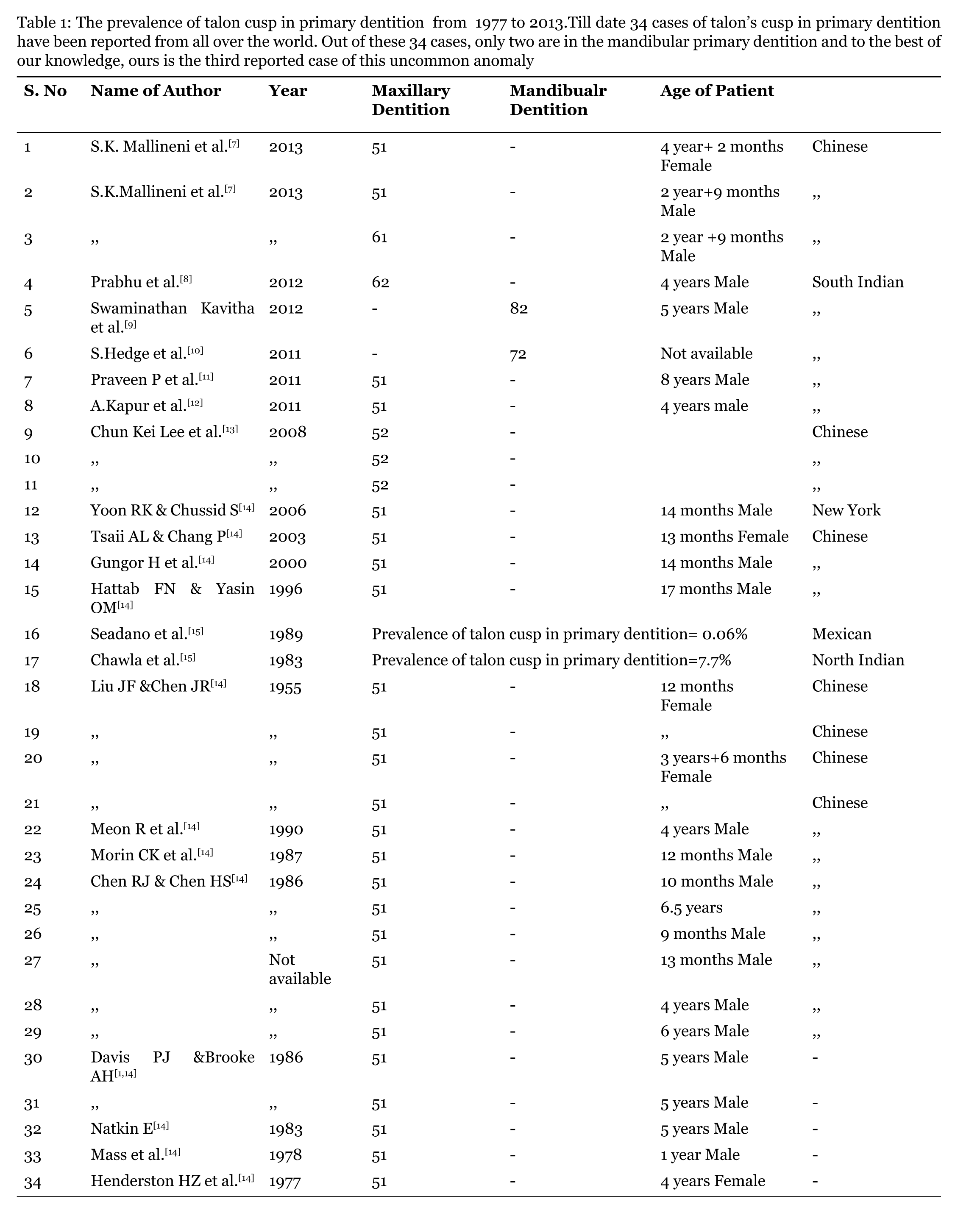
More than two centuries ago, William Mitchel described accessory cusp on the lingual surface of permanent upper central incisor of a woman and described it as, "process of horn like shape curving from the base downwards to the cutting edge". In 1972, Mellor and Ripa named it talon cusp owing to its close resemblance with an eagle's talon. [3] Since then , many names have been used for this dysmorphic disturbance of teeth, namely, dens evaginatus, supernumerary cusp, horn, hyperplastic cingulum, evaginated odontome, cusped cingulum, accessory cusp and supernumerary lingual tubercle. [5] The usage of multiple terms added up to confusion which was cleared when Mader suggested that the term talon cusp should be reserved only for those anomalous cusp that prominently projected from the lingual surface of a succedaneous tooth, that are morphologically well delineated and extend at least half the distance from cementoenamel junction to the incisal edge. Smaller cusp like projections in the cingulum should be referred to as enlarged or prominent cingulum. [6] The prevalence of talon cusp in primary dentition is extremely low as concluded from the review of literature from 1977 to 2013. (Table 1) Till date 34 cases of talon cusp in primary dentition have been reported from all over the world. Out of these 34 cases, only two are in the mandibular primary dentition and to the best of our knowledge, ours is the third reported case of this uncommon anomaly. The etiology still remains unclear. Various hypotheses regarding its etiology have been put forward. Some of these are; it is supposed to be a consequence of outward folding of inner enamel epithelial cells or may be due to hyperactivity of dental lamina. [2] Another hypothesis suggests genetics to be a causative factor of talon cusp based on its occurrence in a family. Trauma and other localized forces on tooth germ have also been held responsible for talon cusp. [2] [4] [10] Lee proposed that hyperactivity of cells of tooth germ may lead to development of talon cusp, which is genetically determined but the degree is influenced by environmental factors. [16] Clinically, it presents as an accessory cusp that projects from the cingulum area of anterior teeth and involves more than the half of the lingual or palatal surface. Hattab et al. classified talon's cusp based on the degree of formation and extension into three categories. These are: [15]
Histologically, it may or may not contain pulpal tissue. Radiographically, it appears to be superimposed over the tooth on which it develops. [4] Talon cusp may be seen in association with Mohr syndrome, Rubinstein-Taybi syndrome, Sturge-Weber syndrome, Ellis-van Creveld syndrome. [7] The clinical problems associated with talon cusp are predisposition to caries due to the presence of deep grooves and resultant stagnation of food debris, periapical lesions, occlusal interference, and irritation to tongue during mastication or speech. But our patient presented with no difficulties. Treatment is required only for symptomatic cases. In case of deep developmental grooves, these should be thoroughly cleaned to get rid of debris and sealed using fissure sealant. In case of carious grooves, restoration of the involved tooth becomes mandatory. If due to deep carious lesion or occlusal interferences, a portion of talon cusp has to be removed then grinding should be done gradually on consecutive visits at six weeks intervals so as to ensure deposition of reparative dentin. Pulp therapy is done in cases of pulpal involvement. [7] [8] [11] | ||||||
|
| ||||||
|
| ||||||
|
Conclusion
| ||||||
|
In this article, we have reviewed literature regarding talon cusp in primary dentition and have added significantly to the present knowledge by documenting a rare case report. | ||||||
|
References
| ||||||
| ||||||
|
[HTML Abstract]
[PDF Full Text]
|
|
Author Contributions
Ravi Prakash Sasankoti Mohan – Substantial contributions to conception and design, Acquisition of data, Analysis and interpretation of data, Drafting the article, Revising it critically for important intellectual content, Final approval of the version to be published Sankalp Verma, Udita Singh – Substantial contributions to conception and design, Acquisition of data, Analysis and interpretation of data, Revising it critically for important intellectual content, Final approval of the version to be published Neha Agarwal – Substantial contributions to conception and design, Acquisition of data, Analysis and interpretation of data, Revising it critically for important intellectual content, Final approval of the version to be published Soumi Ghanta – Substantial contributions to conception and design, Acquisition of data, Analysis and interpretation of data, Revising it critically for important intellectual content, Final approval of the version to be published Kuber Tyagi – Substantial contributions to conception and design, Acquisition of data, Analysis and interpretation of data, Revising it critically for important intellectual content, Final approval of the version to be published |
|
Guarantor of submission
The corresponding author is the guarantor of submission. |
|
Source of support
None |
|
Conflict of interest
Authors declare no conflict of interest. |
|
Copyright
© Ravi Prakash Sasankoti Mohan et al. 2013; This article is distributed the terms of Creative Commons attribution 3.0 License which permits unrestricted use, distribution and reproduction in any means provided the original authors and original publisher are properly credited. (Please see Copyright Policy for more information.) |
|
|