| |
|
|
|
Case Report
| ||||||
| Idiopathic double telescoping intussusception in an adult | ||||||
| Sahoo Manash Ranjan1, Gowda Manoj Srinivas2, Kaladagi Raghavendra Mohan2, | ||||||
|
1MBBS, MS (General Surgery), Associate Professor, Department of General Surgery, SCB Medical college and Hospital, Cuttack, Odisha, India.
2MBBS, MS (General Surgery), Post Graduate, Department of General Surgery, SCB Medical college and Hospital, Cuttack, Odisha, India. | ||||||
| ||||||
|
[HTML Abstract]
[PDF Full Text]
[Print This Article]
[Similar article in Pumed] [Similar article in Google Scholar] 
|
| How to cite this article: |
| Sahoo MR, Gowda MS, Kaladagi RM. Idiopathic double telescoping intussusception in an adult. International Journal of Case Reports and Images 2013;4(12):691–694. |
|
Abstract
|
|
Introduction:
Intussusception is uncommon in adults compared with the pediatric population. Unlike its pediatric counterpart, intussusception in adults is associated with obvious pathology. Small bowel intussusceptions are much less common than the ileocolic type, with jejunoileal intussusceptions being amongst the rarest. There are no reports of double intussusception in literature. We report a first case of double telescoping intussusception in an adult where the proximal ileum (intussusceptum) is telescoping into distal ileum (intussuscipiens) and this as a whole is again telescoping into terminal ileum.
Case Report: A 46-year-old woman came to the emergency ward with a three-day history of pain abdomen, distension and multiple episodes of bilious vomiting. The abdomen was distended and there was rebound tenderness on palpation. There was a palpable mass just below the umbilicus. Plain X-ray abdomen showed multiple air fluid levels. Ultrasonography of abdomen showed dilated bowel loops, with target sign giving an impression of ileoileal intussusception. Intraoperatively double telescoping ileoileal intussusception was present one foot proximal to ileocecal junction. Resection of the ileal segment bearing the intussusception with end ileostomy was done. Conclusion: Intussusception in adults is very rare and has an identifiable cause in 80% of cases. Double telescoping intussusception is the condition where there will be a proximal segment intussuscepting in to the distal segment and this whole thing will again intussuscept into the still farther segment of intestine. | |
|
Keywords:
Intussusception, Laparotomy, Intussusceptum, Intussuscipiens
| |
|
Introduction
| ||||||
|
Intussusception was first reported in 1674 by Barbette from Amsterdam and further presented in a detailed report in 1789 by John Hunter as ‘introssusception’. Intussusception is defined as the telescoping of a segment of the gastrointestinal tract (intussusceptum) into an adjacent one (intussuscipiens). This may lead to intestinal obstruction and loss of blood supply to the area. More rarely, the intussusceptum may become strangulated, necrotic, and gangrenous and lead to sepsis or death. Intussusception is uncommon in adults compared with the pediatric population. It is estimated that only 5% of all intussusceptions occur in adults and approximately 5% of bowel obstructions in adults are the result of intussusception [1]. Clinically, intussusception in adults often presents with nonspecific symptoms such as abdominal pain, nausea, diarrhea, and rectal bleeding. The classical triad of symptoms seen in children of sausage-shaped palpable mass, red currant jelly stools, and acute abdominal pain is less often seen in adults [2, 3]. In contrast to childhood intussusception, which is idiopathic in 90% of cases, adult intussusception has a demonstrable lead point, which is a well-definable pathological abnormality in 70–90% of cases [2–5]. Since 90% of pediatric cases are due to unidentifiable cause, only pneumatic or hydrostatic reduction of intussusception is sufficient. In contrast, adult intussusception needs surgical intervention due to associated pathologic lead point. There is no report of double telescoping intussusception in literature. We report the first case of double telescoping intussusception in an adult without any obvious pathology. | ||||||
|
Case Report
| ||||||
|
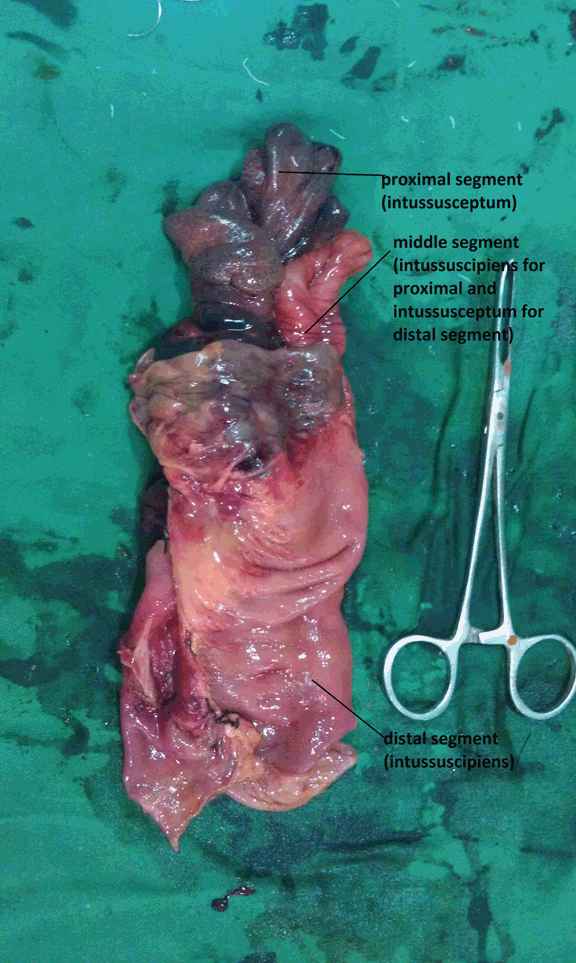
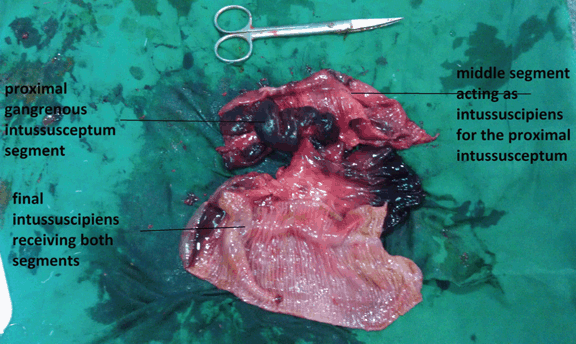
A 46-year-old woman came to the emergency ward with a three-day history of abdomen pain, distension and multiple episodes of bilious vomiting. She also had complaint of constipation for last two days. There was no significant past medical history. On physical examination, she had tachycardia and hypotension; temperature was normal. The abdomen was distended and there was rebound tenderness on palpation. There was a palpable mass just below the umbilicus. Laboratory investigations showed leukocytosis. Liver function tests were normal. Plain X-ray abdomen showed multiple air fluid levels. Ultrasonography of abdomen showed dilated bowel loops, with target sign giving an impression of ileo-ileal intussusception. With all these findings suggestive of acute intestinal obstruction, patient was planned for urgent exploratory laparotomy. Intraoperatively double telescoping ileoileal intussusception was present one foot proximal to ileocecal junction (Figure 1). The bowel proximal to this area was dilated and the intussusceptum was gangrenous. There was no intramural mass or any other type of lead point of intussusceptions (Figure 2). There was no free fluid and inter bowel adhesions. The resection of the ileal segment bearing the intussusception with end ileostomy was done. Even though primary anastomosis is the standard after resection in this case, end ileostomy was done due to poor general condition of the patient and gangrenous bowel segment. The histopathological study of the specimen did not reveal any pathology. Patient recovered well in postoperative period and was discharged on 10th postoperative day. Patient was doing well during follow-up, and after three months ileo-ascending anastomosis was done. | ||||||
| ||||||
| ||||||
|
Discussion
| ||||||
|
Adult intussusception is an uncommon clinical entity encountered by surgeons. Common sites of intussusception are the junctions of mobile and immobile bowel segments, i.e., ileocolic, rectosigmoid junction [6]. Intussusception in adults affects mainly the small intestine (52–55%), while the colon is affected in 38–45% of cases [7]. Various methods have been applied in the classification of intussusception. Based on location, it has been classified into four categories:
In addition adult intussusception has been classified based on etiology as idiopathic, benign and malignant. In the small intestine, an intussusception can be secondary either to the presence of intra- or extra-luminal lesions [9]. Only 30% of cases of small bowel intussusceptions are due to malignancy, where as 66% of large bowel intussusceptions have malignant etiology [4]. Although our patient presented with an ileoileal intussusception, no extra- or intra-luminal lesion was seen. This atypical presentation is seen in 8–20% of cases [7]. The exact mechanism of the development of intussusception is not well defined in these cases. On the other hand, in secondary intussusception the lead point will alter normal peristalsis and initiate an invagination of one segment of bowel in to other [4, 10]. Usually, proximal segment telescopes into distal segment to cause intussusception. There are no reports of double telescoping in literature where the proximal segment intussuscept into the distal segment and this whole thing will again intussuscept into the still farther segment of intestine. Intussusception leads to bowel obstruction and inflammatory changes ranging from thickening to ischemia of the bowel wall. This thickening or ischemia of the intussusceptum might have acted as the lead point for the proximal segment to intussuscept again in to the distal segment causing double telescoping intussusception. This is a case of an idiopathic type of ileoileal double telescoping intussusception which as per our knowledge has not been reported earlier. | ||||||
|
Conclusion
| ||||||
|
Intussusception in adults is very rare and has an identifiable cause in 80% of cases. We report an unusual cause of small bowel obstruction in an adult patient, secondary to double telescoping intussusception with no lead point. Double telescoping intussusception is the condition where there will be a proximal segment intussuscepting into the distal segment and this whole thing will again intussuscept into the still farther segment of intestine. Since most cases are secondary to lead point surgery remains the mainstay of management. | ||||||
|
References
| ||||||
| ||||||
|
[HTML Abstract]
[PDF Full Text]
|
|
Author Contributions
Manash Ranjan Sahoo – Conception and design, Acquisition of data, Analysis and interpretation of data, Drafting the article, Critical revision of the article, Final approval of the version to be published Manoj Srinivas Gowda – Conception and design, Acquisition of data, Analysis and interpretation of data, Drafting the article, Critical revision of the article, Final approval of the version to be published Raghavendra Mohan Kaladagi – Acquisition of data, Drafting the article, Critical revision of the article, Final approval of the version to be published |
|
Guarantor of submission
The corresponding author is the guarantor of submission. |
|
Source of support
None |
|
Conflict of interest
Authors declare no conflict of interest. |
|
Copyright
© Manash Ranjan Sahoo et al. 2013; This article is distributed the terms of Creative Commons Attribution License which permits unrestricted use, distribution and reproduction in any means provided the original authors and original publisher are properly credited. (Please see Copyright Policy for more information.) |
|
|