
  |

|
 |
|
Case Report
| ||||||
| Chronic urticaria and angioedema associated with Hashimoto’s thyroiditis in a child: A case report | ||||||
| Ashutosh Kumar1, Sandeepkumar Kuril1, Sasikumar Kilaikode1, Paul Saenger2 | ||||||
|
1MD, Resident, Pediatrics, The Brooklyn Hospital Center, Brooklyn, New York.
2MD, Attending, Pediatric Endocrinology, The Brooklyn Hospital Center, Brooklyn, New York, USA. | ||||||
| ||||||
|
[HTML Abstract]
[PDF Full Text]
[Print This Article]
[Similar article in Pumed] [Similar article in Google Scholar] 
|


| How to cite this article: |
| Kumar A, Kuril S, Kilaikode S, Saenger P. Chronic urticaria and angioedema associated with Hashimoto’s thyroiditis in a child: A case report. International Journal of Case Reports and Images 2013;4(11):635–637. |
|
Abstract
|
|
Introduction:
The association between chronic urticaria and Hashimoto’s thyroiditis has been rarely reported in children.
Case Report: We are reporting a case of an eight-year-old girl with chronic urticaria unresponsive to antihistaminic therapy, who was subsequently diagnosed to have Hashimoto’s thyroiditis. Patient’s urticarial lesion remitted after treatment with levothyroxine. Conclusion: We emphasize to consider testing for Hashimoto’s thyroiditis by thyroid autoantibodies and thyroid profile in cases of chronic urticaria, and starting the patient on levothyroxine for the symptomatic improvement of both chronic urticaria and Hashimoto’s thyroiditis. | |
|
Keywords:
Angioedema, Chronic urticaria, Hashimoto’s thyroiditis, Levothyroxine
| |
|
Introduction
| ||||||
|
Hashimoto’s thyroiditis is an organ specific autoimmune disease characterized histologically by lymphocytic infiltration of the thyroid gland. This disorder is 2–4 times more frequent in girls than in boys. Most of the affected children are euthyroid and asymptomatic. The most common clinical manifestations are goiter and growth retardation secondary to hypothyroidism. Thyroid anti peroxidase antibody (TPO Abs) and antithyroglobulin antibodies are present in 90% of the affected children. [1] Childhood chronic urticaria is a common disorder characterized by the appearance of hives for more than six weeks. [2] [3] The pathogenesis of chronic urticaria is poorly understood and the cause is unknown in majority of cases. [4] A subset of patients with chronic urticaria has been classified as autoimmune on the basis of association with thyroid autoimmunity and anti-IgE and/or anti-IgE receptor antibodies. [5] As per literature review, an association has been found between Hashimoto’s thyroiditis and chronic urticaria in adults, [6] but there are only a few cases reported in children. [7] Hence, we are presenting a case of an eight-year-old girl with chronic urticaria and Hashimoto’s thyroiditis who became asymptomatic after treatment with levothyroxine. | ||||||
|
Case Report
| ||||||
|
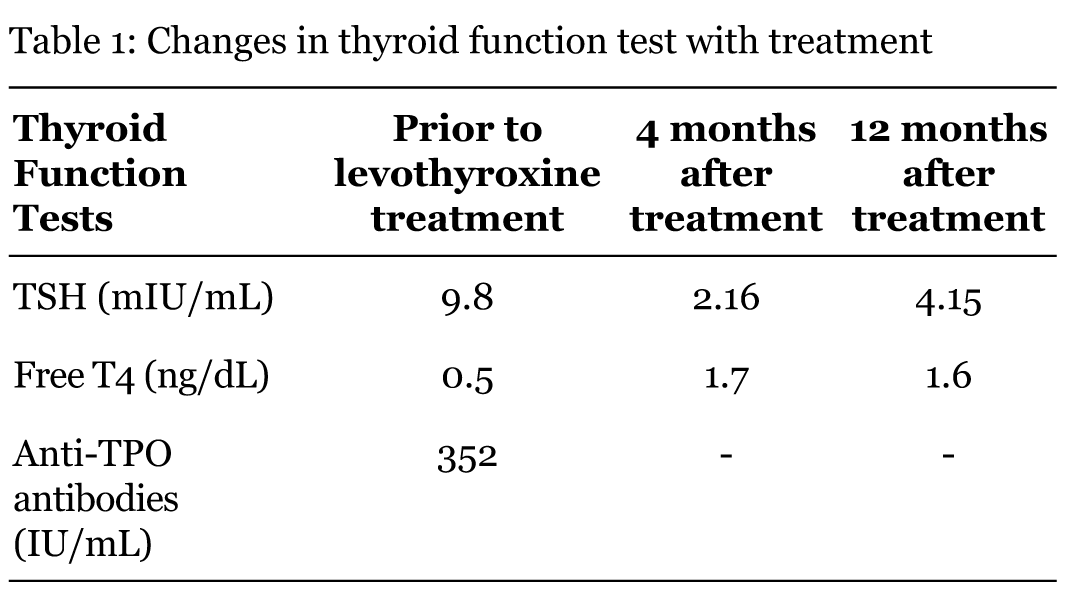
An eight-year-old Hispanic girl referred by immunologist to our pediatric endocrinology clinic in month of September 2010 with abnormal thyroid function test and chronic urticaria. On August 2010, patient was presented to immunology clinic with a two-month history of recurrent urticarial lesions over face, trunk and extremities accompanied by swelling of lips and tongue which were non-responsive to antihistamine treatment. Patient also complained of weakness, fatigue and significant weight gain over the period of six months. In the immunology clinic routine laboratory analysis, allergy tests and thyroid function tests including thyroid autoantibodies were performed. Patient was found to have high TSH 9.8 mIU/mL (< 4.6 mIU/mL), free T4 0.5 ng/dL (normal limit 0.7–1.5 ng/dL), high anti-TPO antibodies 352 IU/mL and positive anti-Fc epsilon Receptor (anti-FCER) antibody. Routine laboratory analysis and total serum IgE was within normal limits. Allergic testing to common food allergens was negative. On examination in pediatric endocrinology clinic, patient’s vital signs were normal, weight 46.03 kg (>95 percentile), height 133.5 cm (75–90 percentile) and BMI- 25.83 (>97 percentile). Her physical examination showed multiple urticarial lesions over the face, trunk and extremities, thyroid gland was not palpable. Systemic examination was unremarkable. Patient was started on levothyroxine 100 µg/day and antihistamine as needed for urticaria and angioedema. Patient was followed-up in February 2011; urticarial lesions were completely remitted during the visit while on levothyroxine with normal thyroid function. Patient was continued to follow-up at regular interval in our endocrinology clinic and remained asymptomatic after one year on hormone replacement therapy with normal thyroid function test. (Table 1) | ||||||
| ||||||
|
Discussion
| ||||||
|
Chronic urticaria is a common clinical condition whose etiology in about 75% of cases is unknown. A link between chronic urticaria and autoimmune thyroid diseases such as Hashimoto’s thyroiditis has been proposed and studied. [8] Approximately one-fourth of chronic urticaria patients have serological evidence of thyroid autoimmunity suggesting association between them. There are various hypotheses on how these two entities might be related:
Hashimoto’s thyroiditis with chronic urticaria in children is rare with only a few reported cases. A study by Levy et al. described eight female patients in the age group of 7–17 years with chronic urticaria and positive thyroid autoantibodies. Two of the eight patients were hypothyroid and were started on thyroxine without any improvement in urticaria. [7] In our patient, the common causes of chronic urticaria like allergy to external agents, hereditary angioedema and occult infections were excluded and the patient was diagnosed to have Hashimoto’s thyroiditis based on high TPO antibodies titers and abnormal thyroid profile. The patient was started on levothyroxine therapy. After four months of treatment with levothyroxine, urticarial lesions disappeared without any recurrences noticed over the one year follow-up. This was in contrast with the two hypothyroid patients studied by Levy et al. whose urticaria did not respond to thyroxine treatment. Therefore, we assume an association between chronic urticaria and Hashimoto’s thyroiditis with clinical remission of resistant urticarial lesions after levothyroxine treatment. | ||||||
|
Conclusion
| ||||||
|
We recommend considering testing for Hashimoto’s thyroiditis by thyroid autoantibodies and thyroid profile in cases of chronic urticaria and starting levothyroxine in a hypothyroid patient with Hashimoto’s thyroiditis for its symptomatic improvement as well as for ameliorating chronic urticaria. | ||||||
|
References
| ||||||
| ||||||

|
[HTML Abstract]
[PDF Full Text]
|
|
Author Contributions
Ashutosh Kumar – Conception and design, Acquisition of data, Analysis and interpretation of data, Drafting the article, Critical revision of the article, Final approval of the version to be published Sandeepkumar Kuril – Conception and design, Acquisition of data, Analysis and interpretation of data, Drafting the article, Critical revision of the article, Final approval of the version to be published Sasikumar Kilaikode – Conception and design, Acquisition of data, Analysis and interpretation of data, Drafting the article, Critical revision of the article, Final approval of the version to be published Paul Saenger – Conception and design, Acquisition of data, Analysis and interpretation of data, Drafting the article, Critical revision of the article, Final approval of the version to be published |
|
Guarantor of submission
The corresponding author is the guarantor of submission. |
|
Source of support
None |
|
Conflict of interest
Authors declare no conflict of interest. |
|
Copyright
© Ashutosh Kumar et al. 2013; This article is distributed the terms of Creative Commons Attribution License which permits unrestricted use, distribution and reproduction in any means provided the original authors and original publisher are properly credited. (Please see Copyright Policy for more information.) |
|
|