
  |

|
 |
|
Case Report
| ||||||
| Frank hematuria as sole manifestation of acute myeloid leukemia: A case report | ||||||
| ML Patel1, Rekha Sachan2, Apul Goel3 | ||||||
|
1MD (Medicine), Assistant Professor, Department of Medicine, CSM Medical University, Lucknow.
2MS (Obs & Gynae), Associate Professor, Department of Obstetrics and Gynaecology, CSM Medical University, Lucknow. 3MS, MCh (Urology), Professor, Department of Urology, CSM Medical University, Lucknow. | ||||||
| ||||||
|
[HTML Abstract]
[PDF Full Text]
[Print This Article]
[Similar article in Pumed] [Similar article in Google Scholar] 
|


| How to cite this article: |
| ML Patel, Sachan R, Goel A. Frank hematuria as sole manifestation of acute myeloid leukemia: A case report. International Journal of Case Reports and Images 2013;4(10):575–577. |
|
Abstract
|
|
Introduction:
Unexplained hematuria may be presenting feature of various systemic illnesses such as coagulation disorder, anticoagulation therapy, leukemia, disseminated intravascular coagulation and multiorgan dysfunction. Bleeding is a common presenting feature of acute leukemia. This may occur in any mucosal surface of body.
Case Report: A 52-year-old male presented with complaints of low grade fever, and gross hematuria for last three days. He was diagnosed as a case of acute myeloid leukemia on the basis of bone marrow aspiration and cytochemistry. Conclusion: Presentation of acute leukemia with gross hematuria is uncommon. Gross hematuria as the sole presenting feature in such cases is unusual and only few cases have been described in literature. | |
|
Keywords:
Frank hematuria, Acute myeloid leukemia, Chemotherapy, Cystoscopy.
| |
|
Introduction
| ||||||
|
Usually, frank hematuria is a clinical manifestation of various systemic illnesses such as coagulation disorders, anticoagulation therapy, leukemia, disseminated intravascular coagulation and multiorgan dysfunction (severe liver function derangement). [1] Hemorrhagic cystitis due to viral infection like Adeno virus, BK/JC virus reported in immunocompromised patients. [2] Acute leukemia particularly acute myeloid leukemia can result in leukemic infiltration of many organs including urinary tract resulting in manifestations like hematuria. [1] Though leukemic infiltration of urinary tract is clinically not evident but autopsy studies have been shown involvement of urinary system. [3] Gross hematuria is an uncommon presentation of acute leukemia. Bleeding in acute leukemias usually results from thrombocytopenia, involving the skin, mucous membrane and may or may not correlate with the degree of thrombocytopenia as platelet dysfunction may also be present. Another cause of bleeding in some patients with acute myeloid leukemia is coagulopathy due to disseminated intravascular coagulation (DIC), which is commonly seen in patients with acute promyelocytic leukemia. [4] | ||||||
|
Case Report
| ||||||
|
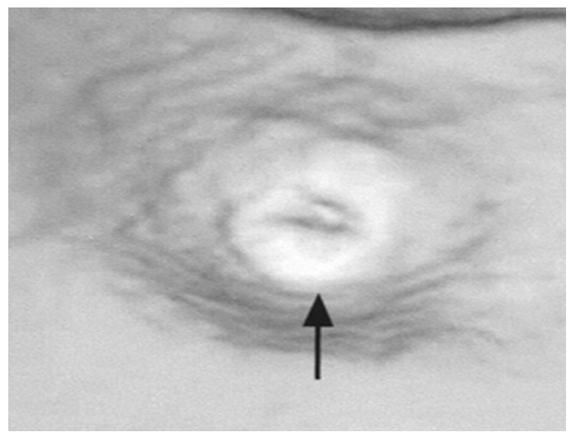
A 52-year-old male patient was admitted in Department of Medicine, Chhatrapati Shahuji Maharaj Medical University, (Erstwhile KGMC) Lucknow in January 2011 with complaints of low grade fever, and gross hematuria for last three days. On general examination patient was febrile 100.6°F, blood pressure 130/80 mmHg, pulse 86/min, mild pallor present and no signs of dehydration was present. General examination revealed there was no lymphadenopathy, icterus, edema, hemorrhagic spot or bleeding from any other site on the body. Systemic examination was within normal limit no palpable lump was present in abdomen. There was no history of intake of medication such as anticoagulation therapy, antiplatelet drug, nonsteroidal anti-inflammatory drug or steroid in the past. On routine investigation hemoglobin 7.8 g/dL, leukocyte count 20.6x10³/µL, MCV 90 fL, MCH 30 pg, and platelet count was 60.0x10³/µL. General blood picture revealed 22% blast cells with auer rods. Liver function tests and coagulation profile were normal. Serum creatinine was 1.2 mg/dL and blood urea was 24 mg/dL. Mid stream urine examination showed protein in traces, 2–4 pus cells/high power field, and numerous red blood cells along with amorphous deposit of crystals. Urine culture and sensitivity were sterile, there was no evidence of glomerulonephritis. FDP and D-dimer were normal. Patient refused PCR test for detection of viral etiology. Ultrasonography of kidney and computed tomography (CT) scan of abdomen revealed no abnormality of urinary tract region. Cystoscopic examination of the bladder was normal. (Figure 1) The bone marrow aspirate and cytochemistry were consistent with the diagnosis of acute myeloid leukemia of M4FAB subtype. The patient was kept on induction chemotherapy (daunorubicin 50 mg/m2/day on day 1, 2, 3 and cytarabine 150 mg/m2/day, intravenous infusion for seven days) and achieved remission. Hematuria subsided within three days after treatment. | ||||||
| ||||||
|
Discussion
| ||||||
|
Frank hematuria is a clinical manifestation of various systemic illnesses such as coagulation disorders, anticoagulation therapy, leukemia, disseminated intravascular coagulation and multiorgan dysfunction (severe liver function derangement). Hematuria as the only or main presenting feature in acute leukemia is rare and to best of our knowledge only 17 cases have been reported till now. [5] [6] In this case blood investigation reports were suggestive of acute leukemia. Although any organ system in the body can be infiltrated by leukemic cells but involvement of renal system is unusual. If the urinary tract is infiltrated by leukemic cells, kidney is the most common site of involvement. [5] [7] Leukemic infiltration of the urinary bladder is very rare, till date only few cases have been reported. [5] [6] [7] [8] In this case though cystoscopy was normal but it could not ruled out occult leukemic infiltration, this could be confirmed only by biopsy but patient refused for the same. Although clinically evident involvement of the urinary system and hematuria as the presenting symptom is rare, leukemic infiltration was observed in more than 50% of cases in an autopsy study. [7] Our case was unusual, because patient initially presented with gross hematuria, later on diagnosed as a case of acute myeloid leukemia on the basis of bone marrow aspiration and cytochemistry. [9] However, malignancy of kidney or urinary bladder could be another possible cause of hematuria, as per review based on the articles mentioned bladder cancer usually causes no frank hematuria until it reaches an advance stage. Mainly large exophytic urinary bladder carcinoma causes frank hematuria. In our reported case patient who initially presented with gross hematuria, diagnosed as case of systemic disease (acute myeloid leukemia). In this case since hematuria did not recur after the treatment with chemotherapy for acute myeloid leukemia despite the drop in platelet count to very low level, the possibility of occult leukemic infiltration of urinary tract appears to be the likely cause of hematuria. The disappearance of hematuria also suggests that disease responded with the treatment and this hematuria might be due to acute myeloid leukemia. Hemorrhagic cystitis due to viral infection like Adeno virus, BK/JC virus usually occurs between 15–60 days following bone marrow transplantation and within the first three months of kidney transplantation in immunocompromised patients. [9] [10] Our patient was not immunocompromised so the possibility of hemorrhagic cystitis was ruled out. [11] | ||||||
|
Conclusion
| ||||||
|
There are so many causes of hematuria such as viral hemorrhagic cystitis, kidney or urinary bladder malignancy and systemic illness. When patient presented with hematuria as the main symptom, acute leukemia should be kept in mind. | ||||||
|
Acknowledgements
| ||||||
|
We acknowledge Dr. Ravi Uniyal, Senior Resident, Department of Medicine, CSMMU, Lucknow for helping in collection of data and investigation. | ||||||
|
References
| ||||||
| ||||||

|
[HTML Abstract]
[PDF Full Text]
|
|
Author Contributions
ML Patel – Substantial contributions to conception and design, Acquisition of data, Analysis and interpretation of data, Drafting the article, Revising it critically for important intellectual content, Final approval of the version to be published Rekha Sachan – Acquisition of data, Revising it critically for important intellectual content, Final approval of the version to be published Apul Goel – Acquisition of data, Revising it critically for important intellectual content, Final approval of the version to be published |
|
Guarantor of submission
The corresponding author is the guarantor of submission. |
|
Source of support
None |
|
Conflict of interest
Authors declare no conflict of interest. |
|
Copyright
© ML Patel et al. 2013; This article is distributed the terms of Creative Commons Attribution License which permits unrestricted use, distribution and reproduction in any means provided the original authors and original publisher are properly credited. (Please see Copyright Policy for more information.) |
|
|