| |
|
|
|
Case Report
| ||||||
| Polyarticular tophaceous gouty arthritis: A case report | ||||||
| Sheikh Javeed Ahmad1, Sumyra Khurshid2 | ||||||
|
1Departments of Physical Medicine and Rehabilitation, Sher I Kashmir Institute of Medical Sciences, Srinagar, India.
2Departments of Pathology, Sher I Kashmir Institute of Medical Sciences, Srinagar, India. | ||||||
| ||||||
|
[HTML Abstract]
[PDF Full Text]
[Print This Article]
[Similar article in Pumed] [Similar article in Google Scholar] 
|
| How to cite this article: |
| Ahmad SJ, Khurshid S. Polyarticular tophaceous gouty arthritis: A case report. International Journal of Case Reports and Images 2013;4(10):554–558. |
|
Abstract
|
|
Introduction:
Gout is a disorder of purine metabolism, affecting men 40–50 years of age resulting in recurrent bouts of arthritis and subcutaneous tophi in patients with long standing disease.
Case Report: We report a case of a 45-year-old male with symmetric, deforming polyarticular arthritis, affecting all the joints of hands, wrists and feet with diffuse subcutaneous nodules over his body. The radiographic findings of the patient were atypical. Conclusion: Following clinical evaluation and additional investigations, the patient received a diagnosis of chronic tophaceous gouty arthritis mimicking rheumatoid arthritis. | |
|
Keywords:
Gout, Arthritis, Tophi, Hand, Foot
| |
|
Introduction
| ||||||
|
Gout is a metabolic disorder of purine degradation pathway usually affecting middle aged and elderly men and postmenopausal females. Usually, it results in acute, monoarticular arthritis, intercritical period and chronic tophaceous gout associated with hyperuricemia and characterized by the presence of monosodium urate (MSU) crystals in connective tissues and kidneys. [1] [2] However, some patients develop chronic polyarthritis mimicking rheumatoid arthritis. [3] [4] [5] [6] Both disease entities have been reported to occur in adult population to the extent of approximately 1% [2] [7] [8]with symmetric polyarthritis. Symmetrical presentation or positive rheumatoid factor (RF) can be seen in both the diseases. A few cases of polyarticular tophaceous gout have been reported in literature. [9] [10] We report a rare case of a 45-year-old male with polyarticular tophaceous gout with atypical involvement of hand and feet with disabling effects of untreated hyperuricemia. | ||||||
|
Case Report
| ||||||
|
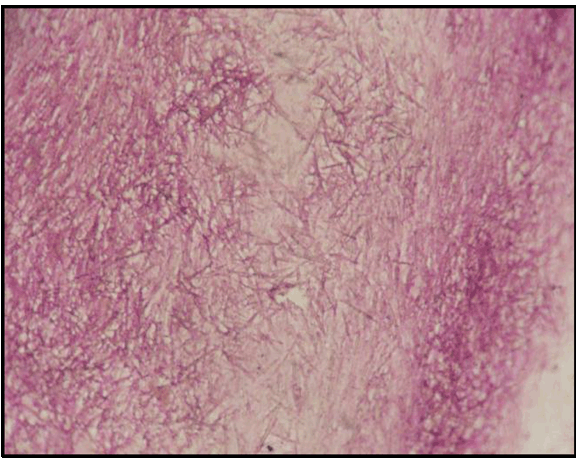
A 45-year-old male (from Kashmir) was presented to our department of physical medicine and rehabilitation at Sher-i-Kashmir Institute of Medical sciences (Srinagar) a multispecialty hospital with long standing history of pain, swelling and deformity of small and large joints of both hands and feet for approximately 12 years. The patient reported with the history of polyarthralgia which had improved over a week’s time. This was followed by frequent intermittent episodes of arthritis of small and large joints of hands, knees, wrists, ankles and feet without morning stiffness. The disease had been treated symptomatically with non-specific non-steroid anti-inflammatory drugs (NSAIDs) leading to the improvement over a period of time. Thereafter, patient developed recurrent episodes of polyarthritis with painless nodules on hand and feet. He was put on allopurinol for 6 months and dietary restriction of protein on account of hyperuricemia with serum uric acid levels of 12.43 mg/dL. Patient intentionally interrupted the treatment following his betterment of health. When the patient visited the outpatient department of our clinic on first physical examination, he was conscious, afebrile, and normotensive. Cardiovascular and respiratory system parameters were normal. Physical examination of Locomotor system revealed muscle atrophy of all four limbs and interossei muscles of both hands; multiple deformities of wrists, metacarpophalangeal joints (MCP), proximal interphalangeal joints (PIP) of hands (Figure 1) and metatarsophalangeal joints of feet. (Figure 2) Skin examination showed subcutaneous nodule of different sizes, measuring 1–2 cm along metacarpophalangeal joints (MCP) and proximal interphalangeal joints (PIP) of hands (Figure 1) metatarsophalangeal joints feet. (Figure 2) These nodules were not showing any signs of inflammation and were fixed to deeper tissues. Laboratory workup revealed hemoglobin 12.1 g/dL, Leukocyte counts of 4,300/µL, platelet counts of 150x103/ µL, ESR of 14/mm Ist hr, uric acid of 14 mg /dL, creatinine of 1.35 mg/dL, rheumatoid factor (RF) negative, blood glucose fasting of 110 mg/dL. Urinary uric acid levels were 1.19 g/24 hr and creatinine clearance of 40 mL/min/1.73 m2, C-reactive protein 15 mg/L. X-ray of hands showed narrowing of joint space, subarticular cysts at proximal interphalangeal joint of middle finger of right hand with asymmetric soft tissue swelling. (Figure 3) X-ray of feet showed the evidence of narrowing of joint spaces bilaterally with subarticular cysts and overhanging edges. There is complete osteolysis of little toe of right foot. (Figure 4) Histopathological examination of nodule removed from left MCP joint revealed presence of uric acid crystals (tophus) with no atypical cells. (Figure 5) A diagnosis of polyarticular tophaceous gout was made and patient was treated with colchicine 0.5 mg/day and febuxostat 40 mg/day, which was increased to 1 mg/day and 80 mg/day respectively till acute stage. Currently, patient is showing good response with febuxostat 80 mg/day alone. | ||||||
| ||||||
| ||||||
| ||||||
| ||||||
| ||||||
|
Discussion
| ||||||
|
Gout is an inflammatory arthropathy affecting 2.13% of population in United States of America in 2009 [11] with high preponderance for old age, male gender, postmenopausal females and black race. [12] Gout is a metabolic disorder which is characterized by elevation of uric acid levels above 6.8 mg/dL resulting from impaired renal uric acid excretion. High uric acid level can be attributed to uric acid elevating drugs, genetic predisposition and dietary factors. [13] Gout is a metabolic disorder in which needle shaped crystal of monosodium urate from super saturated fluids are deposited in tissues resulting in gouty arthritis, tophi formation, uric acid nephrolithiasis and renal impairment. [14] [15] The tophi formation usually occurs over a mean period of 10 years. [16] Tophi are present commonly as subcutaneous, sharply circumscribed nodular collection of monosodium urate crystals [17] at periarticular site in and around bursae and in soft tissue overlying tendon and cartilage. [18] [19] [20] The most common locations are skin overlying joints and helix of the ears. Rarely, these are found in eyes, nose, larynx, breast and heart valves, penis, spinal cord, tongue, epiglottis. [21] [22][23][24][25][26][27][28][29][30][31] Adel and Janitzia have reported location of intradermal tophi on legs, forearm, buttock, abdominal wall, palm and sole. [32][33] The optimal serum urate level necessary for elimination of tissue deposits of monosodium urate in patients of chronic gout is controversial. Some studies reveal the decrease in serum urate levels achieved by urate lowering drugs and the fast reduction in tophaceous deposition. [34] Surgical treatment is seldom required for gout and is usually reserved for cases of recurrent attacks with deformities, severe pain and joint destruction. [35] The main indication of surgical intervention in gout is sepsis or infection of ulcerated tophi followed by mechanical problems, confirmation of diagnosis and pain control. [36] The radiologic changes in gouty arthritis are asymmetrical, erosive arthritis with preserved articular surface except in late cases. Bone erosions are usually caused by tophi deposits. [10] Almost 30% of patients of rheumatoid arthritis have subcutaneous nodes and all these patients are usually seropositive. Thus polyarthritis with subcutaneous nodules with negative rheumatoid factor should be investigated for tophaceous gout. [37] Early diagnosis and initiation of early treatment of gouty arthritis will halt the progression of disease to tophaceous state. The current medical management of gouty arthritis has changed a lot. At present management of gout includes non-steroid anti-inflammatory drugs (NSAIDs), colchicines and steroids. The intraarticular steroid has been mainstay to alleviate acute gouty arthritis. It is pertinent to mention interleukin 1 beta inhibitors are the future for amelioration of gouty syndrome. Rilonacept, an interleukin 1 antagonist has proven to be of great advantage in chronic gout and has been helpful in refractory gout but randomized control trails need to be done for its effectiveness. | ||||||
|
Conclusion
| ||||||
|
Polyarticular tophaceous gouty arthritis is uncommon considering pharmacological treatment of hyperuricemia and such cases may be considered as differential diagnosis for rheumatoid arthritis so that early treatment will stop the disability effects in such patients. | ||||||
|
References
| ||||||
| ||||||
|
[HTML Abstract]
[PDF Full Text]
|
|
Author Contributions
Sheikh Javeed Ahmad – Substantial contributions to conception and design, Acquisition of data, Analysis and interpretation of data, Drafting the article, Revising it critically for important intellectual content, Final approval of the version to be published Sumyra Khurshid – Acquisition of data, Analysis and interpretation of data, Drafting the article, Final approval of the version to be published |
|
Guarantor of submission
The corresponding author is the guarantor of submission. |
|
Source of support
None |
|
Conflict of interest
Authors declare no conflict of interest. |
|
Copyright
© Sheikh Javeed Ahmad et al. 2013; This article is distributed the terms of Creative Commons Attribution License which permits unrestricted use, distribution and reproduction in any means provided the original authors and original publisher are properly credited. (Please see Copyright Policy for more information.) |
|
|