| |
|
|
|
Case Report
| ||||||
| Coexistent of giant left atrial myxoma and severe coronary artery disease presenting with paroxysmal atrial fibrillation and syncope | ||||||
| Emine Gazi1, Bahadir Kirilmaz1, Ahmet Temiz1, Hicran Yildiz Şimşek1, Mustafa Saçar2, Tolga Kurt2 | ||||||
|
1MD, School of Medicine, Department of Cardiology, Canakkale Onsekiz Mart University, Canakkale, Turkey.
2MD, School of Medicine, Department of Cardiovasculary Surgery, Canakkale Onsekiz Mart University, Canakkale, Turkey. | ||||||
| ||||||
|
[HTML Abstract]
[PDF Full Text]
[Print This Article]
[Similar article in Pumed] [Similar article in Google Scholar] 
|
| How to cite this article: |
| Gazi E, Kirilmaz B, Temiz A, Şimşek HY, Saçar M, Kurt T. Coexistent of giant left atrial myxoma and severe coronary artery disease presenting with paroxysmal atrial fibrillation and syncope. International Journal of Case Reports and Images 2013;4(8):457–459. |
|
Abstract
|
|
Introduction:
Large intracardiac mass is a rare condition but it brings extremely high-risk of hemodynamic and embolic complications. Presentation is usually heart failure, syncope or embolic events, but occasionally it may have atypical symptoms even may be asymptomatic.
Case Report: Herein we are discussing a case of a 69-year-old male with syncope due to giant left atrial myxoma and coronary artery disease. Conclusion: Although atrial myxomas are the most common type of benign cardiac tumors coexistent with significant coronary artery stenosis is very rare and only a few cases available in literature. Surgery performed safely despite patient age, mass size and coronary artery disease coexistence and ultimate prognosis is good. Myxomas may be symptom free despite the coexistent of severe coronary artery disease, older age and large size of the mass until a contributing factor, such as atrial fibrillation episode as in our case, bring out the symptoms. Once the myxomas are detected before any complication surgery performed safely despite patient age, mass size and coronary artery disease coexistence and ultimate prognosis is good. | |
|
Keywords:
Giant myxoma, Syncope, Atrial fibrillation, Coronary heart disease, Echocardiography
| |
|
Introduction
| ||||||
|
Large intracardiac mass is a rare condition but it brings extremely high-risk of hemodynamic and embolic complications. [1]Presentation is usually heart failure, syncope or embolic events, but occasionally it may have atypical symptoms even may be asymptomatic. Herein, a case is reported with syncope and paroxysmal atrial fibrillation due to giant left atrial myxoma. | ||||||
|
Case Report
| ||||||
|
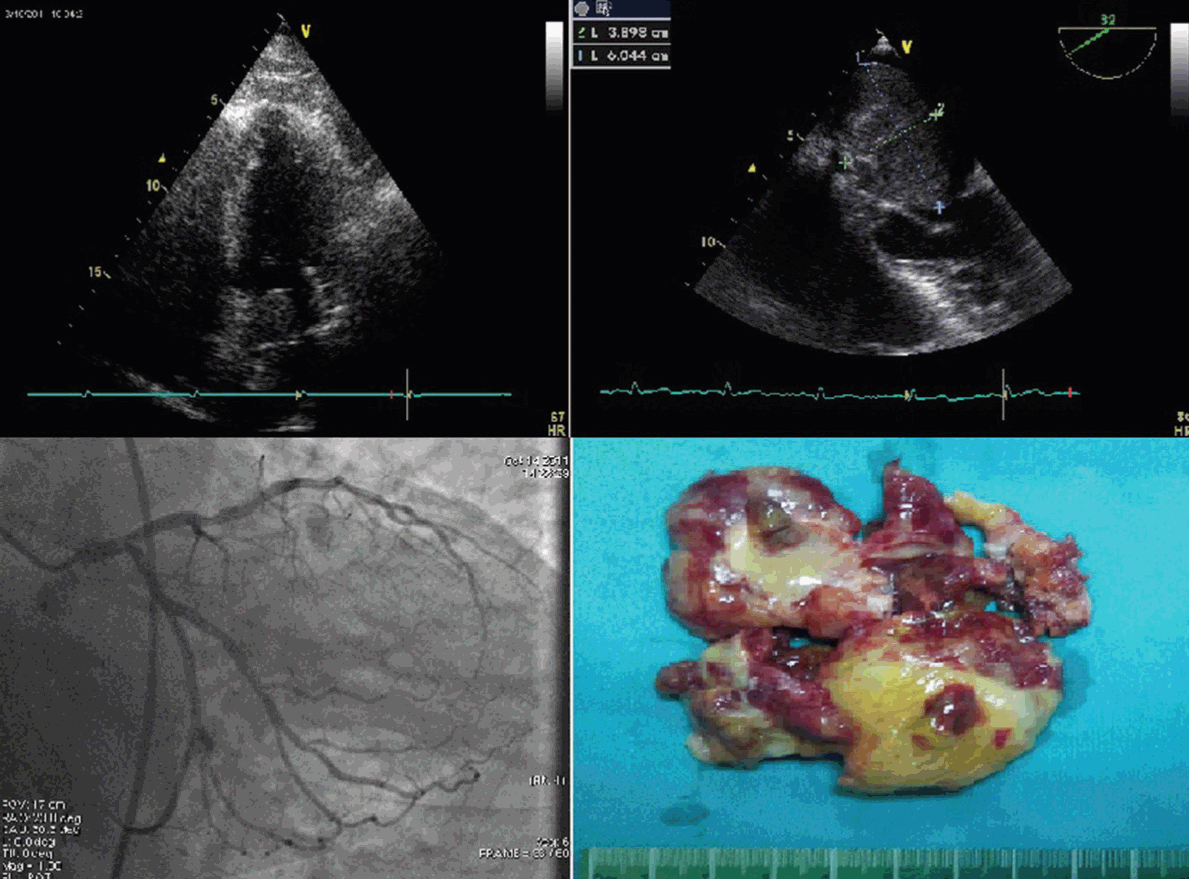
A 69-year-old male was admitted to our clinic suffering from palpitation just started a few hours ago with ensuing syncope. History revealed mild to moderate exercise dyspnea in last two years. In physical examination, auscultation revealed mild diastolic murmur at apex. Rhythm was atrial fibrillation in electrocardiography. Subsequently, the patient underwent transthoracic echocardiography, which revealed normal systolic function, significantly enlarged left atrium with a giant, ball-shaped mass in its cavity. Transesophageal echocardiography (TEE) was performed to determine the presence of additional cardiac anomaly and to confirm the diagnosis of myxoma. The TEE demonstrated the mass that is 60x39 mm in diameter, hyperechoic, immobile and attached to the fossa ovalis territory of the interatrial septum. Surgical treatment was planned and coronary angiography performed due to the older age of the patient and in order to detect vascularity of the mass. Coronary angiography demonstrated two vessel disease including left anterior descending artery and circumflex artery, and no vascularity of mass. The patient undergone mass excision and two vessel coronary by-pass graft operation (Figure 1). Pathologic assessment ascertained the diagnosis of benign atrial myxoma. Patient was discharged home with no complication in hospital. | ||||||
| ||||||
|
Discussion
| ||||||
|
Atrial myxomas are the most common type of benign cardiac tumors whereas primary cardiac tumors are rare. [2] Giant intracardiac mass is rarely found and it may be diagnosed incidentally during an echocardiographic examination and usually located in left atrium and an attached to the interatrial septum, at the fossa ovalis region. Thrombus formation may superimpose on tumoral mass and, although rarely, embolic events may occur by the pieces of the mass. Clinical features are different, such as cerebral or peripheral embolic events, symptoms of heart failure due to impaired left ventricle filling or mitral regurgitation due to failure of coaptation of the mitral valve leaflets because of the mass and syncope due to obstruction of the mitral valve orifice, but occasionally can be asymptomatic or with atypical symptoms [1] and in a case report, it is demonstrated that myxoma may cause severe pulmonary hypertension. [3] In our case, there was no embolic event although the mass was giant and despite the episode of atrial fibrillation. Syncope probably occurred due to obstruction of the mitral valve orifice and ensuing decreasing of cardiac output. Coexistence of giant myxoma and significant coronary artery stenosis is very rare and only a few cases available in literature. Our patient had two vessel coronary artery disease which required surgery. Generally, transthoracic echocardiography is the first imaging technique for detecting myxomas but TEE is extremely useful in the assessment of intracardiac structures, thrombus detection and interatrial septum evaluation so that TEE has been shown to be superior method for defining the characteristics of a mass in the left atrium. [4] Recently, three-dimensional transthoracic and transesophageal echocardiography serve a useful technic for detection and differential diagnosis of cardiac masses. [5] Surgery should be performed promptly when the possibility of embolic complications and even acute myocardial infarction can be caused by coronary emboli [6] and diagnosis has been established. | ||||||
|
Conclusion
| ||||||
|
It is possible that myxomas may be symptom free despite the coexistent of severe coronary artery disease, older age and large size of the mass until a contributing factor, such as atrial fibrillation episode as in our case, bring out the symptoms. Once the myxomas are detected before any complication surgery performed safely despite patient age, mass size and coronary artery disease coexistence and ultimate prognosis is good. | ||||||
|
References
| ||||||
| ||||||
|
[HTML Abstract]
[PDF Full Text]
|
|
Author Contributions
Emine Gazi – Conception and design, Acquisition of data, Analysis and interpretation of data, Drafting the article, Critical revision of the article, Final approval of the version to be published Bahadir Kirilmaz – Conception and design, Acquisition of data, Analysis and interpretation of data, Drafting the article, Critical revision of the article, Final approval of the version to be published Ahmet Temiz – Conception and design, Acquisition of data, Analysis and interpretation of data, Drafting the article, Critical revision of the article, Final approval of the version to be published Hicran Yildiz Şimşek – Conception and design, Acquisition of data, Analysis and interpretation of data, Drafting the article, Critical revision of the article, Final approval of the version to be published Mustafa Saçar – Conception and design, Acquisition of data, Analysis and interpretation of data, Drafting the article, Critical revision of the article, Final approval of the version to be published Tolga Kurt – Conception and design, Acquisition of data, Analysis and interpretation of data, Drafting the article, Critical revision of the article, Final approval of the version to be published |
|
Guarantor of submission
The corresponding author is the guarantor of submission. |
|
Source of support
None |
|
Conflict of interest
Authors declare no conflict of interest. |
|
Copyright
© Emine Gazi et al. 2013; This article is distributed the terms of Creative Commons Attribution License which permits unrestricted use, distribution and reproduction in any means provided the original authors and original publisher are properly credited. (Please see Copyright Policy for more information.) |
|
|