
  |

|
 |
|
Case Report
| ||||||
| An uncommon complication of central venous catheter placement | ||||||
| L Ray Matthews1, Travealyan Walker1, Kenneth L Wilson1, Omar K Danner1 | ||||||
|
1Morehouse School of Medicine, Department of Surgery, 720 Westview Drive, Atlanta.
| ||||||
| ||||||
|
[HTML Abstract]
[PDF Full Text]
[Print This Article]
[Similar article in Pumed] [Similar article in Google Scholar] 
|


| How to cite this article: |
| Matthews LR, Walker T, Wilson KL, Danner OK. An uncommon complication of central venous catheter placement. International Journal of Case Reports and Images 2013;4(5):287–289. |
|
Abstract
|
|
Introduction:
The most commonly used inferior vena cava filters in the United States are the Greenfield filters.
Case Report: We report a case of a 60-year-old man with ensnarement of a Greenfield filter by a J-tip guide wire used to insert a central venous catheter from the femoral approach. Conclusion: We conclude that ensnarement of the filter by the guide wire is a preventable complication. | |
|
Keywords:
Greenfield filter, Ensnarement, Central venous
| |
|
Introduction
| ||||||
|
Greenfield filters are commonly used for the treatment of deep vein thrombosis (DVT) and pulmonary embolism (PE) in patients with contraindications to anticoagulation. We report a case of ensnarement of a Greenfield filter by a J-tip guide wire used to insert a central venous catheter from the femoral approach. | ||||||
|
Case Report
| ||||||
|
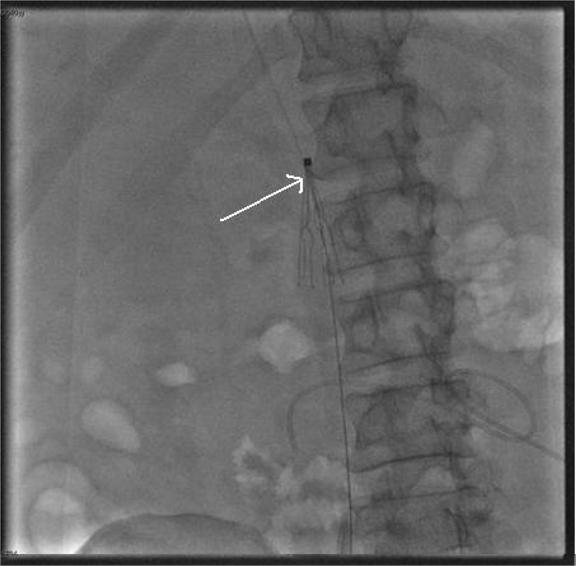
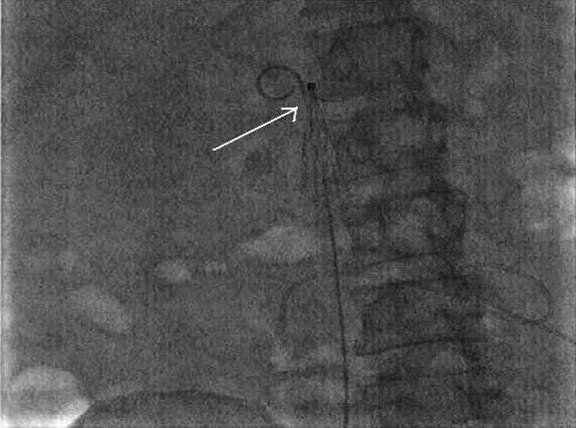
A 60-year-old man with a history of diabetes mellitus, hypertension, morbid obesity and ventilator-associated pneumonia was admitted to a surgical intensive care unit for a subarachnoid hemorrhage after an assault. During placement of a right femoral catheter, the J-tip guide wire was advanced for approximately 55 cm. Subsequently, the J-tip guide wire could not be removed even with excessive force. When the patient presented to the physical examination was unremarkable except for a foreign body (guide wire) protruding from the patient's right groin area. A radiograph showed the Greenfield filter in the proper position with the J-tip guide wire ensnared in the Greenfield filter. (Figure 1) The J-tip guide wire was removed using fluoroscopic visualization with a filter sheath without any complications. (Figure 2) An inferior vena cavogram showed no extravasation. The patient was discharged home two weeks later without any complications. | ||||||
| ||||||
| ||||||
|
Discussion
| ||||||
|
The most commonly used filter in the United States is the Greenfield filter. These filters work by allowing venous flow through the filter while capturing the emboli. Ensnarement of the filter by the guide wire is a preventable complication that can happen from the jugular, subclavian and femoral approaches. [1] [2] Ensnarement of the inferior vena cava (IVC) filter is noted clinically as the wire becoming "stuck" during wire withdrawal. [3] Further attempts to remove the wire should be halted immediately. Any attempt to remove the guide wire with force can cause catastrophic complications including filter caval disruption, perforation, arrhythmias, cardiac tamponade and even death. [3] [4] To prevent this complication, all patients should be queried about the presence of an IVC filter before elective insertion of a central venous catheter. In the event that a history cannot be obtained from the patient, an abdominal radiograph will show the presence of this device. If a Greenfield filter is present, to avoid this type of complication, the straight end of the J-tip guide wire should be used to place the central venous catheter in patients with Greenfield filters. Treatment of this complication demands emergent consultation with interventional radiology. Techniques used to free the guide wire include using fluoroscopic visualization and placement of a vascular sheath and snares to work the guide wire free. | ||||||
|
Conclusion
| ||||||
|
We present a case of ensnarement of Greenfiled filter by J-tip guide wire which is a preventable complication of central venous catheter placement. It can be avoided by taking a detailed patient history and/or abdominal radiographs when placing central venous catheters. | ||||||
|
References
| ||||||
| ||||||

|
[HTML Abstract]
[PDF Full Text]
|
|
Author Contributions
L Ray Matthews – Substantial contributions to conception and design, Acquisition of data, Analysis and interpretation of data, Drafting the article, Revising it critically for important intellectual content, Final approval of the version to be published Travealyan Walker – Analysis and interpretation of data, Drafting the article, Revising it critically for important intellectual content, Final approval of the version to be published Kenneth L Wilson – Analysis and interpretation of data, Drafting the article, Revising it critically for important intellectual content, Final approval of the version to be published Omar K Danner – Analysis and interpretation of data, Drafting the article, Revising it critically for important intellectual content, Final approval of the version to be published |
|
Guarantor of submission
The corresponding author is the guarantor of submission. |
|
Source of support
None |
|
Conflict of interest
Authors declare no conflict of interest. |
|
Copyright
© L Ray Matthews et al. 2013; This article is distributed the terms of Creative Commons Attribution License which permits unrestricted use, distribution and reproduction in any means provided the original authors and original publisher are properly credited. (Please see Copyright Policy for more information.) |
|
|