
 |

|
 |
|
Case Series
| ||||||
| Sandwich technique of closure of lumbar hernia: A novel technique | ||||||
| Manash Ranjan Sahoo1, Anil Kumar T2 | ||||||
|
1MS, Associate Professor, Department of Surgery, S.C.B. Medical College, Cuttack, Odisha, India.
2Post Graduate, Department of Surgery, S.C.B. Medical College, Cuttack, Odisha, India. | ||||||
| ||||||
|
[HTML Abstract]
[PDF Full Text]
[Print This Article]
[Similar article in Pumed] [Similar article in Google Scholar] 
|


| How to cite this article: |
| Sahoo MR, Anil Kumar T. Sandwich technique of closure of lumbar hernia: A novel technique. International Journal of Case Reports and Images 2013;4(5):243–247. |
|
Abstract
|
|
Introduction:
Lumbar hernia is a rare hernia which accounts for less than 1.5% of total hernia incidence. Only about 300 cases have been reported in literature. Lumbar hernia herniates through the superior or inferior lumbar triangle. Herniation through inferior triangle is more common, probably due to variable attachment of external oblique and latissimus dorsi to iliac crest. If they are closely attached then this triangle is not present and no hernia occurs.
Case Series: We present our experience of four cases of lumbar hernias over a period of two years. All patients presented with gradually enlarging swelling in the loin which enlarged in size on coughing and straining. Two of them presented with multiple small ulceration over the swelling. Examination revealed swelling in the lumbar region with positive cough impulse, incomplete reducibility, and bowel sounds on auscultation. Ultrasound and computed tomography (CT) scan revealed hernia in right lumbar region in all cases. Transverse skin incision was given over the hernia. After dissection in layers, the sac was separated and contents were reduced. Around 15x15 cm prolene mesh was placed extraperitoneally and fixed around the defect. Another overlay of 15x15 cm prolene mesh was placed, thus sandwiching prolene mesh in between layers of abdomen. Negative suction drain was given in all cases. 10 months of mean follow-up revealed no recurrence. Conclusion: Sandwich technique of closure of lumbar hernias is safe, feasible, acceptable and associated with no short-term recurrence rates. However, long-term follow-up is needed to prove the efficacy of this technique. | |
|
Keywords:
Lumbar hernia, Sandwich technique, Superior lumbar triangle, Inferior lumbar triangle
| |
|
Introduction
| ||||||
|
Lumbar hernias are rare defects of posterior abdominal wall. Lumbar region is bordered by 12th rib superiorly, iliac crest inferiorly, erector spinae muscles posteriorly and vertical line between anterior tip of 12th rib and iliac crest. [1] The two main areas of lumbar herniation are superior lumbar triangle (Grynfelt-Lesshaft) and inferior lumbar triangle (Petit). Hernia through the inferior triangle is more common but superior triangle is larger in size. [2] Lumbar hernia can be classified as congenital or acquired. Congenital hernias are rare but case reports can be found in literature. The acquired type may be secondary to trauma or surgical operation. Most incisional lumbar hernias occur after flank surgery (nephrectomy, aortic aneurysm repair, iliac bone graft harvest or latissimus dorsi myocutaneous flap). [3] | ||||||
|
Case Series
| ||||||
|
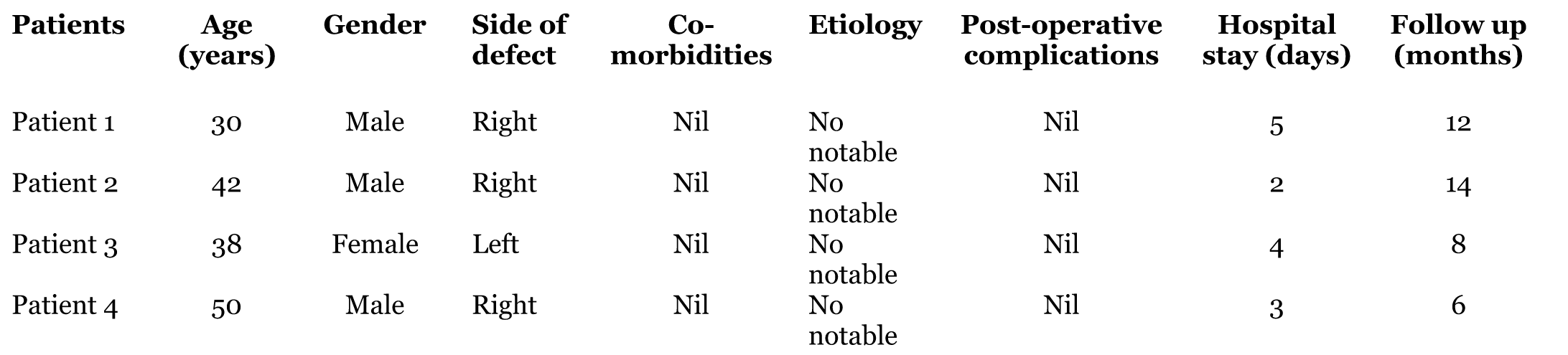
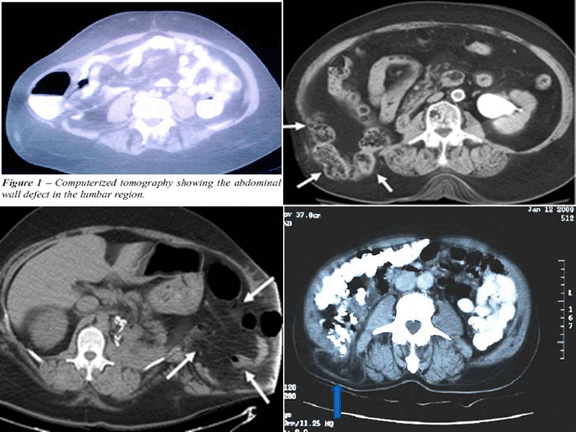
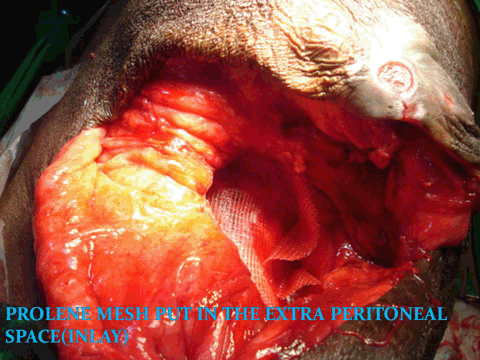
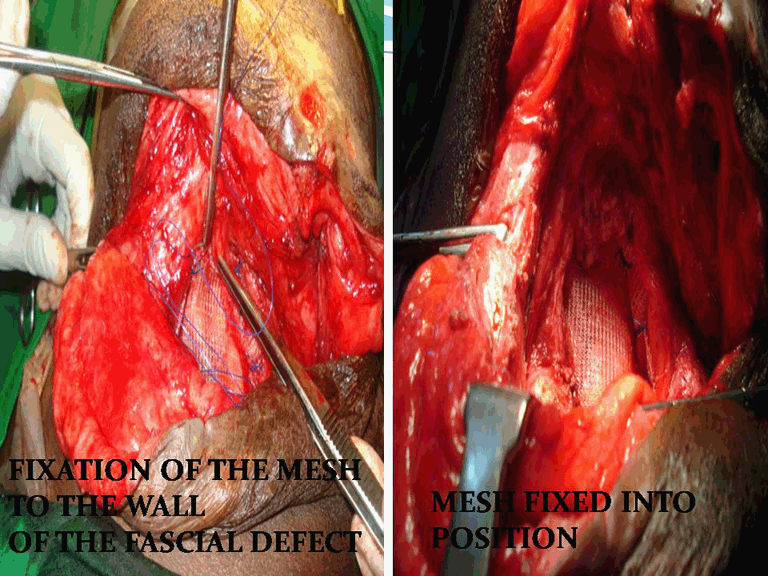
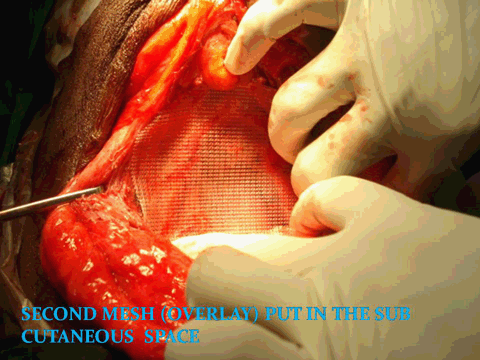
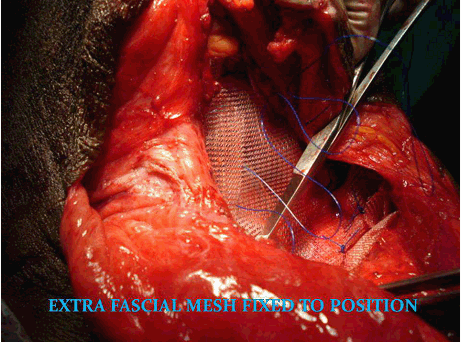
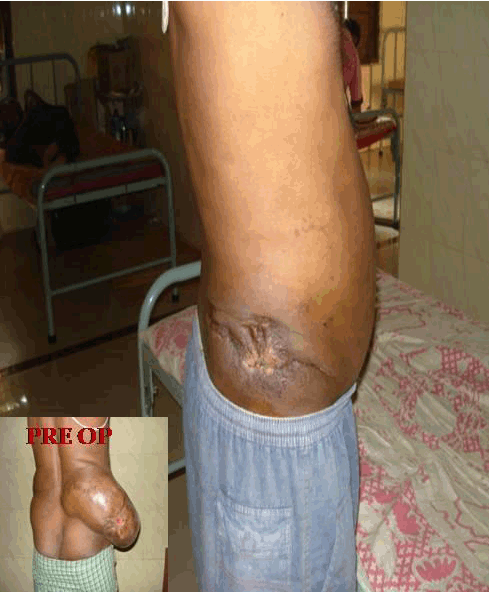
Four patients, three male and one female, with age ranging from 30–50 years (mean age 40 years), presented with a gradually enlarging swelling in the loin. (Figure 1) Three had swelling on the right side and one on the left side. The swelling enlarged in size on coughing and straining and was reduced in supine position. Dragging pain was present in all cases at the site of the swelling. Two patients had multiple small ulceration over the swelling at the time of presentation. There were no associated co-morbid conditions in any patient. (Table 1) There was no notable etiology like trauma or surgery in any patient. On examination impulse on cough was positive with incomplete reducibility in all patients. Mild tenderness was present in the abdomen. Auscultation revealed bowel sounds over the swelling. Ultrasound and CT scan revealed hernia in right lumbar region containing small bowel. (Figure 2) During surgery a transverse incision was given over the hernia. After dissection in layers, the hernial sac was separated and contents were reduced. First a prolene mesh of 15x15 cm was placed extraperitoneally and fixed around the defect. (Figure 3) (Figure 4) Another overlay of 15x15 cm prolene mesh was placed and fixed. (Figure 5) (Figure 6) Skin and subcutaneous tissue was closed after giving negative suction drain. Same procedure was followed for all cases. Postoperative period was uneventful. There are no postoperative complications like wound infection or dehiscence in any case. Mean postoperative hospital stay was three and half days (range 2–5 days). Sandwich technique was used to provide strength to the repair because of lack of sufficient fascia for repair of the hernia. Ten months of mean follow up revealed no signs and symptoms of recurrence. (Figure 7) | ||||||
| ||||||
| ||||||
| ||||||
| ||||||
| ||||||
| ||||||
| ||||||
| ||||||
|
Discussion
| ||||||
|
Lumbar hernia is a rare hernia which account for less than 1.5% of total hernia incidence. [4] It was first described by Barbette in 1672. Till date, less than 300 cases have been reported in literature. Among the two lumbar triangles superior triangle is larger, more constant and safe than inferior triangle. About 20% of lumbar hernias are congenital and 80% are acquired. [5] Most commonly patient presents with reducible flank bulge associated with pain and discomfort. Lumbar hernias are associated with 25% risk of incarceration and 80% chance of strangulation [6] because two of the three boundaries for hernia defect are soft and muscular in origin. Computed tomography scan is the diagnostic modality of choice. [7] It can provide detailed information about the anatomy of the lumbar area, extent of the defect, presence of herniated intra-abdominal viscera and also differentiates hernia from muscle atrophy with no fascial defect, for which no surgical intervention is required. The predominant cause for the postoperative bulge is intercostal nerve injury which results in subsequent paralysis of abdominal wall musculature. This injury can be reduced by avoiding extending the incision into the 11th intercostal space. [8] Surgical repair is the treatment of choice and should be considered in all cases if medically feasible. Various surgical approachs have been described including primary repair, tissue flaps and mesh repair including laparoscopic trans-abdominal and retroperitoneoscopic approaches. [9] Comparative studies have shown certain advantages of laparoscopic approach over the conventional open repair. [10] In intraperitoneal laparoscopic repair, lateral peritoneal reflection of colon is taken down to facilitate exposure of hernia defect. In retroperitoneal approach lateral retroperitoneal space is entered and insufflated. Now has days laparoscopic repair become the procedure of choice for lumbar hernia. [3] Regarding open approaches to surgery no procedure has been shown to have a definite advantages over others, especially in view of the relatively rarity of these cases. Surgical repair is sometimes difficult and challenging for the surgeons. The difficulty in defining the margins of the fascial defect, the weakness of the involved structures, the involvement of a bone element and lack of surgical experience are all taken into consideration during surgical planning. Bleichrodt et al. used omentum polypropylene sandwich in presence of infection with good results. [11] Very less literature is available on using sandwich technique for repair of lumbar hernia. In our study we used a novel technique of sandwiching two prolene meshes in between layers of abdomen to provide strength to the defect repair with very good results. | ||||||
|
Conclusion
| ||||||
|
Sandwich technique repair of lumbar hernia is safe, easy and a novel idea to strengthen the weak abdominal wall. It provides better results in short-term follow-up without recurrences, however, long-term follow-up is needed to prove its efficacy. | ||||||
|
References
| ||||||
| ||||||


|
[HTML Abstract]
[PDF Full Text]
|
|
Author Contributions:
Manash Ranjan Sahoo – Conception and design, Acquisition of data, Analysis and interpretation of data, Drafting the article, Final approval of the version to be published Anil Kumar T – Conception and design, Acquisition of data, Analysis and interpretation of data, Drafting the article, Critical revision of the article, Final approval of the version to be published |
|
Guarantor of submission
The corresponding author is the guarantor of submission. |
|
Source of support
None |
|
Conflict of interest
Authors declare no conflict of interest. |
|
Copyright
© Manash Ranjan Sahoo et al. 2013; This article is distributed the terms of Creative Commons Attribution License which permits unrestricted use, distribution and reproduction in any means provided the original authors and original publisher are properly credited. (Please see Copyright Policy for more information.) |
|
|