| |
|
|
|
Letter to Editors
| ||||||
| Acute renal failure caused by tumor-induced hypercalcemia successfully treated by denosumab | ||||||
| Kouichi Kuninaka1, Hiromu Tengan2, Tadashi Nishimaki1 | ||||||
|
1MD, PhD, Division of Digestive and General Surgery, Ryukyu University Graduate School of Medicine, Okinawa, Japan.
2MD, Division of Digestive and General Surgery, Ryukyu University Graduate School of Medicine, Okinawa, Japan. | ||||||
| ||||||
|
[HTML Abstract]
[PDF Full Text]
[Print This Article]
[Similar article in Pumed] [Similar article in Google Scholar] 
|
| How to cite this article: |
| Kuninaka K, Tengan H, Nishimaki T. Acute renal failure caused by tumor-induced hypercalcemia successfully treated by denosumab. International Journal of Case Reports and Images 2013;4(3):187–189. |
|
To the Editors,
|
|
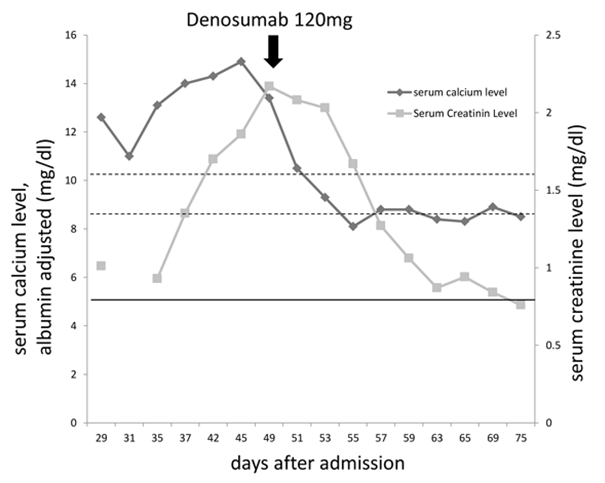
Denosumab, a human monoclonal antibody that binds to and neutralizes the receptor activator of nuclear factor-& #954; ligand (RANKL), has recently become available for the prevention of skeletal-related events (SRE) of bone metastases from breast cancer. In a recent study, denosumab was shown to be more effective than zoledronic acid in delaying SRE [1], and it has been shown that hypocalcemia occurred more frequently and renal failure less frequently, in patients treated with denosumab as compared to those treated with zoledronic acid [1-3]. In light of these studies, we used denosumab to successfully treat a patient presenting with acute renal failure caused by a tumor-related hypercalcemia arising from breast cancer bone metastases. A 53-year-old woman was admitted to the orthopedics ward due to walking difficulties. Investigations revealed compression of the spine by metastatic carcinoma of the thoracic vertebrae. An emergency decompression surgery was performed. Pathological examination of the resected specimen revealed metastatic carcinoma of probable breast cancer origin that was immunohistochemically positive for estrogen receptor, negative for progesterone receptor, and 2+ for HER2 receptor (additional fluorescence in situ hybridization revealed significant amplification of HER2/neu). The patient had undergone surgery for left breast cancer 13 years ago in our hospital and had shown no evidence of recurrence at her last visit to the outpatient clinic three years ago. A positron emission tomography (PET) scan after the decompression surgery revealed multiple bone metastases (in the thoracic and lumbar vertebre, sternum, humeri, scapula, ribs, pelvis, and femur). Lung metastasis and serum calcium level started to increase 29 days after admission. Tumor-related hypercalcemia was strongly suspected and the patient was treated with elcatonin (80 U/day), normal saline (1,000 ml/day) and furosemide (40 mg/day) for six days from day 29, but the serum calcium level continued to increase and renal dysfunction developed (Figure 1). The patient developed severe appetite loss and renal dysfunction with creatinin clearance of 26 ml/min. With these findings a diagnosis of acute renal failure due to tumor related hypercalcemia was made. Usually, we use zoledronic acid to treat tumor-related hypercalcemia, but it could not be used in this case because of renal dysfunction. As an alternative, on day 49, we administered single dose of denosumab (120 mg) to treat the acute renal failure caused by tumor-related hypercalcemia. The serum calcium level decreased to within normal limits after only five days, and renal functions improved and completely recovered after a month (Figure 1). The patient is now under treatment with exemestane and trastuzumab. Denosumab is still being administered every four weeks and the serum calcium level and renal function are stable owing to a daily intake of 600 mg calcium and 0.25 µg vitamin D, respectively. Enhanced bone resorption is the primary cause of tumor-induced hypercalcemia. The release of tumor-derived mediators induces this increase in osteoclast-mediated resorption. The interaction between osteoclasts and cancer cells are mainly mediated by parathyroid hormone-related protein (PTHrP), that activates osteoblasts to produce RANKL which stimulates osteoclast differentiation [4]. Denosumab, human RANKL antibody inhibits this vicious cycle. Moreover, denosmab binding to RANKL is metabolized by peptides and cleared by the reticuloendothelial system and probably does not have a nephrotoxic effects [5]. Zoledronic acid, one of the third generation bisphosphonates, also inhibits the effect of RANKL and is used for treatment of tumor-related hypercalcemia, but cannot be used for patients with renal dysfunction (with creatinin clearance <30ml/min). Use of denosumab for such a condition is limited [5], but it may be a reasonable treatment choice in certain circumstances, such as those outlined here. |
|
|
|
|
|
References
|
|
|
[HTML Abstract]
[PDF Full Text]
|
|
Author Contributions:
Koichi Kuninaka – Conception and design, Acquisition of data, Analysis and interpretation of data, Drafting the article, Critical revision of the article, Final approval of the version to be published Hiromu Tengan – Conception and design, Acquisition of data, Analysis and interpretation of data, Drafting the article, Final approval of the version to be published Tadashi Nishimaki – Conception and design, Acquisition of data, Analysis and interpretation of data, Drafting the article, Final approval of the version to be published |
|
Guarantor of submission
The corresponding author is the guarantor of submission. |
|
Source of support
None |
|
Conflict of interest
Authors declare no conflict of interest. |
|
Copyright
© Koichi Kuninaka et al. 2013; This article is distributed the terms of Creative Commons Attribution License which permits unrestricted use, distribution and reproduction in any means provided the original authors and original publisher are properly credited. (Please see Copyright Policy for more information.) |
|
|