
  |

|
 |
|
Case Report
| ||||||
| Acute urinary retention in a female adolescent | ||||||
| Alberto Mendoza-Paredes1, Antonio Pierre2 | ||||||
|
1Resident - PGY3, Pediatrics, Lincoln Medical and Mental Health Center, Bronx, NY, US.
2Attending - Pediatrics, Lincoln Medical and Mental Health Center, Bronx, NY, US. | ||||||
| ||||||
|
[HTML Abstract]
[PDF Full Text]
[Print This Article]
[Similar article in Pumed] [Similar article in Google Scholar] 
|


| How to cite this article: |
| Mendoza-Paredes A, Pierre A. Acute urinary retention in a female adolescent. International Journal of Case Reports and Images 2013;4(1):55–57. |
|
Abstract
|
|
Introduction:
Acute urinary retention requires timely evaluation and management in order to prevent damage to the kidneys and urinary tract.
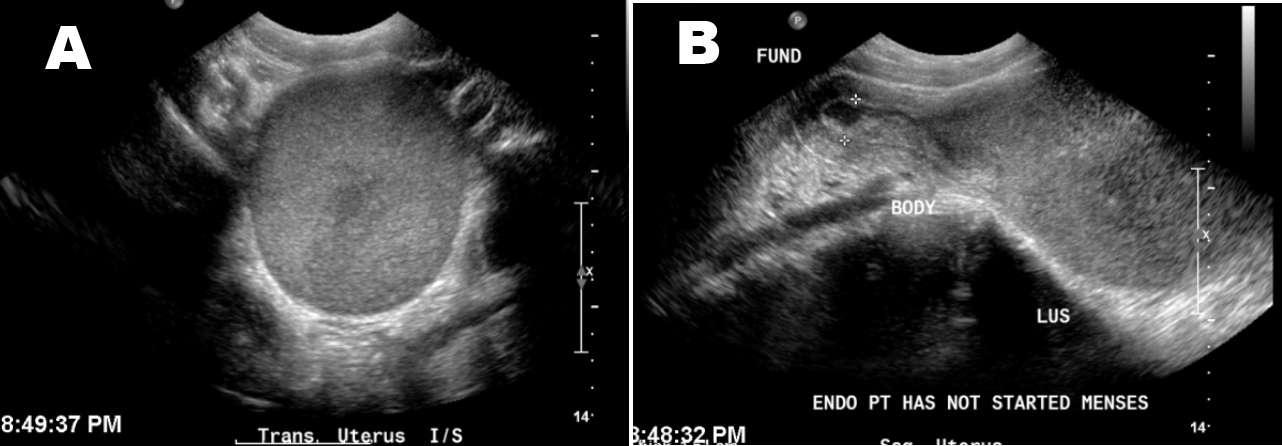
Case Report: An 11-year-old female child came to the emergency department complaining of abdominal pain for three days and oliguria with dysuria for the last 24 hours. Physical examination showed a palpable mass in lower abdomen up to umbilical level and a bulging mass in the introitus. A Foley catheter was inserted, draining 500 mL of urine with relief of the abdominal pain. After emptying the bladder, a residual mass was palpated. Renal ultrasound showed no abnormalities and pelvic ultrasound demonstrated a large homogeneous echogenic mass in the lower uterine region, diagnosed as hematocolpos. Further surgical hymenectomy resolved patient's symptoms. Conclusion: Acute urinary retention is relatively infrequent in children. Hematocolpos is a rare gynaecological abnormality that results from imperforate hymen. Retained blood in the vagina can cause compression of the urethra and consequent urinary retention. Hematometrocolpos is another rare cause of acute urinary retention. In the evaluation of a premenarchal adolescent with acute urinary retention and with tanner stage of development 3–4, a high index of suspicion should be placed towards finding an anomaly in the genital tract. | |
|
Keywords:
Urinary obstruction, Development, Tanner
| |
|
Introduction
| ||||||
|
Acute urinary retention (AUR) is a condition that requires timely evaluation and management in order to prevent damage to the kidneys and urinary tract. Although AUR in men due to benign prostatic hyperplasia is well known and recognized, but in women and especially in children, it is rare and has mostly been described as case reports. [1] [2] [3] | ||||||
|
Case Report
| ||||||
|
An 11-year-old female child, came to the emergency department (ED) complaining of abdominal pain for three days localized to suprapubic and periumbilical area, concomitant dysuria, dribbling and oligouria for the last 24 hours. The patient complained of tactile fever at home one day prior to ED visit, denied sexual activity and stated that she is premenarchal. On physical examination she was tanner stage 3 of development. A palpable mass was localized in the lower abdomen up to the umbilical level. In the costovertebral angle (CVA), a questionable tenderness was elicited. A bulging mass was observed in the introitus. A Foley catheter was inserted which drained 500 mL of urine with relief of abdominal pain. Beta human chorionic gonadotrophin (bHCG) was negative. Complete blood count and basic metabolic profile were within normal limits. Urinalysis showed no abnormalities and urine was sent for culture and sensitivity testing. After emptying the bladder, a residual mass was palpated two fingers above the pubic symphysis. A renal ultrasound showed no abnormalities. An abdominal pelvic ultrasound demonstrated a large homogeneous echogenic mass in the lower uterine segment and the cervix, (Figure 1A and 1B) most consistent with hematometrocolpos. The patient was admitted to the pediatric ward and a specialist in obstetrics and gynecology was consulted. The patient was taken to the operating room where a cruciate incision was performed with evacuation of 450 mL of old blood from vagina with subsequent hymenectomy. After the surgical procedure the abdominal pain resolved, the Foley catheter was removed and the patient was able to void freely. Urine culture follow-up was negative. | ||||||
| ||||||
|
Discussion
| ||||||
|
Acute urinary retention is relatively infrequent in children. There are a variety of causes that are poorly defined in literature and they differ greatly from those seen most frequently in adults. Among the main etiologies; neurological processes, severe voiding dysfunction, urinary tract infection, constipation, adverse drug effect, local inflammatory causes, locally invading neoplasms, benign obstructing lesions and idiopathic cases are included. [4] Menarche is associated more with developmental stages rather than chronological age. It usually occurs by tanner stage 4 of development, but it can be achieved in tanner stage 3, [5] as in our patient. Imperforate hymen is reported at an approximate rate of 0.1% and occurs due to the incomplete canalization of the Mullerian and the urogenital system. [6] Collection of blood in the vagina (hematocolpos) is a rare gynaecological abnormality that results from imperforate hymen. However, vaginal atresia or iatrogenic injury can also result in hematocolpos. [7] Retained blood in the vagina can cause compression of the urethra and urinary retention. [8] [9] It can also present as low back pain [10] or constipation. [11] In such cases thorough physical examination (sometimes difficult in this particular age group due to personal and cultural reasons) will suggest the diagnosis and an imaging test such as pelvic ultrasound or magnetic resonance imaging will be confirmatory. [12] | ||||||
|
Conclusion
| ||||||
|
Hematometrocolpos is a rare cause of acute urinary retention. In the evaluation of a premenarchal adolescent with acute urinary retention and tanner stage of development 3–4, a high index of suspicion should be placed towards finding an anomaly in the urogenital tract. | ||||||
|
References
| ||||||
| ||||||

|
[HTML Abstract]
[PDF Full Text]
|
|
Author Contributions
Alberto Mendoza-Paredes – Conception and design, Acquisition of data, Analysis and interpretation of data, Drafting the article, Critical revision of the article, Final approval of the version to be published Antonio Pierre – Final approval of the version to be published |
|
Guarantor of submission
The corresponding author is the guarantor of submission. |
|
Source of support
None |
|
Conflict of interest
Authors declare no conflict of interest. |
|
Copyright
© Alberto Mendoza-Paredes et al. 2013; This article is distributed the terms of Creative Commons Attribution License which permits unrestricted use, distribution and reproduction in any means provided the original authors and original publisher are properly credited. (Please see Copyright Policy for more information.) |
|
|