
  |

|
 |
|
Case Report
| ||||||
| Pneumoperitoneum is not always an indication for laparotomy: A case report | ||||||
| Oleg Ponomarenko1, Ohn Sibirsky1, Sergio Susmallian1 | ||||||
|
1Department of Surgery, Bikur Cholim Hospital, Jerusalem, Israel.
| ||||||
| ||||||
|
[HTML Abstract]
[PDF Full Text]
[Print This Article]
[Similar article in Pumed] [Similar article in Google Scholar] 
|


| How to cite this article: |
| Ponomarenko O, Sibirsky O, Susmallian S. Pneumoperitoneum is not always an indication for laparotomy: A case report. International Journal of Case Reports and Images 2012;3(10):39–42. |
|
Abstract
|
|
Introduction:
Pneumoperitoneum is a radiological term that is used to describe an abnormal collection of free gas in the peritoneal cavity but outside the viscera. In the majority of cases (>90%), it is a result of perforation of intra-abdominal viscus with serious consequences and it needs for emergency surgical management. Pneumoperitoneum reflex to the surgeons to proceed to an exploration. Laparotomy and general anesthesia are associated with significant morbidity, therefore it is important to recognize idiopathic spontaneous pneumoperitoneum and treat it appropriately.
Case Report: A case of 67-year-old male patient with a massive idiopathic spontaneous pneumoperitoneum that was operated without any cause of free air with a benign evolution during the postoperative period is reported. Conclusion: The absence of clear signs of peritonitis and sepsis allow the possibility to perform more studies as computed tomography scan and not to follow the suggestion of 'any pneumoperitoneum require exploration'. Correct management of those cases can be treated conservatively avoiding unnecessary operations. | |
|
Key Words:
Pneumoperitoneum, Pneumatosis, Laparotomy
| |
|
Introduction
| ||||||
|
Pneumoperitoneum is a radiological term that is used to describe an abnormal collection of free gas in the peritoneal cavity but outside the hollow viscera. In the majority of cases (>90%), it is a result of perforation of intra-abdominal viscous with serious consequences and it needs for emergency surgical management. [1] Pneumoperitoneum reflex to the surgeons to proceed to an exploration. Laparotomy and general anesthesia are associated with significant morbidity, therefore it is important to recognize idiopathic spontaneous pneumoperitoneum and treat it appropriately. We present a case of a patient with bloody stool and abdominal distention with radiological pneumoperitoneum. | ||||||
|
Case Report
| ||||||
|
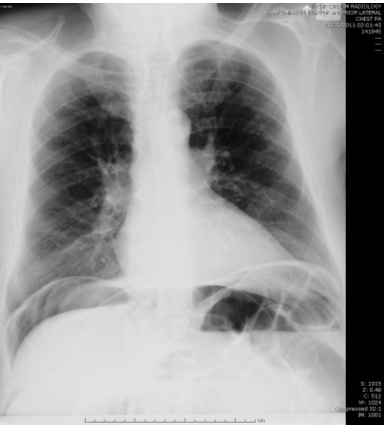
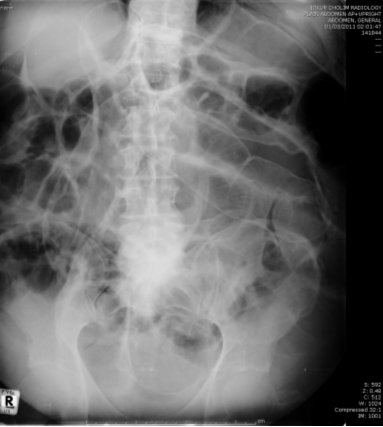
A 67-year-old male with a history of umbilical hernia and underlay mesh repair twenty years ago, without any medicamentation, presented to the emergency department with complains on single fresh bloody stool passing and increasing abdominal distension for the last day. It was a first episode in his life. From anamnesis was known about mild constipation without weight loss history. There were no associated gastrointestinal or systemic symptoms. The patient was hemodynamically stable. Respiratory rate 16/min. On physical examination his abdomen was markedly distended, tympanic to percussion but not tender and without any peritoneal signs. The surgical scar from umbilical hernia repair was normal without signs of recurrence and without tenderness. A left inguinal hernia was found without sings of incarceration. Plain radiographs of the chest (Figure 1) and abdomen (Figure 2) revealed a large pneumoperitoneum with small bowel and colon distention. Blood count, biochemical screening and blood gas analyses were within normal limits. Rectoscopy was subsequently performed and this also showed normal mucosal pattern. He was admitted to the hospital. An exploratory laparotomy was performed with large quantities of entirely odorless gas rushed out of the abdomen, all the peritoneal cavity and retroperitoneum was minousciously checked. There was no evidence of perforation or fluids. We found distention of small and large bowel looked like non-mechanical paralytic ileus. During the exploration, we found mild sigmoid diverticulosis and gallbladder stone without any signs of inflammation. The computed tomography scan was performed on the second day after operation and it showed small amount of free gas and fluid, distention of small bowel without signs of leakage of contrast and no inflammation. The patient was managed of broad-spectrum intravenous antibiotics and intravenous hydration with pain killer. On the third day after operation, the patient was started to pass gases and on the fourth day, he passed diarrhea bowel movement. The patient took a regular diet and was discharged on the sixth day after operation. | ||||||
| ||||||
| ||||||
|
Discussion
| ||||||
|
The first mention of pneumoperitoneum in literature was by Kelling [2] in 1902 who suggested its induction for diagnostic purposes. Popper in August 1915 first called attention to the possibility of pneumoperitoneum in ruptured peptic ulcer. [3] Vaughan and Brams demonstrated the presents of subphrenic free gas in 26 of 29 cases of acute perforation of peptic ulcer. [4] Although perforated colon or small bowel may also present with pneumoperitoneum. Pneumoperitoneum without evidence of visceral perforation has been reported in 5% to 14% of all occurrences. [5] In April 1915, Weiland had found a similar sign in a patient with perforated ulcer, but necropsy showed that this radiolucent zone above the liver was due to the presence of transverse colon in the zone. [6] An alternative radiological sign suggesting intraperitoneal free gas was described by Rigler in 1941, as the ability to visualize the outer as well as the inner wall of the bowel on plan X-ray in the supine position. [7] About 10% of all cases of pneumoperitoneum are caused by physiologic processes that do not require surgical management. Chandler et al. were the first to doubt on the relevance of this sign when they reported 11 of 29 patients having pneumoperitoneum in the absence of peritonitis. [8] Hinkel in 1940 reported a case of spontaneous pneumoperitoneum without peritonitis, demonstrable visceral perforation or exogenous origin. [9] Since then there have been sporadic reports in literature highlighting various non- surgical conditions which predispose to spontaneous pneumoperitoneum, where laparotomy is unnecessary. There is some kind of classification of non-surgical causes of spontaneous pneumoperitoneum as thoracic causes of non-surgical pneumoperitoneum, abdominal causes, gynecological causes and miscellaneous causes that includes use of cocain, dental extraction, diving with decompression, scleroderma and idiopatic. [10] But almost all of them have any sources like some disease or manipulation. Occasionally, as in this case, the diagnosis was never established and one may only speculate as to the underlying etiology. The most common abdominal cause of non-surgical spontaneous pneumoperitoneum is pneumatosis cystoides intestinalis, also referred as lymphomatosis or enteromesenteric emphysema. [11] John Hunter first recognized this condition and contributed two specimens from hog intestine to the museum of the Royal College of Surgeons that demonstrated multiple gas-filled cysts beneath the serosal layer, the first pathologic description is attributed to DuVernoi from a cadaver dissection in 1730. [12] Pneumatosis cystoides intestinalis is characterized by multiple intramural gas-filled cysts that may be throughout the gastrointestinal tract but are most commonly found at the terminal ileum. The condition is generally benign and asymptomatic. It is generally considered to be a primary idiopathic phenomenon or secondary to another clinical condition such as chronic obstructive pulmonary disease, connective tissue disease, asthma, inflammatory bowel disease and intestinal obstruction. Of 213 cases reviewed, Koss found that 85% were secondary to other underlying causes. [13] Theories of etiology include a mechanical theory in which air originates from the chest and reaches the abdomen via a perivascular plane, supporting the association with chronic obstructive airways disease, [14] a bacterial theory in which gas-producing organisms are thought to penetrate the intestinal mucosa producing cysts, an inflammatory process, and several others. Rarely, spontaneous pneumoperitoneum is reported following tracheostomy, adenotonsillectomy, dental extraction, aerophagia, scleroderma, amyloidosis and in cocaine addicts. [15] When the cysts rupture, a pneumoperitoneum may be produced with a spectrum of symptoms ranging from asymptomatic to acute abdominal pain. The condition generally resolved spontaneously but may be indolent and recurrent. Treatment with hyperbaric oxygen and antibiotics has demonstrated some efficacy in reducing long-term symptoms from this disease. [16] | ||||||
|
Conclusion
| ||||||
|
Spontaneous or non-surgical pneumoperitoneum is an uncommon pathology but it is important to identify patients with this condition from among the larger group with intraperitoneal free gas and prevent unnecessary laparotomy. Generally, most of the patients with pneumoperitoneum have peritonitis and require immediate abdominal exploration and treatment. The absence of clear signs of peritonitis and sepsis allow the possibility to perform more studies as computed tomography scan and not to follow the suggestion of 'any pneumoperitoneum require exploration'. | ||||||
|
References
| ||||||
| ||||||

|
[HTML Abstract]
[PDF Full Text]
|
|
Author Contributions:
Oleg Ponomarenko – Substantial contributions to conception and design, Acquisition of data, Analysis and interpretation of data, Drafting the article, Revising it critically for important intellectual content, Final approval of the version to be published Ohn Sibirsky – Substantial contributions to conception and design, Acquisition of data, Analysis and interpretation of data, Drafting the article, Revising it critically for important intellectual content, Final approval of the version to be published Sergio Susmallian – Substantial contributions to conception and design, Acquisition of data, Analysis and interpretation of data, Drafting the article, Revising it critically for important intellectual content, Final approval of the version to be published |
|
Guarantor of submission:
The corresponding author is the guarantor of submission. |
|
Source of support:
None |
|
Conflict of interest:
Authors declare no conflict of interest. |
|
Copyright:
© Oleg Ponomarenko et al. 2012; This article is distributed the terms of Creative Commons Attribution License which permits unrestricted use, distribution and reproduction in any means provided the original authors and original publisher are properly credited. (Please see Copyright Policy for more information.) |
|
|