|
|
|
|
Case Report
| ||||||
| Giant cellular neurilemmoma, a rare mesenchymal tumor of the oesophagus: A case report | ||||||
| Mitali Singhal1, Vatsala Misra1, Vishal Dhingra1, Sri Prakash Misra2 | ||||||
|
1Department of Pathology, Moti Lal Nehru Medical College, Allahabad, India.
2Departments of, Gastroenterology, Moti Lal Nehru Medical College, Allahabad, India. | ||||||
| ||||||
|
[HTML Abstract]
[PDF Full Text]
[Print This Article]
[Similar article in Pumed] [Similar article in Google Scholar] 
|
| How to cite this article: |
| Singhal M, Misra V, Dhingra V, Misra SP. Giant cellular neurilemmoma, a rare mesenchymal tumor of the oesophagus: A case report with review of literature. International Journal of Case Reports and Images 2012;3(10):35–38. |
|
Abstract
|
|
Introduction:
Gastrointestinal schwannomas are classified as mesenchymal or neuroectodermal neoplasms. Most common site is stomach followed by rectum. Schwannoma of oesophagus is very rare. It can present with dysphagia and odynophagia.
Case Report: A 30-year-old female was presented with progressive dysphagia, mild odynophagia, retrosternal heartburn and vomiting for last six months. On radiological investigations a rounded radio opaque shadow in right paratracheal region was seen. Endoscopy showed ulcerated mucosa that bled on touch. Lumen was narrowed. Endoscopic biopsy showed only mild dysplasia in squamous epithelial lining. Segmental oesophagectomy was done to remove the mass. On gross examination an already cut open segment of oesophagus of about 6 cm in length was received. An irregular, lobulated, firm, grey white growth, of 7x5x8.5 cm, having smooth external surface was observed towards serosal surface. Cut surface was homogenous white. Histology showed monomorphic spindle shaped cells arranged in fascicular and whorled pattern with nuclear palisading at places. Peri tumoral lymphoid aggregates were also seen. Conclusion: Oesophageal schwannomas are benign tumors having excellent prognosis following surgical resection. A case of oesophageal schwannoma is documented here. | |
|
Key Words:
Oesophagus, Schwannomas
| |
|
Introduction
|
|
Schwannoma or neurilemmoma is a benign tumor of the peripheral nerves. Most common sites are flexor aspects of extremities, neck, mediastinum, retroperitoneum, posterior spinal roots and cerebellopontine angle. Schwannomas of the gastrointestinal tract are rare and distinctively different neoplasms from conventional schwannomas that arise in soft tissue or the central nervous system. [1] Gastrointestinal schwannomas occur most commonly in the stomach (60–70% of cases), followed by the colon and rectum. [2] [3] [4] [5] Esophageal and small-intestinal schwannomas have been rarely reported. [2] [3] [4] The most common mesenchymal tumor occurring in oesophagus is leiomyoma. [6] Oesophageal schwannoma is a rare and different neoplasm from conventional schwannomas arising in soft tissue or the central nervous system. Peak incidence is in the third and fourth decade of life. These are more common in females as compared to males. Oesophageal schwannoma like other gastrointestinal schwannomas show distinctive histological features that separate them from conventional schwannomas. On microscopic examination, Oesophageal schwannomas show spindle cells with a microtrabecular pattern, peripheral lymphoid cuffing with occasional germinal centers. Cells show S-100 positivity. [1] [2] [3] They do not show nuclear palisading that is usually present in conventional schwannomas. Gastrointestinal schwannomas lack neurofibromatosis-2 genetic alterations supporting the theory that gastrointestinal schwannomas are unique tumors that are distinct from conventional schwannomas. [7] To date about 30 cases of oesophageal schwannoma have been documented in literature. [8] [9] [10] [11] [12] [13] [14] [15] A case of oesophageal schwannoma is documented here due to its rarity and unusual presentation. |
|
Case Report
|
|
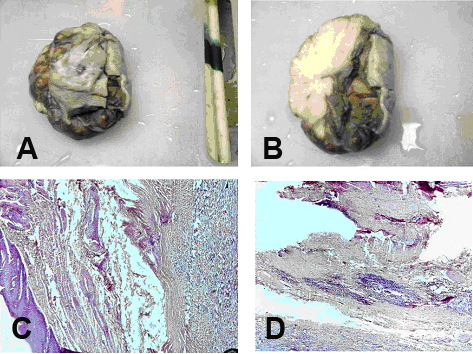
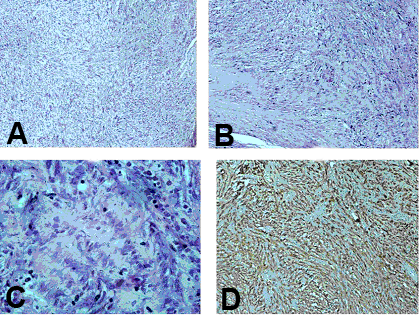
A 30-year-old female was presented with progressive dysphagia, mild odynophagia, retrosternal heartburn and vomiting for last six months. On radiological investigations, a round radio opaque shadow in the right paratracheal region was seen. CT scan revealed a large (7x5x8.5 cm) lobulated homogenous mildly enhancing soft tissue mass in tracheoesophageal groove extending in right paratracheal and subcarinal region. Endoscopy showed ulcerated mucosa which bled on touch. Lumen was narrowed. Endoscopic biopsy showed only mild dysplasia in squamous epithelial lining. Segmental oesophagectomy was done to remove the mass. On gross examination an already cut open segment of oesophagus of about 6 cm in length was received (Figure 1A). An irregular, lobulated, firm, grey white growth, of 7x5x8.5 cm, having smooth external surface was observed towards serosal surface. Cut surface was homogenous white (Figure 1B). Multiple sections were processed and showed variable picture on histopathological examination. Sections processed from mucosal surface showed hyperplastic stratified squamous epithelial lining underneath which areas of hemorrhage and fibrocollagenous tissue were seen (Figure 1C). Fibrocollagenous tissue was compressed and surrounded by lymphocytes and plasma cells extending into the underlying mass (Figure 1D). Sections from tumor area showed monomorphic spindle shaped cells surrounded by fibrocollagenous tissue. Cells were arranged in fascicular and whorled pattern. Cells had poorly defined eosinophilic cytoplasm and pointed basophilic nuclei with nuclear palisading at places (Figure 2A–C). Some of them showed large wavy nuclei. Occasional mitotic figures were seen. Thickened blood vessels and perivascular hyalinization was present along with moderate amount of inflammatory infiltrate mainly (lymphocytes and plasma cells). Peritumoral lymphoid aggregates were also seen. Immunohistochemistry for S-100, Desmin and CD 117 was done. Tumor was strongly positive for S-100 (Figure 2D) and negative for CD 117 and desmin. |
|
|
|
|
|
Discussion
|
|
Oesophageal schwannomas are benign tumors having excellent prognosis following surgical resection. Benign tumors of oesophagus are more common in men than women in the oesophagus most common soft tissue tumors are leiomyomas. [6] [16] Others are leiomyosarcomas and GIST. It is difficult to distinguish schwannoma from leiomyoma, and GIST. So preoperative diagnosis is difficult and can be confirmed only by histopathological and immunohistological examination. Oesophageal schwannomas like other gastrointestinal schwannomas are not encapsulated, a feature that distinguishes them from schwannomas in peripheral nervous system. On histopathological examination, these schwannomas have a lymphoid cuff with germinal centre. They are composed of interlacing bundles of spindle cells which show only loose palisading. They may resemble GISTs but the presence of lymphoid cuff helped in diagnosing it as schwannomas in this case. The tumor cells of oesophageal schwannoma are positive for S-100 protein and negative for smooth muscle markers, such as actin and desmin, which are positive in myogenic tumors. Oesophageal schwannoma tumor cells are also negative for CD34 and CD117, which are positive in GIST. [1] [4] In present case, mass showed spindle shaped cells having wavy nuclei, arranged in fascicular and whorled pattern with evidence of nuclear palisading at places. Peritumoral lymphoid aggregates were also seen suggesting a diagnosis of Schwannomas. No significant difference in oesophageal schwannoma and other gastrointestinal schwannomas has been documented in literature. Leiomyomas are benign tumour showing perpendicularly oriented fascicles of brightly eosinophilic spindle cells with blunt ended cigar shaped nuclei and sometimes Para nuclear vacuole. [16] They are positive for desmin, smooth muscle actin, calponin and caldesmon. Gastrointestinal stromal tumors show differentiation along interstitial cells of Cajal and CD117/ c-kit positivity on immunohistochemistry. They may behave in benign and malignant fashion. On microscopic examination, they are spindle cell or epithelioid type, sometimes with skeinoid fibers in stroma. [17] Though oesophageal schwannomas can be treated by enucleation, [18] Partial oesophagectomy has been used to treat Large benign schwannomas. [19] |
|
Conclusion
|
|
Oesophgeal schwannomas are benign tumors having excellent prognosis following surgical resection. A case is documented here due to its rarity and unusual presentation. |
|
References
|
|
|
[HTML Abstract]
[PDF Full Text]
|
|
Author Contributions:
Mitali Singhal – Acquisition of data, Analysis and interpretation of data, Drafting the article, Final approval of the version to be published Vatsala Misra – Analysis and interpretation of data, Revising it critically, Final approval of the version to be published Vishal Dhingra – Acquisition of data, Analysis and interpretation of data, Drafting the article, Final approval of the version to be published Sri Prakash Misra – Acquisition of data, Revising it critically for important intellectual content, Final approval of the version to be published |
|
Guarantor of submission:
The corresponding author is the guarantor of submission. |
|
Source of support:
None |
|
Conflict of interest:
Authors declare no conflict of interest. |
|
Copyright:
© Mitali Singhal et al. 2012; This article is distributed the terms of Creative Commons Attribution License which permits unrestricted use, distribution and reproduction in any means provided the original authors and original publisher are properly credited. (Please see Copyright Policy for more information.) |
|
|