
  |

|
 |
|
Case Series
| ||||||
| Heterotopic pregnancy in spontaneous conception: Report of three cases and review of literature | ||||||
| Zied Khediri1, Chaouki Mbarki2, Anis Ben Abdelaziz3, Najeh Hsayoui1, Mezghenni S4 Hedhili Oueslati5 | ||||||
|
1Resident in Gynecology & Obstetrics, Department of Gynecology & Obstetrics, Hospital of Ben Arous, Tunisia.
2Assistant Professor in Gynecology & Obstetrics, Department of Gynecology & Obstetrics, Hospital of Ben Arous, Tunisia. 3Resident in Gynecology & Obstetrics, Department of Gynecology & Obstetrics, Hospital of Ben Arous, Tunisia. 4Professor in Radiology, Department of Radiology, Hospital of Ben Arous, Tunisia. 5Professor in Gynecology & Obstetrics, Department of Gynecology & Obstetrics, Hospital of Ben Arous, Tunisia. | ||||||
| ||||||
|
[HTML Abstract]
[PDF Full Text]
[Print This Article]
[Similar article in Pumed] [Similar article in Google Scholar] 
|


| How to cite this article: |
| Khediri Z, Mbarki C, Abdelaziz AB, Hsayaoui N, Mezghenni S, Oueslati H. Heterotopic pregnancy in spontaneous conception: Report of three cases and review of literature. International Journal of Case Reports and Images 2012;3(10):8–11. |
|
Abstract
|
|
Introduction:
Heterotopic pregnancy is an uncommon clinical condition in which intrauterine and ectopic pregnancies occur at the same time.
Case Report: We report three cases of heterotopic pregnancy in a natural conception that had different clinical presentation and surgical management. Conclusion: Although heterotopic pregnancy is a rare event in spontaneous conception, physicians must always keep in mind that confirming an intrauterine pregnancy does not exclude the coexistence of an ectopic pregnancy especially in women presenting a pelvic pain. | |
|
Key Words:
Heterotopic, Ectopic pregnancy, Spontaneous conception
| |
|
Introduction
| ||||||
|
Heterotopic pregnancy is diagnosed in the presence of simultaneous gestations at two or more implantation sites. It is commonly used to define a rare clinical condition in which intrauterine and ectopic pregnancies occur at the same time. It was first reported in the year 1708 as an autopsy finding. Its occurrence is rare in spontaneous conception with an incidence of 1:30,000, [1] and is much higher with assisted reproductive techniques (ART). The diagnosis can be easily missed, leading to life-threatening complications. We report three cases of heterotopic pregnancy in a natural conception. | ||||||
|
Case Series
| ||||||
|
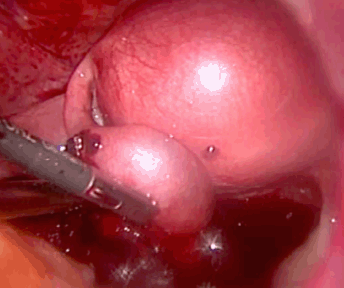
Case 1: A 34-year-old primigravid woman was brought to our emergency room in the gynecology and obstetrics department, with a history of an acute pain in her abdomen, with nausea and vomiting for six hours. She was six weeks pregnant. It was a spontaneous conception and there was no past history of abortion, infertility, pelvic inflammatory disease or any history of abdominal surgery. The patient had never had contraception. The patient knew she was in a gravid state, has already consulted a midwife, and has had obstetrical ultrasonography that had shown an intrauterine pregnancy one week earlier. On examination, she was pale with a pulse rate of 145 per minute and blood pressure of 80/40 mmHg. Abdominal examination revealed diffuse lower abdominal tenderness. Pelvic examination revealed an enlarged uterus corresponding to seven weeks of pregnancy, with no bleeding. Laboratory investigations showed an anemia with a 6.3 g/dL hemoglobin level. HCG dosage was positive. Despite an initial resuscitation with intravenous colloids, the patient had instable hemodynamics. She has been directly conducted to undergo an emergency exploration laparotomy. The laparotomy revealed a seven weeks gravid uterus and rupture of the left tube at its isthmic level and the presence of approximately 2.5 liters of hemoperitoneum. Left salpingectomy with removal of the hemoperitoneum and peritoneal lavage was performed. Dilatation and curettage (D&C) has immediately followed the laparotomy, which brought normal trophobast that has been addressed to histological examination. The patient was transfused with two units of blood during the surgery and her postoperative period was uneventful. Pathology of the resected specimen confirmed the ruptured tubal pregnancy. Histology of the D&C product showed the presence of regressive chorionic villi confirming an intrauterine miscarriage. The patient was discharged on the fourth postoperatory day. Follow-up was uneventful. Case 2: A 29-year-old woman, who had a history of infertility for two years that has not been explored, consulted in our emergency for acute pelvic pain. She had eight weeks of amenorrhea. Physical examination found lower abdominal tenderness, with enlarged uterus corresponding to eight weeks of pregnancy, with no bleeding. Hemodynamics was stable. Ultrasonography found an intrauterine seven weeks ongoing pregnancy, and a left latero-uterine heterogeneous mass, with an extra-uterine embryo and positive cardiac activity. Routine laboratory tests were normal. Diagnosis of heterotopic pregnancy was confirmed and the patient underwent urgent exploratory laparoscopy. Laparoscopy confirmed the left tubal pregnancy, and found 200 mL of hemoperitoneum (Figure 1). The patient had left salpingectomy and we have decided to preserve the intrauterine pregnancy. Postoperatory period was uneventful, and patient was discharged under progesterone tocolysis. The intrauterine pregnancy was monthly followed-up in our department until delivery on term by vaginal delivery. | ||||||
| ||||||
|
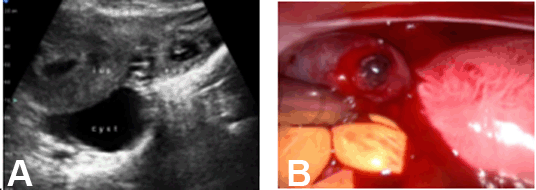
Case 3: A 32-year-old woman, with a past history of late miscarriage, has consulted the emergency room for moderate pelvic pain with seven weeks of amenorrhea. Physical examination was normal. Ultrasound examination found an intrauterine ongoing pregnancy of seven weeks, with a non-complicated ovarian cyst of 5 cm. The patient was discharged home with symptomatic treatment. The patient consulted the emergency department again after two days, with persistent pelvic pain. Clinical examination found pelvic tenderness with stable hemodynamics. Ultrasound found the ongoing intrauterine pregnancy, the ovarian cyst, and discovered a ruptured left tubal pregnancy with an extrauterine embryo and positive cardiac activity (Figure 2A). Diagnosis of heterotopic pregnancy with ruptured tubal pregnancy was confirmed. The patient immediately underwent laparoscopic surgery. Laparoscopy found a ruptured tubal pregnancy and 400 mL of hemoperitoneum (Figure 2B). The patient had left salpingectomy. In postoperatory period, the patient had an ultrasound examination that checked the positive cardiac activity of the intrauterine pregnancy. Patient was discharged after three days under progesterone treatment. To date, the patient is 13 weeks pregnant and no complication occurred after surgery. | ||||||
|
| ||||||
|
Discussion
| ||||||
|
Heterotopic pregnancy is defined as the presence of multiple gestations, with one being present in the uterine cavity and the other outside the uterus. [2] [3] In natural conception cycles, heterotopic pregnancy is a rare event, It occurs in about 0.08% of all pregnancies. [4] With assisted reproduction techniques, however, this incidence increases to between 1/100 and 1/500, and occurs in 5% of pregnancies achieved after in vitro fertilization. [5] In our department, we have recorded three cases of confirmed heterotopic pregnancy that are hereby presented, in the period between 2005 and 2010, which corresponds to about 1/8000 pregnancies. Tal et al. [6] reported that 70% of the heterotopic pregnancies were diagnosed between five and eight weeks of gestation, 20% between nine and ten weeks and only 10% after the 11th week. Our cases were all diagnosed between six and eight weeks, which is the most common period of diagnosis. The early diagnosis of heterotopic pregnancy is often difficult because the clinical symptoms are lacking. Literature has reported the four most common circumstances of diagnosis, which are: abdominal pain, adnexal mass, peritoneal irritation and an enlarged uterus. [7] Our three patients have presented firstly an acute abdominal pain. Only one of them shortly followed by physical signs of peritoneal irritation then a hypovolemic shock. The recent advances in transvaginal sonography (TVS) helped in the early diagnosis of heterotopic pregnancy. However, the sensitivity of TVS in diagnosing heterotopic pregnancy is only 56% at 5–6 weeks. [8] In two of our cases, the patients have had a TVS examination prior to the rupture of the tubal pregnancy, which overlooked the diagnosis. After rupture, TVS was sufficient to confirm the diagnosis of heterotopic pregnancy, since two embryos with positive cardiac activity were found, one inside and one outside the uterine cavity. The identification of an intrauterine pregnancy can divert attention from the possibility of a concurrent ectopic pregnancy in the absence of any clinical sign of the ectopic pregnancy. In the case of an intrauterine pregnancy with acute abdominal pain, peritonism, hypotension shock or hematoperitoneum aspect in ultrasound, the possibility of a heterotopic pregnancy should be considered, despite that this condition is very rare in a natural cycle. After diagnosis, the ectopic component in case of rupture is always treated surgically and the intrauterine pregnancy is expected to continue normally. In two of our cases, intrauterine pregnancy continued normally after surgery. Usual management is a laparoscopic salpingectomy. In case the ectopic pregnancy was unruptured, treatment options include conservative management with aspiration and installation of potassium chloride or prostaglandin into the gestational sac with conservation of the ongoing intrauterine pregnancy. [9] The laparoscopic approach is technically feasible for both cases without disrupting the course of an IU pregnancy. Laparotomy is only chosen when the patient is in hypovolemic shock, and has instable hemodynamics despite resuscitation. Systemic methotrexate (MTX) or local injection of MTX cannot be used in a heterotopic pregnancy because of its toxicity for the intrauterine ongoing pregnancy. [10] In one of our cases, the patient had a laparotomy because she had a hypovolemic shock, and had a radical treatment by salpingectomy, followed by a D&C because she had a simultaneous intrauterine pregnancy arrest. In the two other cases, however, laparoscopy permitted the radical treatment of the ectopic pregnancy by salpingectomy, with the preservation of the ongoing intrauterine pregnancy. | ||||||
|
Conclusion
| ||||||
|
In natural conception cycles, heterotopic pregnancy is a rare event. Physicians must always keep in mind that confirming an intrauterine pregnancy clinically or by ultrasound does not exclude the coexistence of an ectopic pregnancy that should systematically be suspected in any woman presenting abdominal pain, genital bleeding and/or hypovolemic shock during pregnancy. Laparoscopic approach should always be preferred, and treatment should preserve the intrauterine ongoing pregnancy. | ||||||
|
References
| ||||||
| ||||||

|
[HTML Abstract]
[PDF Full Text]
|
|
Author Contributions:
Zied Khediri – Substantial contributions to conception and design, Acquisition of data, Drafting the article, Revising it critically for important intellectual content, Final approval of the version to be published Chaouki Mbarki – Substantial contributions to conception and design, Acquisition of data, Drafting the article, Revising it critically for important intellectual content, Final approval of the version to be published Anis Ben Abdelaziz – Substantial contributions to conception and design, Acquisition of data, Drafting the article, Revising it critically for important intellectual content, Final approval of the version to be published Najeh Hsayoui – Substantial contributions to conception and design, Acquisition of data, Drafting the article, Revising it critically for important intellectual content, Final approval of the version to be published Mezghenni S – Substantial contributions to conception and design, Acquisition of data, Drafting the article, Revising it critically for important intellectual content, Final approval of the version to be published Hedhili Oueslati – Substantial contributions to conception and design, Acquisition of data, Drafting the article, Revising it critically for important intellectual content, Final approval of the version to be published |
|
Guarantor of submission:
The corresponding author is the guarantor of submission. |
|
Source of support:
None |
|
Conflict of interest:
Authors declare no conflict of interest. |
|
Copyright:
© Zied Khediri et al. 2012; This article is distributed the terms of Creative Commons Attribution License which permits unrestricted use, distribution and reproduction in any means provided the original authors and original publisher are properly credited. (Please see Copyright Policy for more information.) |
|
|