
  |

|
 |
|
Case Report
| ||||||
| Application of diode laser for excision of non-inflammatory vascular epulis fissuratum | ||||||
| Amit A Agrawal1, Mahendra Mahajan2, Aarti Mahajan3, Swagat Devhare4 | ||||||
|
1Department of Periodontics, KBH-MGV Dental College and Hospital, Panchvati, Mumbai-Agra road, Nashik, Maharashtra, India.
2Department of Oral Pathology and Microbiology, Dasmesh Institute of Research and Dental Sciences, Faridkot, Punjab, India. 3Department of Oral Pathology and Microbiology, KBH-MGV Dental College and Hospital, Panchvati, Mumbai-Agra road, Nashik, Maharashtra, India. 4Gangapur road, Nashik, Maharashtra, India. | ||||||
| ||||||
|
[HTML Abstract]
[PDF Full Text]
[Print This Article]
[Similar article in Pumed] [Similar article in Google Scholar] 
|


| How to cite this article: |
| Agarwal AA, Mahajan M, Mahajan A, Devhare S. Application of diode laser for excision of non-inflammatory vascular epulis fissuratum. International Journal of Case Reports and Images 2012;3(9):42–45. |
|
Abstract
|
|
Introduction:
Epulis fissuratum is essentially one of overgrowth of fibrous tissue from vestibular mucosa, that most commonly develops when a full denture or partial denture flange begins to impinge/irritate on the tissues in this area. It must be surgically removed with scalpel, electrosurgery or lasers. As a component of the treatment, the denture must usually be re-made or substantially adjusted to prevent recurrence.
Case Report: A fold of fibrous tissue in the anterior left segment of maxillary alveolar ridge with its base in vestibule, in a 65-year-old male patient, was excised using a diode laser. Follow-up was done after 15 days and 1 month and a new complete denture was fabricated for the patient. Conclusion: Based on the results obtained, it can be concluded that, diode laser is an excellent tool for surgical excision of fibrous overgrowths. It also helps in clean field with good vision, less postoperative bleeding or discomfort. Early recovery is an added advantage, since the patient can be delivered denture early and they can resume their regular activities in lesser time. | |
|
Key Words:
Epulis fissuratum, Denture induced fibrous hyperplasia, Granuloma fissuratum
| |
|
Introduction | ||||||
|
Epulis fissuratum refers to the tissue growth into the oral cavity, located over the alveolar ridges but originating from the soft tissues of the vestibular sulcus. The term itself is old fashioned, but it is so ingrained in literature that we continue to apply it. The condition is essentially one of overgrowth of fibrous tissue that most commonly develops when a full denture or partial denture flange begins to impinge on the tissues in this area. The treatment involves elimination of the causing factors and surgical removal of the lesion, if required. In early stages, when fibrosis is minimal, nonsurgical treatment with a denture in combination with a soft liner is frequently sufficient for reduction or elimination of this tissue. If the causal factor persists, the tissue becomes more fibrous over time, and because this does not respond to nonsurgical treatment, excision is frequently required. The most common techniques are: surgical scalpel, electrical scalpel, carbon dioxide laser, Erbium: YAG laser, Neodymium: YAG laser, and diode laser. Diode laser is one of the best lasers as an alternative to the surgical scalpel on oral soft tissues. Conventional surgical procedures, such as removal of epulis fissuratum with a scalpel, cause bleeding and postoperative pain, and require sutures and sometimes tissue grafts. In contrast, with diode laser, a dry treatment area is provided, there is minimal pain after surgery, and no sutures are needed. This report presents a case of massive 'epulis fissuratum' lesion excised using diode laser. Follow-up was done after 15 days and 1 month and a new complete denture was fabricated for the patient. Unlike other reports in literature where CO2 laser was frequently used, this report further discuss the comparison of diode laser as against CO2 lasers and Nd:YAG lasers for management of similar lesions. | ||||||
|
Case Report
| ||||||
|
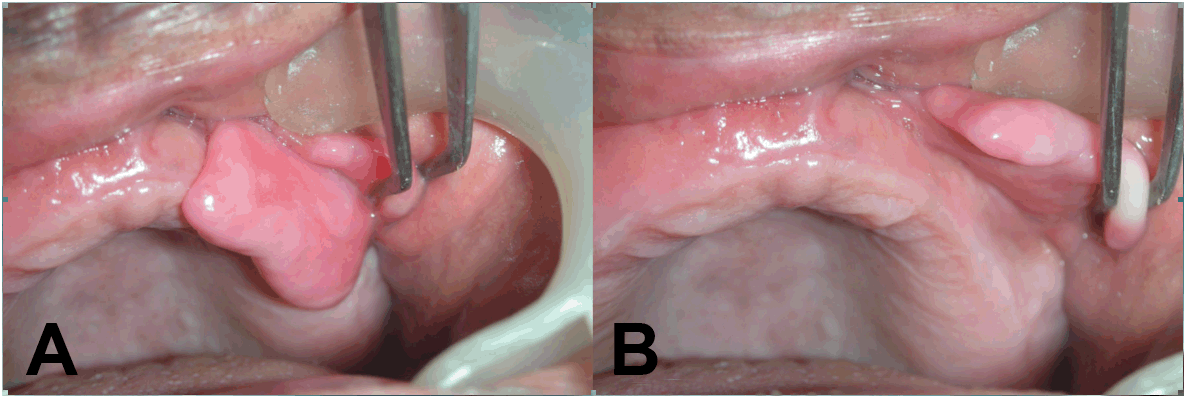
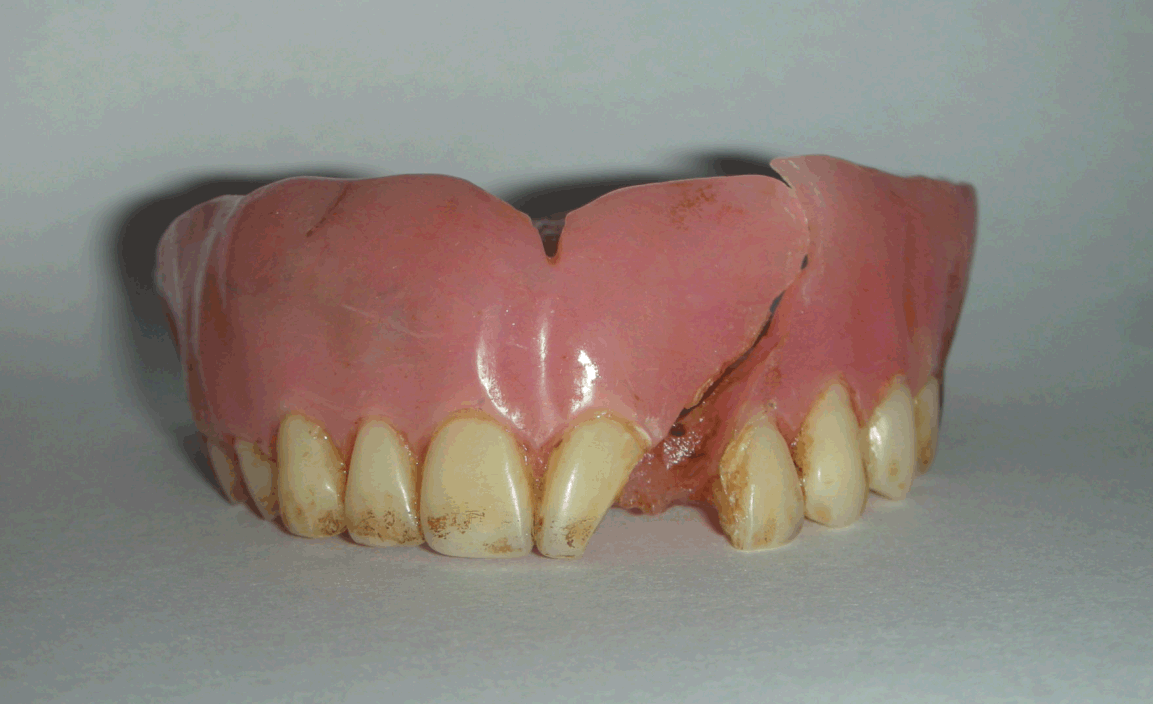
A 65-year-old edentulous male patient was referred with a complaint of enlarged mass covering the anterior left segment of maxillary alveolar ridge with its base in vestibule. The non-ulcerated mass in this region was split in center to form two folds. The superficial mass of the fold, towards the labial mucosa was smaller and was approximately 1x1.5x0.7 cm (Figure 1A). The deeper fold, towards the alveolar ridge, was larger and approximately 4x3x0.7 cm (Figure 1B). The color and surface texture of the mass was same as normal tissue. There was no history of any relevant systemic disease. Patient gave a history of using broken denture for last 6 months (Figure 2). Based on the clinical examination, examination of the broken denture and patient's history a diagnosis of 'epulis fissuratum' was made. Then, the patient was planned for excision of the lesion by diode laser followed by a new complete denture. The patient, assistant and the surgeon himself were protected with laser safety glasses and masks. Under aseptic condition adequate local anesthesia was achieved. The mass in left anterior segment was excised at its base in vestibule using diode laser (840 nm, 2W, pulsed mode). Excised mass was stored in formalin for histopathologic investigation. All tissue tags were removed so that postoperative surgical site is relatively even (Figure 3A). Patient was advised to apply vitamin E gel 2–3 times a day for two days, antibiotic and analgesics were prescribed for three days. Follow-up examination was planned after 15 days and after one month. Since satisfactory healing was achieved after 15 days (Figure 3B), clinical procedures for new complete denture were initiated at the same sitting. Follow up visit after six weeks showed excellent healing (Figure 3C) and patient was happily using the new denture (Figure 4). Histopathology Hematoxylin and eosin stained section showed underlying connective tissue composed of parallel bundles of collagen intermixed with plenty of dilated capillaries, some of which were large with intravasated RBCs filling the lumen of capillaries (Figure 5). In the deeper portions, aggregates of minor salivary glands which were mucous in nature and salivary ducts were also evident. Histopathologic features were suggestive of non-neoplastic, non-inflammatory vascular lesion. | ||||||
|
| ||||||
| ||||||
|
| ||||||
| ||||||
|
| ||||||
|
Discussion
| ||||||
|
Ill-fitting dentures are often used by the patients without any major complaints. Overtime some patients can even manage to use broken denture for years together. Only when some pathology like 'epulis fissuratum' arise then patients seeks attention of a dentist. Mere excision of the lesion without eliminating the causative factor would definitely result in recurrence. This fact should be made very clear to the patient before undertaking surgical excision. The term epulis, first used by Virchoff, that means over the gums, it is not appropriate to these lesions as the affected mucosa is oral mucosa of vestibular sulcus and not gingival mucosa. [1] In this view, some authors prefer to call these lesions denture-induced fibrous hyperplasia. [2] However, even if the appearance is 'fibrous' clinically, histologically it is more vascular than the typical fibroma. Hence the term fibrous hyperplasia cannot be applied to all lesions of so called epulis fissuratum. It has also been referred to as 'granuloma fissuratum', [3] however, this term was subsequently noted as misnomer, as the major histologic features included epidermal hyperplasia with fibrosis and chronic inflammation; with occasional notation of hyperkeratosis and parakeratosis. Since epulis fissuratum are frequently induced by irritation of broken or ill-fitting denture flange, they occur in vestibule, mostly in the anterior region of the upper or lower jaws and origin of the lesion is from vestibular mucosa. The most significant difference in histologic appearance of this lesion was the presence of multiple dilated blood vessels which was not reported in literature. Hence, instead of a histological basis for nomenclature, the clinical appearance and location of the lesion can be more generalized. In this view, term 'vestibulum fissuratum' would be more apt. 'Vestibulum' is the latin name for oral vestibule and 'fissuratum' means 'fissure', which by definition is a natural cleft in a substance of an organ or is a break or slit in tissue. Advantages of diode laser over conventional surgery includes convenient mucosa removal, excellent hemostasis with a bloodless field, high precision in tissue destruction, no need for sutures, bactericidal properties that minimize the possibility of infection and minimal postoperative pain and edema. Majority of case reports in the literature have used CO2 laser for excision of such lesions, [4] but advantage of using diode over CO2 laser is a matter of further debate. When compared with the CO2 lasers, Goharkhay et al. [5] found one characteristic difference from the diode laser, namely that no trend of greater damage to lateral tissues with the constant wave mode at higher power levels can be observed. They also found no charring of bone underlying 0.8 mm thick soft tissue, with continuous wave mode, or with the pulsed mode at an average power of 4.5 W. On the other hand, several authors have reported that the use of CO2 laser can result in possible damage to the underlying bone around teeth when cutting tissues with either pulsed or continuous wave CO2 lasers. [6] Contrary to other investigations, [7] deeper incisions could be achieved with the diode laser than were achieved by other authors with the CO2 or Nd:YAG laser at the same power setting, even with fewer movements of the delivery system. Even the horizontal and vertical zones of thermal damage are in comparable range. [5] When compared with Nd:YAG lasers, the radiation of a diode laser shows a greater absorption and a smaller penetration depth than that of a Nd:YAG laser, especially in blood-rich tissue. The wavelength of the diode laser is considerably more absorbed due to hemoglobin than that of the Nd:YAG laser. This causes not only a better incision performance but also an excellent coagulation of tissues. The thickness of the charring layer and the coagulation layer, and incision depth, are similar for the diode laser and the Nd:YAG laser with the same laser setting. [8] In the present case no hemorrhagic episodes or infection occurred during postoperative period. With lasers, a coagulum of denatured collagen on the surface is formed and with laser sterilization of wound, the acute inflammation reaction is delayed and minimal. Reduced pain can be attributed to the fact that the inflammatory reaction associated with laser application is reduced, since blood and lymphatic vessel sealing occurs, with prevention of the extravasation of fluids responsible for inflammation and pain. Moreover, laser irradiation cause sealing of the nerve endings in the surgical contact area and the denaturalized collagen layer formed on the surface of the surgical wound serves to isolate from the oral fluids. Pogrel [9] has reported a decrease in vestibular depth with conventional epulis fissuratum surgery when the wound is closed with sutures. In addition, laser wounds have been reported to contain fewer myofibroblasts, which are responsible for lesser wound contraction. [10] This can explain the excellent postoperative vestibular depth in the present case. | ||||||
|
Conclusion
| ||||||
|
Diode laser is an excellent tool for surgical excision of vestibulum fissuratum. It also helps in clean field with good vision, less postoperative bleeding or discomfort and lesser wound contraction. Early recovery is an added advantage with lasers; since the patient can be resume their regular activities with the new/altered prosthesis in comparatively less time than conventional surgery. | ||||||
|
References
| ||||||
| ||||||


|
[HTML Abstract]
[PDF Full Text]
|
|
Author Contributions:
Amit A Agrawal – Substantial contributions to conception and design, Acquisition of data, Analysis and interpretation of data, Drafting the article, Revising it critically for important intellectual content, Final approval of the version to be published Mahendra Mahajan – Substantial contributions to conception and design, Acquisition of data, Analysis and interpretation of data, Drafting the article, Revising it critically for important intellectual content, Final approval of the version to be published Aarti Mahajan – Substantial contributions to conception and design, Acquisition of data, Analysis and interpretation of data, Drafting the article, Revising it critically for important intellectual content, Final approval of the version to be published Swagat Devhare – Substantial contributions to conception and design, Acquisition of data, Analysis and interpretation of data, Drafting the article, Revising it critically for important intellectual content, Final approval of the version to be published |
|
Guarantor of submission:
The corresponding author is the guarantor of submission. |
|
Source of support:
None |
|
Conflict of interest:
Authors declare no conflict of interest. |
|
Copyright:
© Amit A Agrawal et al. 2012; This article is distributed the terms of Creative Commons Attribution License which permits unrestricted use, distribution and reproduction in any means provided the original authors and original publisher are properly credited. (Please see Copyright Policy for more information.) |
|
|