
  |

|
 |
|
Case Report
| ||||||
| Ameloblastomatous calcifying ghost cell odontogenic tumor: A case report | ||||||
| Monal Bhaurao Yuwanati1, Jagdish Vishnu Tupkari2, Shubhangi Mhaske3, Avadhoot Avadhani4 Pradnya Joshi5 | ||||||
|
1Assistant Professor, Oral Pathology, Peoples Dental Academy, Bhopal, Madhya Pradesh, India.
2M.D.S. (Oral Pathology), Professor and Head, Oral Pathology, Government Dental College and Hospital, Mumbai, Maharashtra, India. 3Professor and Head, Oral Pathology Peoples Dental Academy, Bhopal, Madhya Pradesh, India. 4Assistant Professor, M.D.S. (Oral Pathology), Government Dental College and Hospital, Mumbai, Maharashtra, India. 5M.D.S. (Oral Pathology), Post Graduate student, Oral pathology, Government Dental College and Hospital, Mumbai, Maharashtra, India. | ||||||
| ||||||
|
[HTML Abstract]
[PDF Full Text]
[Print This Article]
[Similar article in Pumed] [Similar article in Google Scholar] 
|


| How to cite this article: |
| Yuwanati MB, Tupkari JV, Mhaske S, Avadhani A, Joshi P. Ameloblastomatous calcifying ghost cell odontogenic tumor: A case report. International Journal of Case Reports and Images 2012;3(9):21–25. |
|
Abstract
|
|
Introduction:
Calcifying ghost cell odontogenic tumor (CGCOT) is an uncommon developmental odontogenic cyst first described by Gorlin et al. in 1962; represent a heterogeneous group of lesions that exhibit a variety of clinicopathologic and behavioral features.
Case Report: A 63-year-old female reported with a painless swelling in mandible for three months. After detailed clinical and histopathological examination, it was diagnosed as ameloblastomatous CGCOT (Type III) and operated. Conclusion: CGCOT (Type III) is considered to be rare and accounts for only 1% of jaw cysts reported. CGCOT has been classified under two basic groups namely, cystic and neoplastic. Because of its diverse histopathology, there has always been confusion about its nature as a cyst, neoplasm or hamartoma and its behavior. A very few cases of ameloblastomatous CGCOT (Type III) have been reported in literature. The proper surgical procedure is to be followed to minimize chances of recurrence. | |
|
Key Words:
Calcifying odontogenic cyst, Ameloblastomatous calcifying ghost cell odontogenic tumor (CGCOT), Calcifying ghost cell odontogenic tumor, Ghost cell
| |
|
Introduction | ||||||
|
The odontogenic cysts are group of lesions frequently observed in the head and neck regions. The odontogenic epithelium is involved in the formation of cysts in majority of the cases. A calcifying odontogenic cyst (COC) occurs occasionally in the oral region. [1] It was first described by Gorlin et al. and now included in the group of odontogenic tumors in a World Health Organization (WHO) international classification proposed in 1992, in which there is odontogenic epithelium with odontogenic ectomesenchyme with or without dental hard tissue formation. It is well known that this lesion often occurs in association with odontogenic tumors e.g., odontoma ameloblastoma and adenomatoid odontogenic tumor and all recent histopathological classifications of COCs advocate categorizing the variants associated with these tumors. Calcifying odontogenic cyst may clinically be diagnosed as calcifying epithelial odontogenic tumor, adenomatoid odontogenic tumor, unicystic ameloblastoma, ameloblastic fibro-odontoma, odontoma, dentigerous cyst or other odontogenic cysts. In a Recent WHO classification [2] [3] the term COC has been replaced by calcifying ghost cell odontogenic tumor (CGCOT). The association of ameloblastoma with this lesion is important as it will affect the clinical and treatment outcome. The CGCOT has been classified under two basic groups namely, cystic and neoplastic as per dualistic concept. According to Hong et al., [4] there is an ameloblastomatous variant of COC which is characterized by a unicystic structure. The epithelial lining shows unifocal or multifocal intraluminal proliferative activity that resembles ameloblastoma. Although it also contains isolated or clustered ghost cells and calcifications. Since it is associated with ameloblastomatous proliferation, there is a confusion regarding the nature, behavior as well as prognosis of this rare entity. The purpose of this paper is to describe a case of ameloblastomatous COC/CGCOC and to present a review of cases found in literature. | ||||||
|
Case Report
| ||||||
|
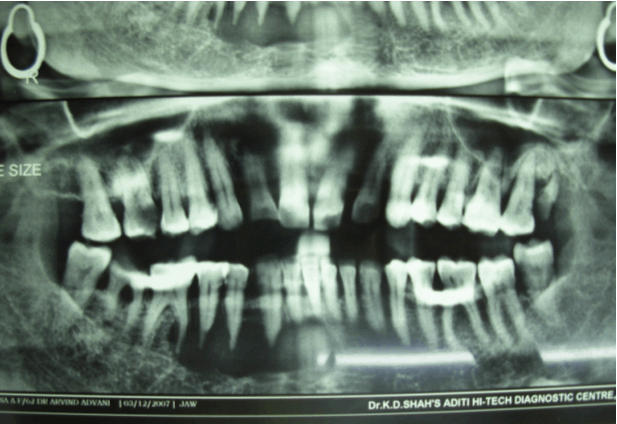
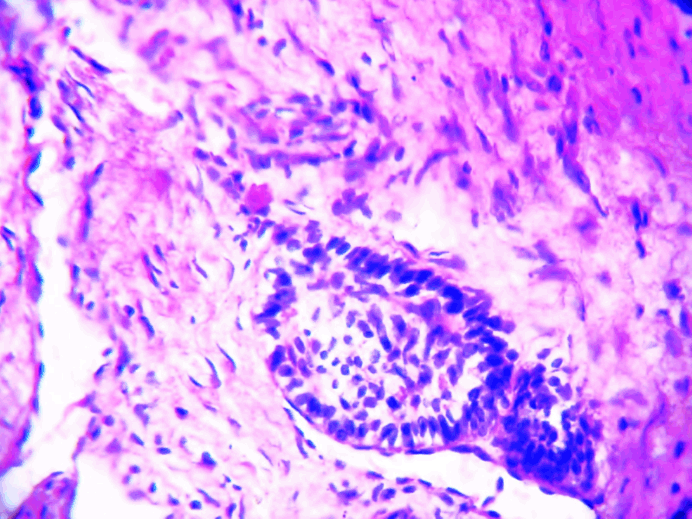
A 63-year-old female patient (Indian) was referred to the Department of Oral and Maxillofacial Pathology, Government Dental College and Hospital, Mumbai, Complaining of an asymptomatic swelling in the right anterior region of mandible that was present since approximately three months. The clinical examination revealed a painless, non-tender swelling over the right parasymphysis region of mandible along with slight facial asymmetry. The mucosa overlying the lesion was normal with expansion of both the cortical plates and showed obliteration of the labial vestibule (Figure 1). The Panoramic radiograph revealed a well-defined multilocular radiolucency from the lower left side central incisor to the right first molar (Figure 2). Calcifications was not clearly evident on radiograph. On aspiration a blood tinged fluid was seen. The clinical diagnosis of an odontogenic cyst was made and an incisional biopsy was obtained from the right parasymphysial area to establish a definitive diagnosis. The differential clinical diagnosis included muticystic ameloblastoma and odontogenic keratocyst. Microscopic examination revealed a cystic lesion lined by odontogenic epithelium with eosinophilic ghost cells (Figure 3) and calcification within the ghost cells. The stroma of the cyst also demonstrated ameloblastic islands, (Figure 4), sheets of eosinophilic ghost cells with areas of calcification (Figure 5). A histopathological diagnosis of ameloblastomatous COC/ CGCOT (Type III) was made. The patient was surgically operated for the lesion and healing was uneventful. Ten months of follow up showed no recurrence. | ||||||
| ||||||
| ||||||
| ||||||
| ||||||
| ||||||
|
Discussion
| ||||||
|
Calcifying odontogenic cysts though rare, are not uncommon in the jaw bones, due to the embryonic odontogenic epithelium or its remnants. The odontogenic cysts are either of developmental or inflammatory origin. The COC is an uncommon well circumscribed, either solid or cystic lesion derived from odontogenic epithelium that resembles follicular ameloblastoma but contains ghost cells and spherical calcification. Since the first description by Gorlin et al., sporadic cases of COCs have been reported in literature. From the time when it was first described in literature, it has become clear that COC has a number of variants, including features of a benign odontogenic tumor. The histologic variation of COC has led to different terminologies such as epithelial odontogenic ghost cell tumor, calcifying ghost cell odontogenic tumor, dentinogenic ghost cell tumor and odontogenic ghost cell tumor. The combined microscopic features of COC and ameloblastoma, merging from one to the other had been reported in the past. Hong et al. [4] described cases of ameloblastoma occurring in neoplastic variant of COC and suggested the two variety of COC associated with ameloblastoma–ameloblastomatous cystic and neoplastic variant with ameloblastoma. According to Hong et al, the cysts can occur as four variants:
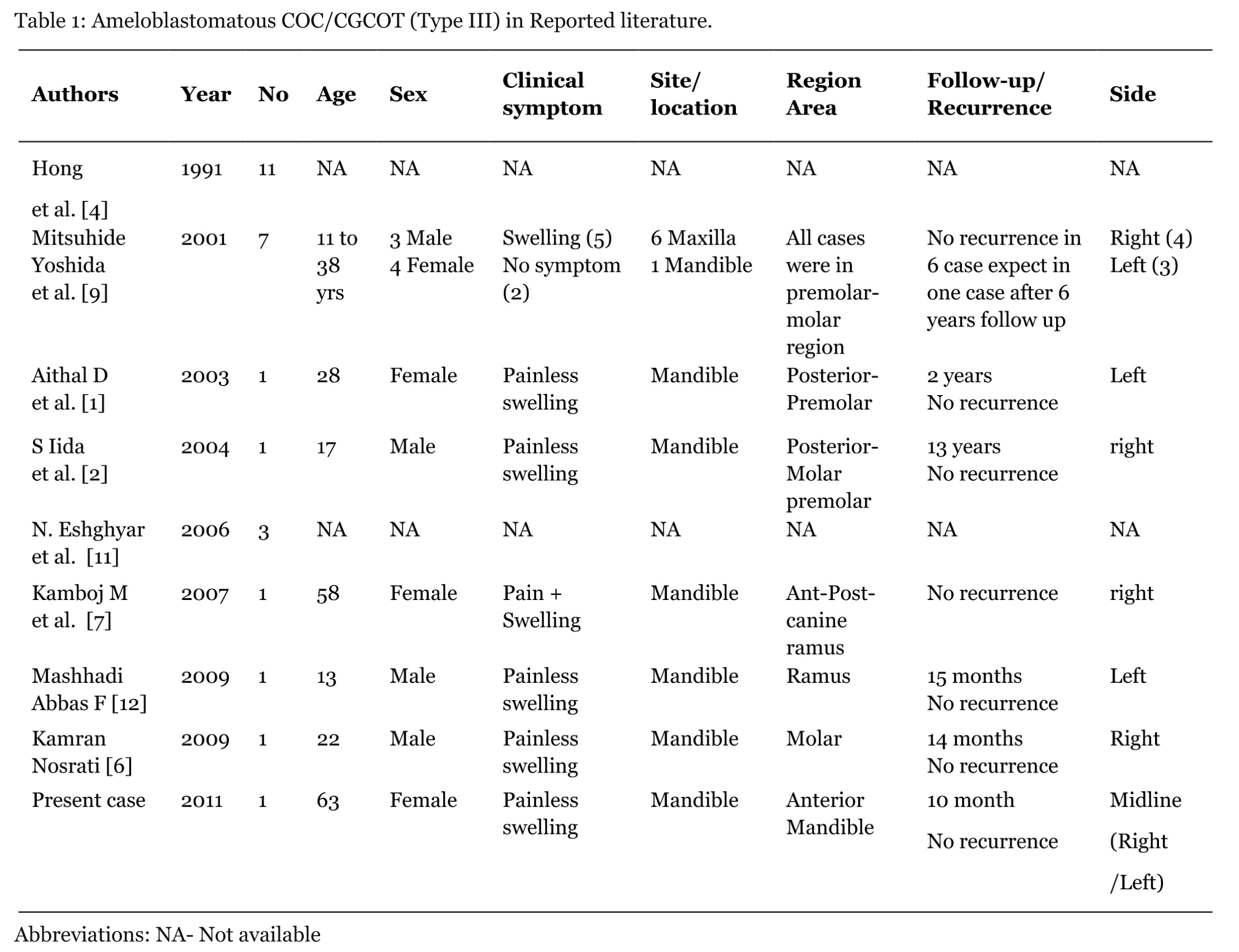
The calcifying ghost cell odontogenic cyst (CGCOC) is of central and peripheral variety. The central CGCOC (intraosseous) presents as an asymptomatic hard swelling of the jaw that produces expansion than erosion of bone and pain in case of secondary infection. [5] Intraosseous variety of ameloblastomatous COC has been reported. [6] The lesion usually presents as a painless, unilateral swelling in the premolar–molar region with a well circumscribed mixed radiographic appearance. However, the present case radiographically showed a well circumscribed radiolucency extending contralaterally up to the mesial of left lateral incisor. Histopathological findings described in previous reported case of ameloblastomatous COC were evident in present case. It was characterized by a unicystic structure in which the lining epithelium showed intraluminal proliferative activity that resembles ameloblastoma and also contains isolated or clustered ghost cells and calcification. It can be differentiated from ameloblastoma ex COC which shows Vickers and Gorlin criteria [7] and lacks ghost cells and calcifications. The peculiar features of CGCOC is the presence of ghost cells. These ghost cells are mostly found within the epithelium but they can also be seen in the connective tissue. These ghost cells are reported to be a type of aberrant keratinization. Takata et al. [8] reported that the ghost cells in calcifying odontogenic cysts, as opposed to ghost cells in dermal calcifying epitheliomas, contain enamel-related proteins in their cytoplasm accumulated during the process of pathological transformation and should not be considered as metaplastic. It was suggested that these cells undergo abnormal terminal differentiation as an apoptotic process. [9] The mechanism for this abnormal terminal differentiation is still not known. The similarity of the immunostaining patterns of cystic and solid calcifying odontogenic cysts supports the view that these lesions are two morphologic variants of the same entity. Irregular calcified bodies of varying size and opacity may be seen in the radiolucent area and in some cases the calcification may be substantial and occupy the greater part of the lesion but in this case calcification was not seen radiographically. Several authors have suggested that, if COC is associated with an ameloblastoma, its behavior and prognosis will be similar to an ameloblastoma, not that to COC. Yoshida et al. [10] based on their immunohistochemical study suggested that COCs with various histological features have neoplastic potential and may not be separate entities within the same histological spectrum. Unlike most of the earlier reported cases the present case did not show any evidence of recurrence after the conservative treatment and follow up of 10 months. Till date, only 27 cases including the present case are reported (Table 1). The most common clinical symptom was painless swelling unless secondarily infected. The ameloblastomatous COC was more commonly showed equal distribution in jaws as well as in gender predilections. It was reported in age range 11–58 years. Premolar–first molar region was most common site of occurrence. There was no deviation in ameloblastomatous COC in age, gender, site distribution when it was compared with all reported cases of COC in literature irrespective of type of COC. No recurrence was noticed in all ameloblastomatous COC cases which was suggestive of non-neoplastic nature of COC, hence, they can be treated in conservative way. Unfortunately, the mural development of ameloblastoma or ameloblastomatous changes in COC is of unknown clinical significance at this time because of the limited number of cases and limited follow-up information. | ||||||
| ||||||
|
Conclusion
| ||||||
|
Ameloblastomatous COC/CGCOT (Type III) shows varying degree of presentation which can be mistaken of any other odontogenic lesion. This review provides some insight to the findings from literature and improves the understanding of this rare entity. Moreover, the present case provides further evidence of a non-aggressive behavior of this lesion. | ||||||
|
References
| ||||||
| ||||||




|
[HTML Abstract]
[PDF Full Text]
|
|
Author Contributions:
Monal Bhaurao Yuwanati – Conception and design, Acquisition of data, Analysis and interpretation of data, Drafting the article, Critical revision of the article, Final approval of the version to be published Jagdish Vishnu Tupkari – Conception and design, Acquisition of data, Analysis and interpretation of data, Drafting the article, Critical revision of the article, Final approval of the version to be published Shubhangi Mhaske – Conception and design, Acquisition of data, Analysis and interpretation of data, Drafting the article, Critical revision of the article, Final approval of the version to be published Avadhoot Avadhani – Conception and design, Acquisition of data, Analysis and interpretation of data, Drafting the article, Critical revision of the article, Final approval of the version to be published Pradnya P Joshi – Conception and design, Acquisition of data, Analysis and interpretation of data, Drafting the article, Critical revision of the article, Final approval of the version to be published |
|
Guarantor of submission:
The corresponding author is the guarantor of submission. |
|
Source of support:
None |
|
Conflict of interest:
Authors declare no conflict of interest. |
|
Copyright:
© Monal Bhaurao Yuwanati et al. 2012; This article is distributed the terms of Creative Commons Attribution License which permits unrestricted use, distribution and reproduction in any means provided the original authors and original publisher are properly credited. (Please see Copyright Policy for more information.) |
|
|