
| Table of Contents |  |
|
Clinical Image
|
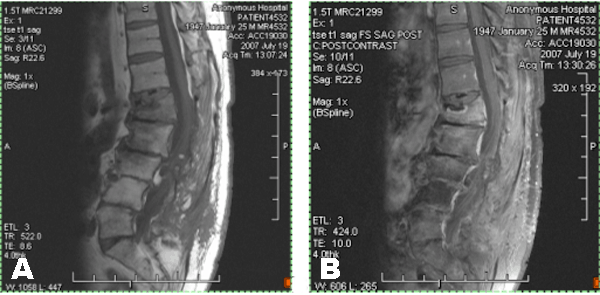
| MRI images of a patient with spondylodiscitis and epidural abscess after stem cell injections to the spine |
| Hamilton Chen1, Eaton Lin2 |
|
1Department of Physical Medicine and Rehabilitation, UCI Medical USA.
2Department of Radiology, St Lukes - Roosevelt Medical Center, New York. |
|
doi:10.5348/ijcri-2012-08-170-CI-17
|
|
Address correspondence to: Dr. Hamilton Chen Department of Physical Medicine and Rehabilitation UCI Medical USA Email: Hchen82@gmail.com |
|
[HTML Abstract]
[PDF Full Text]
|
| How to cite this article: |
| Chen H, Lin E. MRI images of a patient with spondylodiscitis and epidural abscess after stem cell injections to the spine. International Journal of Case Reports and Images 2012;3(8):62–64. |
|
Case Report
|
|
A 59-year-old male presented to a tertiary care center with a two-month history of worsening lower back pain. Two months prior to presentation, the patient had gone to Mexico and received multiple stem cell injections from donor placenta into the lumbar intervertebral disc at multiple levels for degenerative disc disease. Since these injections, his back pain had progressively worsened. A MRI was performed and revealed L3-L5 epidural/paravertebral abscess with discitis and osteomyelitis (Figure 1). The patient was empirically started on vancomycin 1 g IV q 12 hours and cefipime 2 g IV q 12 hours. When bone biopsy culture results were positive for candida parapsilosis, the patient was started on fluconazole 800 mg PO daily. A gallium scan showed increased uptake in the lumbar spine region. An L2-L5 laminectomy and I&D were performed by neurosurgery. Following surgery, the patient was transferred to a rehabilitation unit and remained on antibiotics for six weeks. Fluconazole was continued for one year. Follow-up MRI and gallium scan one year after discharge verified infection resolution (Figure 2). |
|
|
|
|
|
|
|
Discussion
|
|
Degenerative disc disease (DDD) is a common cause of low back pain. Therefore, regeneration strategies aimed at restoring the disc extracellular matrix and height have been proposed as potential treatments for DDD. There have been many studies that investigated the potential of stem cells for treatment of DDD. [1] [2] Even though there is promise in this treatment modality, the optimum method for stem cell usage is still unclear.[3] Despite this uncertainty, stem cell injections have been available for purchase in the global health marketplace in recent years.[4] Mexico has been leading the flourishing stem cell industry, treating chronic discogenic pain from DDD, cerebral palsy, autism, and paralysis with donor placenta.[5] |
|
Conclusion
|
|
This rare case report demonstrates imaging from the catastrophic complications that can result from stem cell injections into the intervertebral discs and that medical tourism is extremely risky for this procedure, especially when there is insufficient evidence at this time regarding the efficacy of the procedure. |
|
References
|
|


|
[HTML Abstract]
[PDF Full Text]
|
|
Author Contributions:
Hamilton Chen – Substantial contributions to conception and design, Acquisition of data, Drafting the article, Revising it critically for important intellectual content, Final approval of the version to be published Eaton Lin – Substantial contributions to conception and design, Acquisition of data, Drafting the article, Revising it critically for important intellectual content, Final approval of the version to be published |
|
Guarantor of submission:
The corresponding author is the guarantor of submission. |
|
Source of support:
None |
|
Conflict of interest:
Authors declare no conflict of interest. |
|
Copyright:
© Hamilton Chen et al. 2012; This article is distributed the terms of Creative Commons Attribution License which permits unrestricted use, distribution and reproduction in any means provided the original authors and original publisher are properly credited. (Please see Copyright Policy for more information.) |
|
|