
| Table of Contents |  |
|
Case Report
|
| Acquired cryptorchidism in an ectopic location |
| Jasneet Singh Bhullar1, Edmund Cheung1 |
|
1Department of Urology, National University Hospital, Singapore.
|
|
doi:10.5348/ijcri-2012-08-159-CR-6
|
|
Address correspondence to: Jasneet Singh Bhullar, MD Department of Surgery, Providence Hospital & Medical Centers 16001 West Nine Mile Road Southfield, MI-48075 USA Phone: 248-849-7638 Fax: 248-849-5380 Email: drjsbhullar@gmail.com |
|
[HTML Abstract]
[PDF Full Text]
|
| How to cite this article: |
| Bhullar JS, Cheung E. Acquired cryptocrchidism in an ectopic location. International Journal of Case Reports and Images 2012;3(8):21–23. |
|
Abstract
|
|
Introduction:
Orchiopexy rates are reported to be as high as 2–3% in males up to the age of 17 years, despite a reported childhood prevalence of cryptorchidism of only about 1%. In light of this, several authors have postulated the existence of acquired cryptorchidism as a separate disease entity from congenital cryptorchidism.
Case Report: A case of acquired testicular ascent in a 19-year-old male. He was involved in a motorcycle accident and was found to have bilaterally retracted testes. Closed reduction of bilateral testes into the scrotum was performed under general anesthesia. Eight months after the initial surgery, the patient presented with spontaneous ascent of the left testis, which was not reducible. Intraoperatively the testis was found to be lying in an ectopic location, superficial to the inguinal canal lateral to the inguinal midpoint. Conclusion: The authors present an unusual case of acquired testicular ascent in an ectopic location. Early surgical exploration is warranted in all cases of cryptorchidism to minimize the possibility of subsequent subfertility or malignant transformation. | |
|
Key Words:
Congenital cryptorchidism, Acquired cryptorchidism, Testicular ascent, Retractile testes, Orchidopexy, Ectopic testes
| |
|
Introduction
| ||||||
|
Cryptorchidism is a broad term encompassing several distinct entities. Congenital cryptorchidism is the most common form, with a prevalence rate of 1% in mature newborns. [1] Retractile testes are those that move spontaneously out of the scrotum but return, either spontaneously or with manipulation, to a dependent scrotal position and remain there for a finite period. [1] Most authors consider retractile testes to be a normal variant, which usually becomes nonretractile (fully descended), at puberty and are not associated with impairment of fertility. In contrast, gliding testes are defined as testes which can be manipulated into a satisfactory scrotal position but will retract quickly once released. These are considered the most distal form of true undescended testis. [1] [2] Testicular ascent is also sometimes known as acquired cryptorchidism. Both terms refers to testes that are in scrotal position at birth, but subsequently ascend out of the scrotum. [3] [4] Different descriptions and classifications of cryptorchidism are based on the probable cause and pathophysiology, thus influencing the timing of the planned surgical intervention. Early detection and treatment of cryptorchidism have clinical importance as testes residing in an extra-scrotal location are at risk of developing subfertility, torsion and malignant transformation, which increases with the age of patient. [1] [2] | ||||||
|
Case Report
| ||||||
|
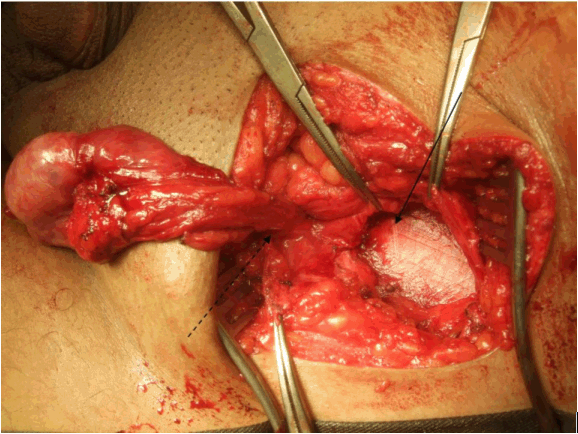
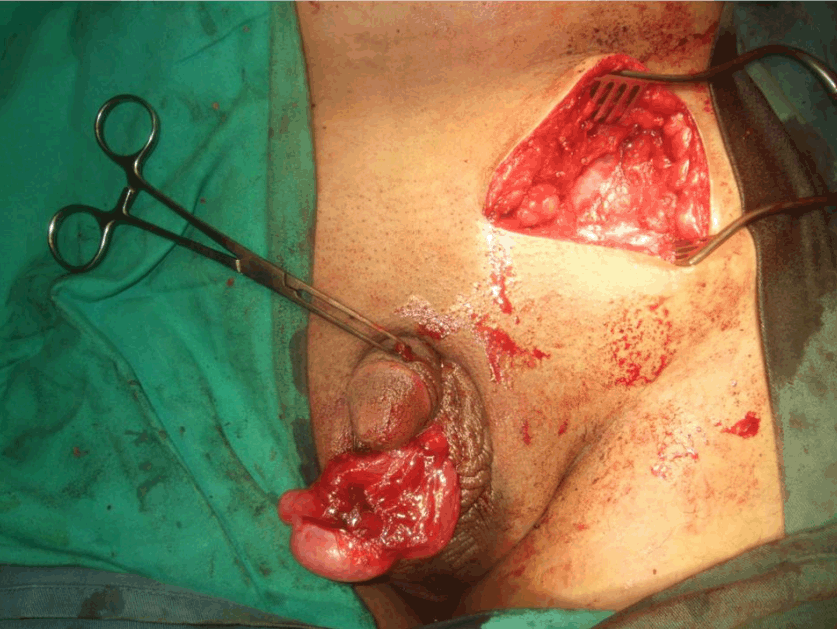
A case of a 19-year-old male with recurrent testicular ascent. This patient had an uncomplicated birth history, no prior medical illness, no prior surgeries and was developmentally normal. He was involved in a motor cycle accident, and sustained a right radius fracture and bilateral testicular retraction. Physical examination revealed both testes to be at the level of superficial inguinal rings and all features of secondary male sexual development were present. As the bilateral testis were palpated at the level of external inguinal rings no imaging investigation was done. He underwent operative reduction and fixation of the radius fracture as well as closed reduction of both testes into the scrotum under general anesthesia. On follow up after three months, he was noted to have normal testes. Five months after the initial accident, he was again involved in a motorcycle accident in which he sustained minor injuries, and did not seek medical attention. However, one month after the latter incident, he noted that the left testis had spontaneously ascended and was not palpable in the scrotum, with no subsequent descent. As he was asymptomatic, he presented to the urology service, two months after he observed the absence of the left testes in the scrotum. Physical examination revealed an empty left hemi-scrotum and a mass over the midpoint of the inguinal canal. Ultrasonographic assessment revealed the presence of the testis in the inguinal region. Under anesthesia multiple unsuccessful attempts were made to reduce the left testis by closed manipulation. An open exploration revealed dense fibrous tissue in the subcutaneous layer. The testis was found to be within the fibrous tissue, lateral to the inguinal canal midpoint and superficial to the external oblique aponeurosis. The ductus deferens entered the external ring and proceeded with its normal course through the inguinal canal (Figure 1). The testis was dissected free and the ductus deferens was mobilized up to the external ring. Throughout the operation, the external oblique aponeurosis was not breached and the inguinal canal was left intact. Other than mild atrophy, the left testis appeared macroscopically normal and was conserved. A dartos pouch was created, the testis was reduced and bilateral orchidopexy was done (Figure 2). The patient convalesced well and was discharged on the first postoperative day. | ||||||
|
| ||||||
| ||||||
|
Discussion
| ||||||
|
The existence of acquired cryptorchidism, unlike congenital cryptorchidism, is still a contentious topic. Indirect evidence obtained from cross sectional epidemiological studies show a childhood cryptorchidism rate of 1%, as compared with an orchidopexy rate of 2–3% among adolescent males. [5] The published studies on acquired cryptorchidism report the mean age of the population to be seven years. It is often unilateral, unlike congenital cryptorchidism. The proposed reasons for the occurrence of acquired cryptorchidism include a hyperactive cremasteric reflex, persistent processus vaginalis allowing free testicular ascent and a fibrous processus vaginalis remnant preventing full testicular descent together with somatic growth during the adolescent years. The most common testicular location for orchiopexy is distal to the inguinal ring (prescrotal, superficial inguinal pouch or high scrotal). Bingol–Kologlu et al. [6] checked cremasteric reflexes in 500 boys from age 3 days to 16 years to determine the prevalence of the cremasteric reflex and the possibility of eliciting prolonged suprascrotal stay through this reflex. It was found that the cremasteric reflex was fatigable in all cases and concluded that it was unlikely that a hyperactive cremasteric reflex was responsible for cases of retractile testes. Hadziselimovic et al. reported a large number of boys undergoing orchiopexy, in whom a more distal testicular location was associated with a lower (25–47%) incidence of patent processus vaginalis [7] and hence postulated the role of a patent processus in permitting cranial migration and trapping of a previously descended testis. [8] Another hypothesis is that a closed but incompletely resorbed ligamentous processus vaginalis causes tethering of the testis in a high position with somatic growth. [9] Histological studies of retractile testes indicate a subnormal tubule fertility index (number of spermatogonia per tubule) in 40–55% prepubertal boys, although the abnormalities are less consistent and diffuse than in cryptorchid testes. [10] All cases of cryptorchidism warrant early surgical fixation to minimize the long term risks of subfertility and malignant transformation. Traumatic dislocation of testes following blunt trauma is a previously reported rare event. [11] Motorcycle crashes are the most common mechanism. The possible locations of a dislocated testis include the superficial inguinal (50%), pubic (18%), canalicular (8%), penile (8%), intra-abdominal (6%), perineal (4%) and crural (2%) regions.[12] This case report is unique in the occurrence of testicular ascent in an ectopic location (as evidenced by its position on the external oblique aponeurosis), which has not been reported previously for traumatic dislocation of testes. [12] As this patient was developmentally normal and mentally competent, it was highly unlikely that this was a case of missed congenital cryptorchidism. This is supported by the fact that the right testis was normal in appearance intra operatively, while the left testis appeared only mildly atrophic. In the case of this patient, neither the processus vaginalis, nor a fibrous tethering remnant was noted. The authors are only able to suggest that the initial trauma led to the creation of an extra-inguinal tract, and that subsequent trauma probably led to the testis ascending to the ectopic location. | ||||||
|
Conclusion
| ||||||
|
The authors present an unusual case of acquired testicular ascent in an ectopic location not previously reported in literature and this adds to our current understanding of such a condition. Radiologic imaging should be performed to localize the testis and determine its morphology. Early surgical exploration is warranted in all cases of acquired cryptorchidism or traumatic testicular dislocation to minimize possibility of subsequent subfertility and malignant transformation. | ||||||
|
References
| ||||||
| ||||||

|
[HTML Abstract]
[PDF Full Text]
|
|
Author Contributions:
Jasneet Singh Bhullar – Conception and design, Acquisition of data, Analysis and interpretation of data, Drafting the article, Critical revision of the article, Final approval of the version to be published Edmund Cheung – Conception and design, Acquisition of data, Analysis and interpretation of data, Final approval of the version to be published |
|
Guarantor of submission:
The corresponding author is the guarantor of submission. |
|
Source of support:
None |
|
Conflict of interest:
Authors declare no conflict of interest. |
|
Copyright:
© Jasneet Singh Bhullar et al. 2012; This article is distributed the terms of Creative Commons Attribution License which permits unrestricted use, distribution and reproduction in any means provided the original authors and original publisher are properly credited. (Please see Copyright Policy for more information.) |
|
|