
| Table of Contents |  |
|
Case Report
|
| Full mouth rehabilitation using a custom-made broadrick flag: A case report |
| Saurabh Chaturvedi1, A K Verma2, Mariyam Ali3, Mayank Shah4 |
|
1Senior Lecturer, Department of Prosthodontics, Career Post Graduate Institute of Dental Sciences, Lucknow, Uttar Pradesh, India.
2Professor & HOD, Department of Prosthodontics, Career post Graduate Institute of Dental sciences, Lucknow, Uttar Pradesh, India. 3Professor, Department of Prosthodontics, Career post Graduate Institute of Dental sciences, Lucknow, Uttar Pradesh, India. 4PG Student Department of Prosthodontics, Career post Graduate Institute of Dental sciences, Lucknow, Uttar Pradesh, India. |
|
doi:10.5348/ijcri-2012-05-124-CR-9
|
|
Address correspondence to: Dr. Saurabh Chaturvedi Flat No. 101, Thakurkala Apartment Vikas Nagar, Sector - 2, Lucknow Uttar Pradesh India - 226020 Phone: 917800722615 Email: dr.saurabh.chaturvedi@gmail.com |
|
[HTML Abstract]
[PDF Full Text]
|
| How to cite this article: |
| Chaturvedi S, Verma AK, Ali M, Shah M. Full mouth rehabilitation using a custom-made broadrick flag: A case report. International Journal of Case Reports and Images 2012;3(5):41–44. |
|
Abstract
|
|
Introduction:
Full mouth rehabilitation is an extensive and intensive restorative procedures in which the occlusal plane is modified to accomplish "equilibration". An instrument called the Broadrick flag has been used to assist in the reproduction of tooth morphology that is commensurate with the curve of Spee. This case report demonstrates the making and use of a custom-made Broadrick occlusal plane analyzer (BOPA) on a semiadjustable articulator to determine the correct orientation of the occlusal plane in a full mouth rehabilitation (FMR).
Case Report: A 62-year-old man complained of difficulty in chewing since two years. On clinical examination, it was found that teeth present were 11, 14, 21, while the mandibular arch had all the teeth except 31, 32, 41, 42, 45 after complete examination, case was planned for full mouth rehabilitation using custom made BOPA. Conclusion: FMR was an the important part in treatment protocol of this case. A custom-made occlusal plane analyzer was fabricated and used for re-establishing the decimated occlusal plane in harmony with the stomatognathic system. | |
|
Key Words:
Full mouth rehabilitation, Anterior survey point, Posterior survey point, Curve of spee, Occlusal plane
| |
|
Introduction
| ||||||
|
In the past, "dental cripples" were condemned to full mouth extraction and complete dentures were made. But the changing face of Prosthodontics due to advancement in technology, materials and equipment have simplified the task of rehabilitating diseased mouths. 'Full mouth rehabilitation' is an extensive and intensive restorative procedures in which the occlusal plane is modified to accomplish "equilibration". [1] Proper management of the occlusal plane is essential for full mouth rehabilitation cases. Broadrick occlusal plane analyser (Broadrick flag; Teledyne Water Pik, Fort Collins, Colo.) has been used to assist in the reproduction of tooth morphology that is commensurate with the curve of Spee and its use prevents the introduction of protrusive interferences. [2] The Broadrick occlusal plane analyser (BOPA) is an expensive instrument and has been adapted to only a few articulator systems, which limits its use universally. [3] [4] To overcome this, a custom-made BOPA was designed for semi-adjustable articulator, which can be used with any semi-adjustable articulator with slight modifications. This case report demonstrates the making and use of a custom-made Broadrick occlusal plane analyzer which can be utilized with any semi-adjustable articulator very efficiently, for full mouth rehabilitation cases. Fabrication of customized Broadrick occlusal plane analyser: Materials Used
Fabrication Method This is the simplest method for fabrication of highly useful BOPA for any type of semiadjustable articulator. (here described for dentatus articulator, type ARH)
| ||||||
|
Case Report
| ||||||
|
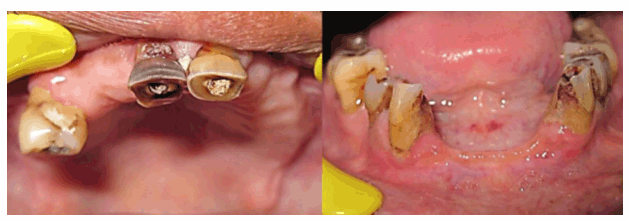
A 62-year-old man reported to the Department of Prosthodontics, with chief complaint of difficulty in chewing since two years. On clinical examination, it was found that teeth present were 11, 14, 21, while the mandibular arch had all the teeth except 31, 32, 41, 42, 45 (Figure 2). From diagnostic mounting and intraoral examination it was found that there was decrease in vertical dimension of occlusion, missing maxillary teeth, supraerupted mandibular posterior teeth and deranged occlusal plane. The treatment option opted was a full mouth rehabilitation. The use of a BOPA was indicated to assess and redesign the level and orientation of the occlusal plane. The maxillary cast was removed from the articulator, and the custom made flag was attached on top of the upper member of articulator. The anterior survey point (ASP) was chosen on the midpoint of the disto-incisal edge of the mandibular right and left canine, from which a long arc of 4-inch radius was drawn on the flag with a compass. The posterior survey point (PSP) was located on the anterior border of condylar element on articulator and a short arc was drawn from the posterior survey point on the flag to intersect the long arc of anterior survey point. [5] The needle of the compass was placed on the point of intersection of both the arc and a four inch radius line was drawn on the buccal surfaces of right mandibular teeth. Similar procedures were repeated for left mandibular teeth. A putty index of polyvinyl siloxane impression material was made on the buccal surfaces of mandibular teeth up to the line. After diagnosis the treatment was planned in two phases: Maxillary: A removable partial denture with rest seats in relation to 11, 21 and a telescopic coping in relation to 24 was fabricated for missing maxillary teeth (Figure 3). Mandibular: A mock preparation was done on the duplicated diagnostic cast. The mandibular teeth were reduced, maintaining the gross anatomy, with help of occlusal plane cutting guide. A clear acrylic template was prepared over the occlusal and lingual surfaces of prepared mandibular teeth. Intraorally, mandibular teeth were prepared, maintaining the gross occlusal morphology of the individual tooth by placing the occlusal plane cutting guide and clear acrylic template. Diagnostic wax up was done and duplicated with vacuum formed acrylic sheet. Provisional restorations in relation to 31, 32, 33, 34, 35, 41, 42, 43, 44, 45 and 46 were fabricated. After a four week trial period, the patient reported that the provisional restorations and upper denture were comfortable, no abnormal wear facets were evident, occlusal contacts were present in maximum intercuspation position and no interferences in eccentric movements. Permanent restorations were temporarily cemented for one week, necessary corrections were made on recall appointment and then final cementation was done (Figure 4, 5). | ||||||
| ||||||
| ||||||
| ||||||
| ||||||
| ||||||
|
Discussion
| ||||||
|
Mouth is an integral part of somatognathic system. Disruption in any component results in malfunctioning of this system. Reintegration of components of somatognathic system requires full mouth rehabilitation. Full mouth rehabilitation seeks to convert all unfavourable forces on teeth, into favourable forces which permit normal function and therefore induce healthy periodontal conditions. Thus entails the performance of all the procedures necessary to produce a healthy, aesthetic, well functioning, self maintaining somatognathic system. [6] [7] In 1963, Dr Lawson Broadrick developed an instrument to provide a guide to the most suitable position and orientation of the posterior occlusal plane. Its purpose is to permit reconstruction of the Curve of Spee in harmony with incisal and condylar guidance. [8] [9] Since no such apparatus was available with Dentatus semiadjustable articulator, a custom made BOPA was fabricated, which served the following purposes in the treatment plan of the case:
(b) Preliminary determination of the amount of reduction that will be required when each tooth is prepared. (c) In the laboratory wax-up and final metal ceramic restoration, determination of the height of each cusp tip, which helped in establishing the curve of Spee and the curve of Wilson. A maxillary removable partial denture with cingulum rests on metal ceramic restorations in relation to 11, 21 was incorporated which helped in distribution of stresses along the long axis of the tooth and a telescopic coping over 14 for support and retention of prosthesis. The altered cast impression technique was used for long span edentulous area in upper jaw to distribute the forces uniformly over a broad area. The weekly follow up for two months showed no clinical signs of occlusal disharmony, no regressive changes in the teeth, maximum intercuspation in centric occlusion, no interferences in protrusive and lateral excursions. The patient reported improvement in masticatory function with the prosthesis. | ||||||
|
Conclusion
| ||||||
|
Full mouth rehabilitation was an imperative aspect in treatment protocol of this case. It entailed all the procedures necessary to produce a healthy, aesthetic, well functioning, self-maintaining masticatory mechanism. A custom-made occlusal plane analyzer was fabricated and used for re-establishing the decimated occlusal plane in harmony with the somatognathic system. Complete treatment procedure ultimately resulted in confidence and satisfaction to the patient. | ||||||
|
Acknowledgements
| ||||||
|
Dr. Mudita Chaturvedi, Dr. Deepti Shah | ||||||
|
References
| ||||||
| ||||||



|
[HTML Abstract]
[PDF Full Text]
|
|
Author Contributions:
Saurabh Chaturvedi - Conception and design, interpretation of data, Drafting the article, Critical revision of the article, Final approval of the version to be published AK Verma - Interpretation of data, Critical revision of the article, Final approval of the version to be published Mariyam Ali - Interpretation of data, Critical revision of the article, Final approval of the version to be published Mayank Shah - Acquisition of data, Drafting the article, Final approval of the version to be published |
|
Guarantor of submission:
The corresponding author is the guarantor of submission. |
|
Source of support:
None |
|
Conflict of interest:
Authors declare no conflict of interest. |
|
Copyright:
© Saurabh Chaturvedi et al. 2012; This article is distributed under the terms of Creative Commons Attribution License which permits unrestricted use, distribution and reproduction in any means provided the original authors and original publisher are properly credited. (Please see Copyright Policy for more information.) |
|
|