
| Table of Contents |  |
|
Case Report
|
| Primary cardiac sarcoidosis causing persistent ST-segment elevation |
| János Tomcsányi1, András Wettstein1, Béla Bózsik1, Tamás Simor2, János Strausz3, Márta Hubay4 |
|
1Department of Cardiology, St John of God Hospital, Budapest, Hungary.
2Heart Institute Medical University Pécs Hungary. 3National Korányi Institute for Pulmonology, Budapest, Hungary. 4Department of Forensic Medicine, Semmelweis University, Budapest Hungary. |
|
doi:10.5348/ijcri-2012-04-107-CR-4
|
|
Address correspondence to: János Tomcsányi Department of Cardiology St.John of God Hospital, Budapest, Hungary 023 Árpád fejedelem u. 7 Hungary Phone: 003614388560 Email: tomcsanyi.janos@t-online.hu |
|
[HTML Abstract]
[PDF Full Text]
|
| How to cite this article: |
| Tomcsányi J, Wettstein A, Bózsik B, Simor T, Strausz J, Hubay M. Primary cardiac sarcoidosis causing persistent ST-segment elevation. International Journal of Case Reports and Images 2012;3(4):15–18. |
|
Abstract
|
|
Introduction:
Sarcoidosis is a multisystem, granulomatous disease of unknown origin. In a few cases, cardiac sarcoidosis appears before systemic sarcoidosis. Cardiac sarcoidosis accounts for 25% of deaths from the disease. The antemortem diagnosis of cardiac sarcoidosis can be challenging due to the variable clinical presentations.
Case Report: We report a case of primary cardiac sarcoidosis which involved the epicardial myocardium initially. For quit long, large ST-segment elevation was the only sign of sarcoidosis in the completely symptom-free patient. Conclusion: Persistent ST-segment elevation could be the first sign of cardiac sarcoidosis. | |
|
Key Words:
Cardiac sarcoidosis, ST-segment elevation, Acute coronary syndrome, Myocarditis
| |
|
Introduction
| ||||||
|
Sarcoidosis is a granulomatous multisystem disease. Cardiac sarcoidosis is detected in 3–30% of cases in clinical and pathology series. [1] In a few cases, cardiac sarcoidosis appears before systemic sarcoidosis. [2] The authors present a case of persistent ST-segment elevation in a 36-year-old woman. For a long time, this marked ST-segment elevation was the only sign of cardiac sarcoidosis in a completely asymptomatic patient. The diagnosis was verified by myocardial biopsy. In conclusion, ST-segment elevation on electrocardiography could be the first sign of cardiac sarcoidosis limited to the epicardial region of the myocardium. | ||||||
|
Case Report
| ||||||
|
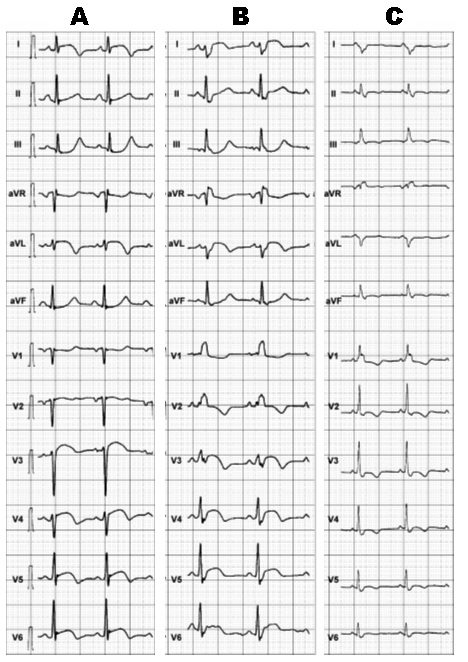
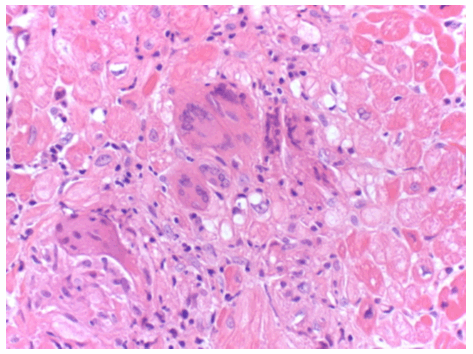
A 36-year-old woman sought medical attention for varicose veins. A routine electrocardiogram (ECG) was made during the workup but was not reviewed until one week later when the ST-segment elevation was detected and the patient was urgently referred to us. Physical examination was unremarkable except for varicosity of the right leg. Her blood pressure was 120/80 mmHg. The ST-segment elevation on the ECG was unchanged (Figure 1A) and the patient did not report any history of chest pain/angina. The results of the laboratory tests and cardiac ultrasonography were unremarkable. Because of the ST-segment elevation of unknown aetiology, coronary angiography was performed, which showed normal epicardial vessel anatomy. Further investigations aimed at establishing the cause of the ST-segment elevation included abdominal ultrasonography and chest X-ray-both with unremarkable results. There was no family history of sudden cardiac death or similar ECG changes. In the end, a gadolinium-enhanced magnetic resonance scan (MR) was requested, which showed a high-intensity area in the lateral subepicardial region on late enhancement, reported as focal perimyocarditis. Repeat laboratory tests, including inflammatory markers were negative. The patient was asymptomatic and was discharged without any treatment. She was asked to return for follow-up in one year. One year later the ECG showed further progression. In addition to the ST-segment elevation, nonspecific widening of the QRS was also present resembling a right bundle branch block and left posterior fascicular block pattern (Figure 1B). Recent-onset conduction abnormalities were suspected and Holter-monitoring was performed which showed normal PQ-intervals. Nevertheless, cardiac electrophysiology was also carried out, which revealed normal AH (atrial-HIS) and HV (HIS-ventricular) intervals. This time, the patient was asked to return for follow-up in six months or sooner if she became symptomatic. Dyspnoea started one year later. The ECG no longer showed ST-segment elevation. Instead, Q-waves were present in I and aVL, and negative T-waves appeared in the chest leads, in addition to the formerly noted nonspecific right bundle branch block (Figure 1C). Echocardiography revealed septal hypokinesis of the proximal segments while NTproBNP, which was normal before (<270 pg/ml), also became elevated (1760 pg/ml). Physical examination did not reveal any signs of manifest heart failure. A repeat MR scan was requested which showed high signal intensity on late enhancement images in all basal segments, except inferoseptally, extending all the way to the subepicardial myocardium. The free wall of the right ventricle was also affected. Therefore we persuaded the patient to undergo yet another invasive procedure. Myocardial biopsies taken from the septum and the free wall of the right ventricle revealed epithelioid noncaseating granulomas without necrosis in or around them (Figure 2). Polarised light microscopy did not reveal foreign bodies and giant cells did not show birefringence. Of the other causes, tuberculosis was excluded using Ziehl-Neelsen stain while fungal infection was excluded with PAS and Grocott stain. Based on the histological picture, this case of granulomatous myocarditis fits the description of sarcoidosis, which was also confirmed by the clinical course of the disease. Other forms of granulomatous myocarditis do not remain asymptomatic this long if left untreated. The patient was initially started on 32 mg methylprednisolone six months ago, the dose of which had to be halved due to intolerance. Her condition is unchanged and so is her ECG. | ||||||
|
| ||||||
| ||||||
|
Discussion
| ||||||
|
Sarcoidosis is an infiltrative disorder marked by granulomatous involvement of multiple organs. There have been reports of cases where cardiac sarcoidosis preceded systemic involvement by several years. [3] Manifestations of cardiac involvement include cardiopathy, heart failure, bradyarrhythmias as well as supraventricular or ventricular tachyarrhythmias. Only 5% of patients with sarcoidosis have signs or symptoms of cardiac involvement. However, 25% of patients have autopsy-proven evidence that the heart was affected. One of the most widely used standards for the diagnosis of cardiac sarcoidosis is the Japanese Ministry of Health and Welfare criteria. There are two groups of criteria. Histological diagnosis confirms cardiac sarcoidosis through the analysis of endomyocardial biopsy demonstrating epithelioid noncaseating granulomas. [4] Clinical diagnosis confirms cardiac sarcoidosis in patients with proven extracardial sarcoid and one or more electrocardiographic abnormalities compatible with cardiac sarcoidosis and/or noninvasive imaging (echocardiography, gallium-67 scintigraphy, positron emission tomography or gadolinium-enhanced cardiac MR) abnormalities. Electrocardiographic abnormalities compatible with cardiac sarcoidosis include complete right bundle branch block, atrioventricular block, [5] ventricular tachycardia, abnormal Q-waves and ST-segment depression or negative T-waves. Corticosteroid treatment has been suggested as a therapeutic option for patients with cardiac sarcoidosis. The duration of corticosteroid therapy for cardiac sarcoidosis has not been established. High dose of corticosteroid may not be essential for treatment of cardiac sarcoidosis. [6] However, starting corticosteroid before the occurrence of systolic dysfunction result in an excellent clinical outcome but the clinical efficacy is controversial in patients with advanced cardiac dysfunction and ventricular arrhythmia. In our case, the ST-segment elevation mimicking acute coronary syndrome was a formerly unknown ECG sign of primary cardiac sarcoidosis which involved the epicardial myocardium initially. For quite long, this large ST-segment elevation was the only sign of sarcoidosis in the completely symptom-free patient. To our knowledge this is the first report of sarcoidosis-induced ST-segment elevation mimicking acute myocardial infarction. | ||||||
|
Conclusion
| ||||||
|
To our knowledge this is the first report of sarcoidosis-induced ST-segment elevation mimicking acute myocardial infarction. | ||||||
|
References
| ||||||
| ||||||

|
[HTML Abstract]
[PDF Full Text]
|
|
Author Contributions:
János Tomcsányi - Substantial contributors to conception and design, Drafting the article, revising it critically for important intellectual content, Final approval of the version to be published András Wettstein - Substantial contributors to conception and design, Drafting the article, revising it critically for important intellectual content, Final approval of the version to be published Béla Bózsik - Substantial contributors to conception and design, Drafting the article, revising it critically for important intellectual content, Final approval of the version to be published Tamás Simor - Substantial contributors to conception and design, Drafting the article, revising it critically for important intellectual content, Final approval of the version to be published János Strausz - Substantial contributors to conception and design, Drafting the article, revising it critically for important intellectual content, Final approval of the version to be published Márta Hubay - Substantial contributors to conception and design, Drafting the article, revising it critically for important intellectual content, Final approval of the version to be published |
|
Guarantor of submission:
The corresponding author is the guarantor of submission. |
|
Source of support:
None |
|
Conflict of interest:
Authors declare no conflict of interest. |
|
Copyright:
© János Tomcsányi et. al. 2012; This article is distributed the terms of Creative Commons Attribution License which permits unrestricted use, distribution and reproduction in any means provided the original authors and original publisher are properly credited. (Please see Copyright Policy for more information.) |
|
|