
| Table of Contents |  |
|
Clinical Image
|
| Serious contracted bladder and vesicoureteral reflux after intravesical Mitomycin-C treatment |
| Mihály Murányi1, Morshed Ali Salah2, Mátyás Benyó1, Tibor Flaskó3 |
|
1Resident, Department of Urology, University of Debrecen Medical School and Health Science Center, Debrecen, Hungary.
2Assistant professor, Department of Urology, University of Debrecen Medical School and Health Science Center, Debrecen, Hungary. 3Head of the Department, Department of Urology, University of Debrecen Medical School and Health Science Center, Debrecen, Hungary. |
|
doi:10.5348/ijcri-2012-03-103-CR-8
|
|
Address correspondence to: Dr Mihály Murányi Nagyerdei krt. 98 Debrecen Hungary - H-4032 Phone: +36 52 255256, +36 20 5718147 Fax: +36 52 255256 Email: vezermurmillo@gmail.com |
|
[HTML Abstract]
[PDF Full Text]
|
| How to cite this article: |
| Murányi M, Salah MA, Benyó M, Flaskó T. Serious contracted bladder and vesicoureteral reflux after intravesical Mitomycin-C treatment. International Journal of Case Reports and Images 2012;3(3):27-29. |
|
Case Report
| ||||||
|
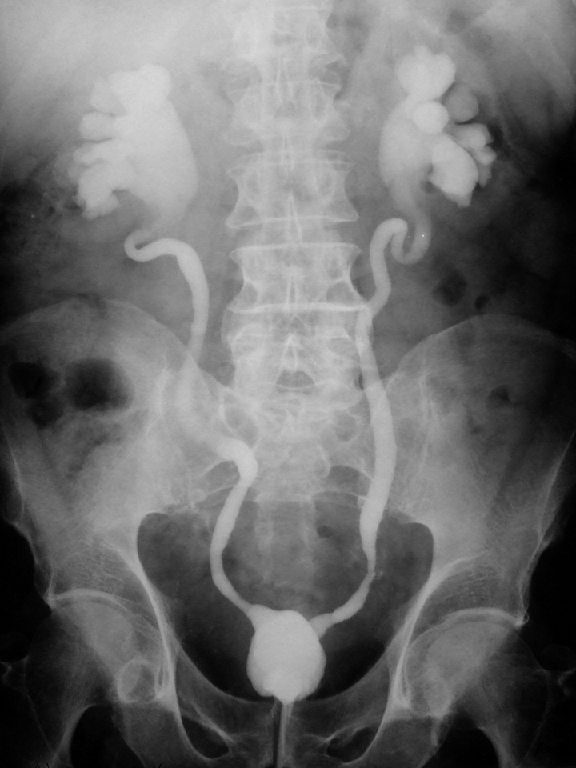
We present a patient with serious contracted bladder and bilateral grade V vesicoureteral reflux which developed after intravesical Mitomycin-C treatment. The 78-years-old male patient had a history of transurethral bladder tumor and prostate resection at the same session in another center, because of a solitary, papillary tumour with a diameter of 20 mm near the left ureteral orifice and an enlarged prostate. Before the operation intravenous urography was done, showed normal bladder capacity (figure 1). The histology revealed transitional cell carcinoma (T1, G1) and benign prostatic hyperplasia. Intravesically 20 mg Mitomycin-C was given weekly for the first six weeks, then monthly for 10 months. During the treatment he developed increasing frequency and urge incontinence, but the treatment was not interrupted. Two years after the end of instillation the patient presented to our department with right flank pain, frequency and urge incontinence. Serum levels of creatinine and urea were 228 µmol/L and 11.3 mmol/L, respectively. Urine culture, including culture for tuberculosis, was negative. His renal ultrasound showed bilateral hydronephrosis, and thin renal cortex. Cystogram revealed contracted bladder and bilateral grade V vesicoureteral reflux (figure 2). Cystoscopy showed golf-hole ureteral orifices and low capacity (50 ml) of the bladder. There were no sign of tumour recurrence. Due to co-morbidity of the patient (hypertension, ischemic heart disease) reconstructive surgery could not be performed; therefore percutaneous suprapubic cystostomy was placed. One year after suprapubic cystostomy placement, the patient was very well, he had no symptoms and his serum level of creatinine stabilized at about 150 µmol/L. | ||||||
| ||||||
|
| ||||||
| ||||||
|
Discussion
| ||||||
|
Mitomycin-C, doxorubicin and epirubicin are the most frequently used intravesical chemotherapy to prevent recurrence of superficial bladder cancer after transurethral resection. These drugs can be used for single, immediate, postoperative instillation or for adjuvant repeat instillations. The efficacy of these drugs are similar. [1] [2] Side effects of intravesical chemotherapy (cystitis, bladder irritation) are usually moderate and localized to the bladder. However, rarely it can cause severe, even fatal, complications, especially after immediate post-operative instillation when there is a bladder wall perforation. [3] Mitomycin-C is considered to be a safe intravesical chemotherapeutic drug, but rarely it can cause contracted bladder, which can require urinary diversion. [4] The cause of contracted bladder in the present case was most likely chemocystitis caused by intravesical Mitomycin-C therapy; we were able to exclude other common cause of contracted bladder (tuberculosis, schistosomiasis, interstitial cystitis, irradiation cystitis). Perhaps, long-term (1-year-long) treatment and the absence of treatment interruption, even though the patient's symptoms facilitated this serious adverse effect. | ||||||
|
Conclusion
| ||||||
|
During intravesical chemotherapy, patients should be closely observed to prevent serious side effects. Urine analysis need to be carried out regularly, and treatment-related symptoms must be monitured. In case of serious symptoms and side effects intravesical treatment should be interrupted, and the side effects must be treated. | ||||||
|
References
| ||||||
| ||||||


|
[HTML Abstract]
[PDF Full Text]
|
|
Author Contributions:
Mihály Murányi - Substantial contributions to conception and design, acquisition of data, analysis and interpretation of data, Drafting the article, revising it critically for important intellectual content, Final approval of the version to be published Morshed Ali Salah - Substantial contributions to conception and design, analysis and interpretation of data, Drafting the article, revising it critically for important intellectual content, Final approval of the version to be published Mátyás Benyó - Analysis and interpretation of data, Drafting the article, revising it critically for important intellectual content, Final approval of the version to be published Tibor Flaskó - Analysis and interpretation of data, Drafting the article, revising it critically for important intellectual content, Final approval of the version to be published |
|
Guarantor of submission:
The corresponding author is the guarantor of Submission. |
|
Source of support:
None |
|
Conflict of interest:
The authors declare no conflict of interest. |
|
Copyright:
© Mihály Murányi et al. 2012; This article is distributed under the terms of Creative Commons Attribution License which permits unrestricted use, distribution and reproduction in any means provided the original authors and original publisher are properly credited. (Please see http://www.ijcasereportsandimages.com/copyright-policy.php for more information.) |
|
|