
| Table of Contents |  |
|
Case Report
|
| Retrograde jejunogastric intussusceptions: A rare case report |
| Lakkanna Suggaiah1, Ramesh Brahmavara Shamburao2, Usha Rani Rathnam3, Preetham Raj4 |
|
1General/Laparoscopic Surgeon, Professor and Head of Surgery department, ESIC-PGIMSR, Rajajinagar Bangalore, Karnataka, India.
2General/Laparoscopic Surgeon, Associate Professor, Surgery department, ESIC-PGIMSR, Rajajinagar Bangalore, Karnataka, India. 3General/Colorectal Surgeon, Assistant Professor, Surgery department, ESIC-PGIMSR, Rajajinagar Bangalore, Karnataka, India. 4General Surgeon, Senior Resident, Surgery department, ESIC-PGIMSR, Rajajinagar Bangalore, Karnataka, India. |
|
doi:10.5348/ijcri-2012-03-98-CR-3
|
|
Address correspondence to: Dr Usha Rani Rathnam House No. F-07 Sreepride apartment, Chikkabanaswadi main road, near CMR College Chikkabanaswadi, Bangalore, Karnataka India-560 033 Phone: 080-25486719, 23325130; Mob: 91-9845054071 Email: drushagiri@gmail.com |
|
[HTML Abstract]
[PDF Full Text]
|
| How to cite this article: |
| Suggaiah L, Shamburao RB, Rathnam UR, Raj P. Retrograde jejunogastric intussusceptions: A rare case report. International Journal of Case Reports and Images 2012;3(3):8-11. |
|
Abstract
|
|
Introduction:
Retrograde jejunogastric intussusception is a rare acute abdominal condition where the small bowel loops get incarcerated and may get strangulated inside the stomach.
Case Report: We report one such rare case of a 50-year-old female who had retrograde jejunogastric intussusception following gastrojejunostomy and outline our treatment. Conclusion: Retrograde jejunogastric intussusception is a rare acute abdominal condition which is a rare complication after gastric surgery. The presence of a mobile mass associated with nausea and vomiting in a patient with previous history of gastric surgery is virtually pathognomic of acute retrograde intussusception. A high degree of suspicion is required for pre-operative diagnosis of the case which should be followed by prompt surgery. | |
|
Key Words:
Retrograde intussusception, Acute abdomen, Sausage mass
| |
|
Introduction
| ||||||
|
Jejunogastric intussusception is a rare complication of gastrojejunostomy or partial gastrectomy. [1] [2] Bozzi described the first case of this complication in 1914. Around 200 cases have been reported in the literature till now. This paper reports a case of retrograde jejunogastric intussusception of both the loops of jejunum in a female patient who underwent surgery for acid peptic disease twenty years back. | ||||||
|
Case Report
| ||||||
|
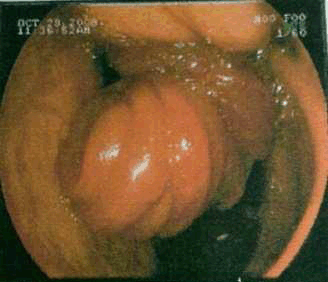
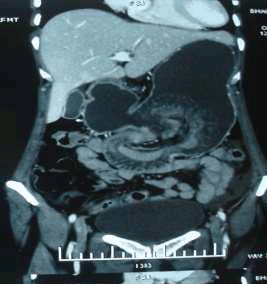
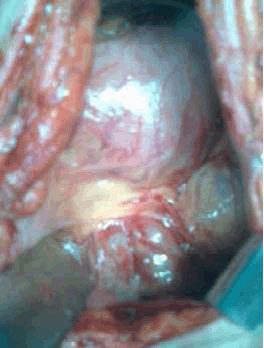
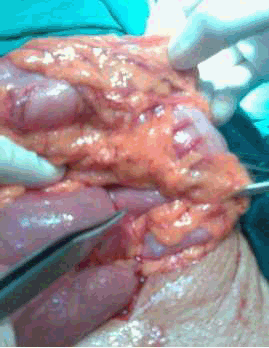
A 50-year-old female patient presented to ESI-PGIMSR with complaints of acute abdominal pain, vomiting and mass in the upper abdomen since four days. She had undergone gastrojejunostomy and truncal vagotomy for chronic duodenal ulcer twenty years back. On physical examination, the patient was dehydrated with pulse rate of 108/minute, blood pressure of 100/60 mmHg and respiratory rate of 18/min. Abdominal examination revealed upper midline abdominal scar of previous laparotomy. A tender sausage shaped lump was palpable in the umbilical region measuring 10x5 cm which moved with respiration (figure 1). Laboratory investigations showed hemoglobin of 9.3 gm%. After correction of dehydration and electrolyte imbalance, an emergency upper gastrointestinal endoscopy was carried out which revealed an intussusception of small bowel at gastro-jejunal anastomosis (figure 2). Computed tomography (CT) scan of the abdomen and pelvis revealed retrograde jejuno-gastric intussusception through previous gastrojejunostomy with edematous walls of intussusception and minimal ascites (figure 3). After initial treatment with intravenous fluids, nasogastric suction and antibiotics, emergency exploratory laparotomy was carried out. Operative findings: Peroperatively a soft mass was palpable in the stomach with evidence of a posterior gastro-jejunostomy afferent and efferent loops intussusception into the gastric stump. Manual reduction of the same showed viable bowel. Jejuno-jejunostomy was performed and afferent and the efferent loops fixed to the gastric wall. The postoperative recovery was uneventful and patient was discharged on the ninth postoperative day (figure 4-6). | ||||||
| ||||||
| ||||||
| ||||||
| ||||||
| ||||||
| ||||||
|
Discussion
| ||||||
|
Retrograde jejunogastric intussusception is a rare acute abdominal condition [1] [2], where the small bowel loops get intussuscepted/incarcerated and strangulated inside the stomach. This is a rare complication after gastric surgery. [2] Till date, around 200 cases of jejunogastric intussusception have been reported in world literature. The widely accepted anatomical classification proposed by Shackman et al. distinguishes three categories of jejuno gastric intussusception; [3] [4] The mechanism of jejunogastric intussusception is poorly understood. [3] Suggested underlying causes include - a long afferent loop, jejunal spasm with abnormal motility, increased motility of efferent loop, adhesions leading to intussusception of a more mobile segment into fixed segment, widening of upper jejunum, causes of increased intra-abdominal pressure like vomiting, pregnancy and labor, dilated atonic stomach and retrograde peristalsis. [3] Clinically patients with jejunogastric intussusceptions may be divided into two types according to the presentations, [1] [3] Type 1 - acute fulminant and Type 2 - chronic intermittent. In acute form, onset is usually sudden and consists of colicky or constant upper abdominal pain associated with vomiting. In chronic form, the symptoms may be roughly similar to the acute form but are milder and transient or sudden and spontaneous. The presence of a mobile mass in association with pain and vomiting in a patient who has had a previous gastric surgery is considered virtually pathognomic of acute retrograde intussusception. Most of the reported cases have not been diagnosed preoperatively. In our case, the condition was suspected and pre-operative upper gastrointestinal endoscopy was done. The reported mortality rate range from 10% for treatment within the first 48 hours to 50% within a 96 hour delay. [5] The surgical options available are manual reduction, resection of gangrenous bowel and revision of anastomosis. Fixation of the jejunum to adjacent tissue like mesocolon, colon, or stomach may be added to prevent recurrence. [2] | ||||||
|
Conclusion
| ||||||
|
A high index of suspicion is required for diagnosis of jejunogastric intussusception. Early recognition of acute variant of jejunogastric intussusception and prompt surgical intervention is the treatment of choice. To prevent recurrences, jejunum may be fixed to the adjacent tissues like mesocolon, colon or stomach. | ||||||
|
References
| ||||||
| ||||||



|
[HTML Abstract]
[PDF Full Text]
|
|
Author Contributions:
Lakkanna Suggaiah - Acquisition of data, Analysis and interpretation of data, Critical revision of the article, Final approval of the version to be published Ramesh Brahmavara Shamburao - Acquisition of data, Analysis and interpretation of data, Critical revision of the article, Final approval of the version to be published Usha Rani Rathnam - Conception and design, Acquisition of data, Analysis and interpretation of data, Drafting the article, Critical revision of the article, Final approval of the version to be published Preetham Raj - Conception and design, Acquisition of data, Analysis and interpretation of data, Drafting the article, Critical revision of the article, Final approval of the version to be published |
|
Guarantor of submission:
The corresponding author is the guarantor of submission. |
|
Source of support:
None |
|
Conflict of interest:
Authors declare no conflict of interest. |
|
Copyright:
© Lakkanna Suggaiah et al. 2012; This article is distributed under the terms of Creative Commons Attribution License which permits unrestricted use, distribution and reproduction in any means provided the original authors and original publisher are properly credited. (Please see http://www.ijcasereportsandimages.com/copyright-policy.php for more information.) |
|
|