
| Table of Contents |  |
|
Case Report
|
| An unusual presentation of uterine leiomyoma: Myxoid leiomyoma |
| Mbarki Chaouki1, Najjar Marouen2, Ben Mna Najet2, Khediri Zied2, Ben Abdelaziz Anis2, Oueslati Hedhili3 |
|
1Academic assistant on obstetric and gynecology, Department of obstetric and gynecology Ben Arous Hospital Tunisia.
2Resident in obstetric and gynecology. Department of obstetric and gynecology Ben Arous Hospital Tunisia. 3Professor in obstetric and gynecology. Department of obstetric and gynecology Ben Arous Hospital Tunisia. |
|
doi:10.5348/ijcri-2012-03-96-CR-1
|
|
Address correspondence to: Mbarki Chaouki Yesminette Ben Arous Tunisia - 2029 Phone: 00216 21799563 Email: chabmbarki@yahoo.fr |
|
[HTML Abstract]
[PDF Full Text]
|
| How to cite this article: |
| Chaouki M, Marouen N, Najet BM, Zied K, Anis BA, Hedhili O. An unusual presentation of uterine leiomyoma: Myxoid leiomyoma. International Journal of Case Reports and Images 2012;3(3):1-3. |
|
Abstract
|
|
Introduction:
Uterine leiomyomas are the most common benign uterine tumors. Leiomyoma is generally a firm and rubbery solid tumor. Infrequently, cystic or myxoid degeneration occurs in the tumor.
Case Report: We report a case of large solid-cystic myxoid leiomyoma arising from posterior side of the uterus in a 47-year-old woman. She complained of pelvic discomfort, feeling of heaviness and had a palpable sub-umbilical mass. She had hysterectomy with salpingo-oophorectomy and mass ablation. Final histological findings confirmed a uterine myxoid leiomyoma. Conclusion: Myxoid leiomyoma of the uterus is a rare benign tumor, its diagnosis remains histological. Leiomyosarcoma should always be refuted. | |
|
Key Words:
Leiomyoma; Myxoid, Uterus, Surgery, Anatomopathology, Ki67
| |
|
Introduction
| ||||||
|
Myxoid leiomyoma is a benign smooth muscle tumor with extensive myxoid changes. It is characterized by the absence of any mitotic activity and the presence of a myogenic phenotype. We report a case of uterine myxoid leiomyoma in a 47-year-old woman. Through this case and a review of literature, we want to highlight clinical and histological aspects of this rare pathology. | ||||||
|
Case Report
| ||||||
|
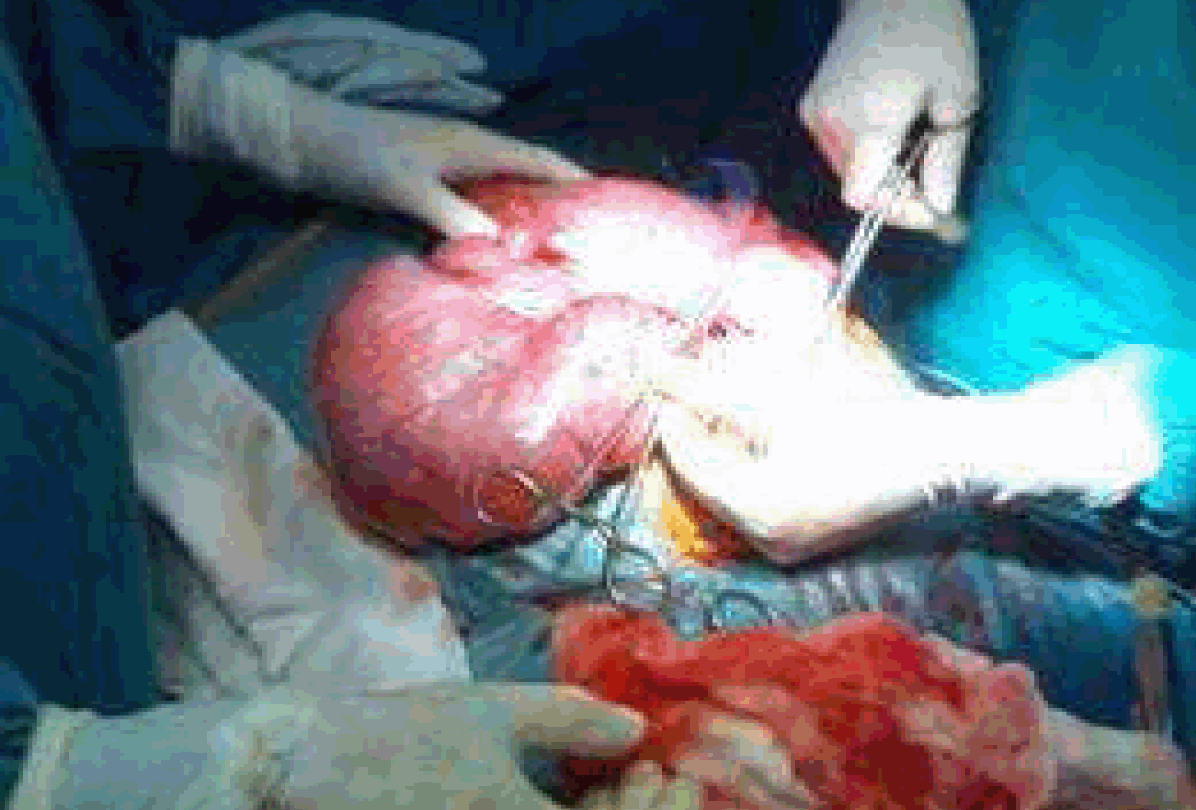
We report the case of a 47-year-old woman who consulted for abdominal fullness and a growing palpable mass in the sub-umbilical region. She did not report any changes in her menstrual cycle or bowel habits. She had no personal past history of neoplasm or hormonal therapy. Physical examination revealed a large, palpable, mobile and painless abdominal-pelvic mass which seemed to take origin in the upper region of the pelvis and extend to the sub-umbilical region. Laboratory tests were within normal limits. Ultrasonography showed a large-sized uterus and heterogeneous masse involving the abdominal cavity. This mass seems taking origin from posterior side of the uterus. Magnetic resonance imaging was performed, which showed a large heterogonous, multivesicular, abdomino-pelvic mass, with high intensity on T2 weighted images and low intensity on T1 weighted images. This mass was arising from the uterus. Diagnosis of an atypical uterine leiomyoma was suspected. The patient underwent exploratory laparotomy that revealed the presence of a large solido-cystic mass (figure 1) included in the broad ligaments, in close contact with retro-peritoneum and extending to the posterior wall of the bladder. This mass was about 40 cm in diameter and was originating from the posterior wall of the uterus and in close contact with sigmoid, rectum and bladder without any intra-mural invasion. Extemporaneous histological examination found a benign tumor proliferation with no evidence of malignancy. However, the histological type of the tumor was difficult to determine. Patient has had hysterectomy with bilateral salpingo-oophorectomy and excision of the tumor. Gross examination showed a solido-cystic tumor that weighted 3650 gm. Histological sections showed that the tumor had a solid-cystic cut surface. The solid areas were whitish and fibrous and showed hemorrhagie. The cystic areas were myxoid. Microscopic examination showed a proliferation of smooth muscle cells without atypia or mitotic activity. The intervening stroma was myxoid and edematous. No vascular invasion or necrosis was observed (figure 2). Less than 5% of cells were positive for Ki67 in immuno-histology. Final patholgy report gave a diagnosis of myxoid uterine leiomyoma without any malignant proliferation. Follow-up was uneventful for the next three years. | ||||||
| ||||||
| ||||||
|
Discussion
| ||||||
|
Leiomyoma are generally firm and rubbery solid tumors. They can undergo various types of degeneration and can be atypical. Different type of degeneration include hyaline, myxoid and cystic degeneration, dystrophic calcification and red degeneration. [1] Among them, hyalinization is the most common type of degeneration, occurring in up to 60% of cases. [2] Myxoid leiomyomas are histologically a specific subtype of degenerated leiomyoma composed primarily of smooth muscle cells, with significant accumulation of a cellular material rich in acid mucins. [3] Clinical diagnosis of myxoid leiomyoma is difficult. In fact this form of leiomyoma is often asymptomatic, and is usually discovered by presented of an abdominal mass and pelvic pain. Our patient had no gynecologic complaint other than a feeling of pelvic heaviness. Radiological investigations are of great help in the diagnosis. In ultrasonography, degenerative leiomyoma is commonly hypoechogenous and excessive degeneration may be recognized as a cystic pattern. [4] In our case, ultrasonography showed the presence of a large mass with solid and multicystic components adjacent to the uterus. Computed-tomography and magnetic resonance imaging (MRI) can remedy these deficiencies preoperatively. [4] [5] [6] Myxoid leiomyoma contains a significant myxoid material between the smooth muscle cells. This myxoid component is heterogonous, high intensity on MRI T2 weighted images. On T1 weighted images, it seems in low intensity, with peripheral contrast enhancement accorded to the multivesicular character. [5] [6] In our case, MRI led to suspecious of the diagnosis and the patient had a hysterectomy with mass excision. The definitive diagnosis of this form of leiomyoma is only by histopathologic examination. Which can determine the myxoid nature of the tumor and eliminate malignancy, especially the myxoid leiomyosarcoma of the uterus. Myxoid changes occur in clinically benign smooth muscle tumors but this phenomenon must be distinguished from myxoid leiomyosarcoma. Myxoid leiomyosarcoma shows infiltrative growth, extensive myxoid change and some degree of nuclear enlargement and pleomorphism. The myxoid stroma in leiomyoma arises from the myxoid degeneration of collagen surrounding nodules of smooth muscle. This connective tissue transformation tends to leave large, thick-walled vessels in the stromer wake, a feature not found in myxoid leiomyosarcoma. When the border between a myxoid tumor and adjacent myometrium becomes infiltrated and the cells large and atypical, the odds become high that the lesion in question is malignant. [7] The lack of cellular and nuclear atypia and the mitotic figures in less than two fields out of 10 fields in microscopy are very similar findings in both tumors. [8] In addition, several studies have shown that uterine leiomyosarcoma have significantly higher Ki67 index and p53 expression levels than benign smooth muscle tumors. [9] In our case, less than 5% of tumor cells expressed Ki67 and diagnosis of benign myxoid leiomyoma was confirmed. | ||||||
|
Conclusion
| ||||||
|
Myxoid leiomyoma of the uterus is a rare benign tumor, its diagnosis remains histological. Leiomyosarcoma should always be ruled out. | ||||||
|
References
| ||||||
| ||||||


|
[HTML Abstract]
[PDF Full Text]
|
|
Author Contributions:
Mbarki Chaouki - Substantial contributions to conception and design, acquisition of data, Drafting the article, revising it critically for important intellectual content, Final approval of the version to be published Najjar Marouen - Substantial contributions to conception and design, acquisition of data, Drafting the article, revising it critically for important intellectual content, Final approval of the version to be published Ben Mna Najet - Substantial contributions to conception and design, acquisition of data, Drafting the article, revising it critically for important intellectual content, Final approval of the version to be published Khediri Zyed - Substantial contributions to conception and design, acquisition of data, Drafting the article, revising it critically for important intellectual content, Final approval of the version to be published Ben Abdelaziz Anis - Substantial contributions to conception and design, acquisition of data, Drafting the article, revising it critically for important intellectual content, Final approval of the version to be published Hedhili Oueslati - Substantial contributions to conception and design, acquisition of data, Drafting the article, revising it critically for important intellectual content, Final approval of the version to be published |
|
Guarantor of submission:
The corresponding author is the guarantor of Submission. |
|
Source of support:
None |
|
Conflict of interest:
The authors declare no conflict of interest. |
|
Copyright:
© Mbarki Chaouki et al. 2012; This article is distributed under the terms of Creative Commons Attribution License which permits unrestricted use, distribution and reproduction in any means provided the original authors and original publisher are properly credited. (Please see http://www.ijcasereportsandimages.com/copyright-policy.php for more information.) |
|
|