
| Table of Contents |  |
|
Case Report
|
| Community acquired methicillin resistant staphylococcus aureus (CA-MRSA) prostatic abscess in a diabetic patient |
| Iqra Javeed1, Parul Kaushik2, Mashiul Chowdhury3, Brandon Palermo3 Christopher L Emery4 |
|
1Medical Student, Department of Infectious Diseases, Drexel University College of Medicine, Philadelphia, PA, USA.
2Fellow, Department of Infectious Diseases, Drexel University College of Medicine, Philadelphia, PA, USA. 3Assistant Professor, Department of Infectious Diseases, Drexel University College of Medicine, Philadelphia, PA, USA. 4Associate Professor, Department of Pathology, Clinical Microbiology Laboratories, Hahnemann University Hospital, Philadelphia, PA, USA. |
|
doi:10.5348/ijcri-2012-91-CR-5
|
|
Address correspondence to: Iqra Javeed 54 Avenue B Lodi New Jersey USA 07644 Phone: 1-973-930-4764 Email: iqrajaveed@gmail.com |
|
[HTML Abstract]
[PDF Full Text]
|
| How to cite this article: |
| Javeed I, Kaushik P, Chowdhury M, Palermo B, Emery CL. Community acquired methicillin resistant staphylococcus aureus (CA-MRSA) prostatic abscess in a diabetic patient. International Journal of Case Reports and Images 2012;3(2):20-23. |
|
Abstract
|
|
Introduction:
Prostatic abscess caused by community acquired methicillin resistant Staphylococcus aureus (CA-MRSA) is very rare with very few previously reported cases. We present here another such case where the signs and symptoms of the patient are markedly different than previously reported cases.
Case Report: A 50-years-old man with diabetes presented to the hospital with cough, fever, general malaise, weight loss, and diffuse abdominal pain. On admission, he was found to have a high grade fever, crackles in left lung, right lower quadrant abdominal pain, and leukocytosis. He was empirically started on levofloxacin and vancomycin. Computed tomography (CT) of the chest showed peripheral ground-glass opacities in the left lung suspicious of septic emboli. His blood and urine cultures both grew MRSA. CT scan of the abdomen and pelvis was done due to his complaint of abdominal pain that showed an enlarged prostate with multiple prostatic abscesses. The largest prostatic abscess was drained under CT guidance, which also grew MRSA. Repeat CT of the abdomen/pelvis and chest after three weeks of treatment showed a decrease in the size and number of prostatic abscesses and pulmonary opacities. Genetic analysis of the isolate was consistent with a CA-MRSA strain. Conclusion: The clinical presentation of our case markedly differs from previously reported cases, as our patient had no signs and symptoms of dysuria, perineal pain, or urinary hesitancy. Also unlike the other cases, we confirmed the identity of MRSA isolate as USA 300 strain, which is the dominant strain of CA-MRSA in the United States. Proper management of prostatic abscess includes drainage as well as appropriate antibiotic therapy. | |
|
Key Words:
Community acquired methicillin resistant Staphylococcus aureus; CA-MRSA; prostatic abscess
| |
|
Introduction
| ||||||
|
Prostatic abscess is usually an ascending infection caused by the reflux of infected urine into the prostatic ducts containing gram-negative bacteria such as Escherichia coli. Other less common organisms include Pseudomonas spp., Staphylococcus spp., and obligate anaerobic bacteria [1] [2]. Staphylococcus aureus can cause prostatic abscess through metastatic spread by blood stream infection. Some signs and symptoms of prostatic abscess include fever, urinary retention, and prostate enlargement. [2] Predisposing factors for prostatic abscess include indwelling catheters, instrumentation of the lower urinary tract, or an immunosuppressive state associated with diabetes mellitus, chronic renal failure, cirrhosis, malignancy, or acquired immunodeficiency syndrome (AIDS). [3] Prostatic abscess caused by community acquired methicillin resistant Staphylococcus aureus (CA-MRSA) is very rare with only few other published cases. Here we present a case where the signs and symptoms of the patient differ from those previously reported. | ||||||
|
Case Report
| ||||||
|
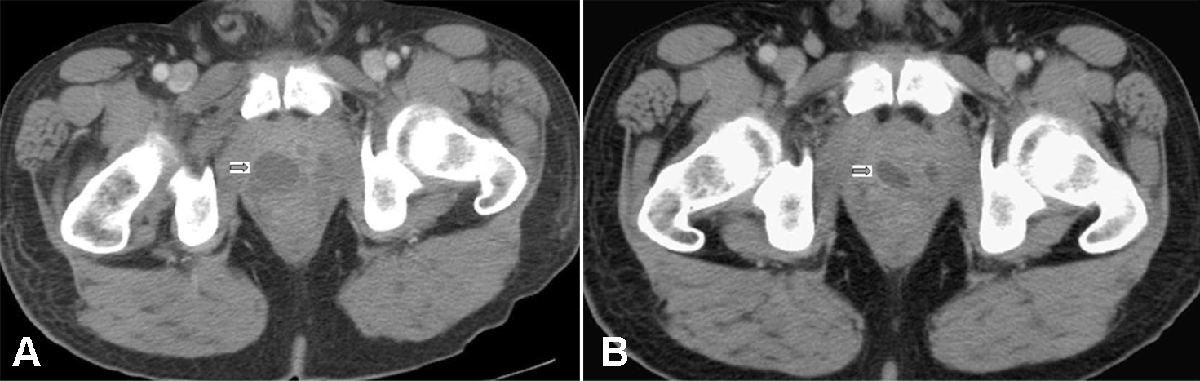
A 50-years-old construction worker with a history of poorly controlled diabetes presented with cough, fever, weight loss, malaise, and diffuse abdominal pain of two weeks duration. He denied dysuria, recent hospitalization, sick contacts or visits to any long-term care facility. His vital signs on admission included a temperature of 101.6°F, pulse of 105 min, and blood pressure of 127/97 mm Hg. Pulmonary examination was significant for crackles in the left lung. Abdominal exam was significant for right lower quadrant tenderness to palpation with rebound tenderness but no guarding. His white blood cell count on admission was 19,100 cells/µl. Urine and blood cultures were drawn and he was empirically started on intravenous Vancomycin and levofloxacin on day 1 of admission. On day two of hospitalization, due to his complaint of diffuse abdominal pain, the patient underwent CT scan of abdomen and pelvis that revealed an enlarged heterogeneous prostate with multiple ring enhancing cystic lesions, the largest one measuring 2.3x2.5x3.5 cm and bladder wall thickening (figure 1A). The largest prostatic abscess was drained under CT guidance, the culture of which grew MRSA. Computed tomography (CT) of chest done on hospital day (HD) three showed peripheral ground-glass opacities in the left lung suspicious of septic emboli (figure 2A). His blood and urine cultures from HD 1 grew methicillin-resistant Staphylococcus aureus (MRSA), sensitive to vancomycin with MIC (Minimum Inhibitory Concentration) of 1 mcg/ml. Repeat blood cultures drawn on day 5 remained positive for MRSA. Blood cultures drawn on day 7 and thereafter remained negative. Trans-esophageal echocardiography (TEE) performed after two weeks of antibiotic treatment did not show any valvular vegetations. Repeat CT of the chest and abdomen/pelvis on HD 20 showed a decrease in the size and number of prostatic abscesses (figure 1B) and pulmonary opacities (figures 2B). The largest prostatic abscess size had decreased to 2x1.5x3.3 cm. Despite being treated with vancomycin for three weeks, he continued to spike intermittent fevers although repeat blood cultures remained negative. IV vancomycin was changed to IV daptomycin after which the patient remained afebrile. He was discharged on IV home infusion of daptomycin for six weeks. The MRSA isolate recovered from the patient's blood was sent to a research laboratory in Cooper University, New Jersey. With PCR testing, the isolate was found to be panton valentine leukocidin toxin (PVL), mec A type IV and type I arginine catabolic mobile element (ACME) positive, which is consistent with a highly virulent USA 300 profile. | ||||||
| ||||||
|
| ||||||
|
Discussion
| ||||||
|
Community-acquired MRSA infection is defined according to the following criteria: i) identification of MRSA in a patient with signs and symptoms of infection within 48 hours after admission to the hospital, ii) no history of a previous MRSA infection or colonization, iii) no history of admission to a nursing home or hospital within the previous year, and iv) absence of any indwelling catheters. [4] Even though Staphylococcus aureus is known to cause deep-seated and occult abscesses, CA-MRSA prostatic abscess is a very rare entity with only a few other published cases in the literature. The first reported case of CA-MRSA was a patient with a history of intravenous drug abuse (IVDA) and hepatitis C who presented with dysuria, tender prostate, perineal pain, slow urinary stream, and urinary hesitancy. [5] The second reported case was a diabetic patient who presented with dysuria, fatigue, weight loss, and a tender prostate. [6] The third reported case was a patient with human immunodeficiency virus (HIV) and AIDS who presented with fever, dysuria, and suprapubic pain. [7] The fourth reported case was a patient with HIV who presented with fever, urinary hesitancy, and intermittent abdominal pain that was relieved following urination. [8] Another case of CA-MRSA prostatitis has been reported by Beckman et al. This patient, with a history of diabetes and hypertension, presented with fever, urinary urgency, chills and fatigue. He was found to have CA-MRSA prostatitis but not a prostatic abscess. [9] There have been a few other cases of MRSA prostatic abscess in the literature but it is difficult to determine whether MRSA in those cases was community or hospital acquired. For example, Fraser et al. describe a case of MRSA prostatic abscess in a patient who had multiple other comorbidities and it was unknown when he was last hospitalized and whether he was frequently in a healthcare setting. [10] Tobian et al. report a case of a patient with diabetes who presented with urinary symptoms and was found to have dual perinephric and prostatic MRSA abscesses. The authors of that case specifically mention that it was unclear whether the bacterium was hospital or community acquired without further laboratory testing. [11] Interestingly unlike our patient, all the patients in these cases had specific signs and symptoms of prostatic abscess such as dysuria, pelvic pain or tender prostate. However, it is not unusual for prostatic abscess to present with non-specific symptoms of abdominal pain, malaise and weight loss. [12] Also, unlike the other cases, our patient continued to spike fevers despite having adequate vancomycin trough levels (15 - 20 mcg/ml). Since his subsequent blood cultures were negative and he was asymptomatic, we believe the persistent fevers could be drug-induced fever and his fevers resolved once the antibiotic was changed to daptomycin. Although vancomycin is the first line of therapy for blood stream infections caused by MRSA, daptomycin has been found to have similar efficacy as vancomycin for treatment of complicated skin and soft tissue infections in two blinded trials. [4] In addition, unlike previously reported cases, we confirmed the identity of the MRSA strain as USA 300. USA 300 strain has been found to be a dominant strain of CA-MRSA in the United States in a large prospective study. [13] Even though TEE failed to reveal any valvular vegetation, our patient had clinical signs of right-sided endocarditis with discrete pulmonary opacities that shrank with antibiotic treatment. TEE can be negative in the setting of possible infectious endocarditis in 10% of cases especially if the vegetation is small or has already embolized. [14] | ||||||
|
Conclusion
| ||||||
|
Prostatic abscess caused by CA-MRSA is a very rare entity with only three other published cases in the literature. Our case is the first to illustrate that urinary symptoms may be absent in the presence of a prostatic abscess. Proper management includes drainage of the abscess and appropriate antibiotic therapy. | ||||||
|
Acknowledgements
| ||||||
|
We thank Henry S. Fraimow MD, Associate Professor of Medicine, Division of Infectious Diseases, Cooper University Hospital, Camden, New Jersey, USA, for doing genetic analysis of MRSA isolate. | ||||||
|
References
| ||||||
| ||||||


|
[HTML Abstract]
[PDF Full Text]
|
|
Author Contributions:
Iqra Javeed - Conception and design, Acquisition of data, Analysis and interpretation of data, Drafting the article, Critical revision of the article, Final approval of the version to be published Parul Kaushik - Conception and design, Acquisition of data, Analysis and interpretation of data, Drafting the article, Critical revision of the article, Final approval of the version to be published Mashiul Chowdhury - Conception and design, Acquisition of data, Analysis and interpretation of data, Critical revision of the article, Final approval of the version to be published Brandon Palermo - Analysis and interpretation of data, Critical revision of the article, Final approval of the version to be published Christopher L. Emery - Analysis and interpretation of data, Drafting the article, Critical revision of the article, Final approval of the version to be published |
|
Guarantor of submission:
The corresponding author is the guarantor of Submission. |
|
Source of support:
None |
|
Conflict of interest:
The authors declare no conflict of interest. |
|
Copyright:
© Iqra Javeed et al. 2012; This article is distributed under the terms of Creative Commons Attribution License which permits unrestricted use, distribution and reproduction in any means provided the original authors and original publisher are properly credited. (Please see http://www.ijcasereportsandimages.com/copyright-policy.php for more information.) |
|
|