
| Table of Contents |  |
|
Case Report
|
| Case of pre and post-subclavian coarctation of aorta associated with aberrant right subclavian artery and symptomatic aneurysm of the distal aortic arch |
| Shivananda Siddappa1, Vikram Patra2, Srujal N Shah2, Madathipat Unnikrishnan3 |
|
1Adhoc consultant, Dept of CVTS, Sree Chitra Institute for Medical Sciences and Technology, Trivandrum, Kerala India.
2Senior Resident, Dept of CVTS, Sree Chitra Institute for Medical Sciences and Technology, Trivandrum, Kerala India. 3Senior Professor, Dept of CVTS, Sree Chitra Institute for Medical Sciences and Technology, Trivandrum, Kerala India |
|
doi:10.5348/ijcri-2011-11-69-CR-7
|
|
Address correspondence to: Shivananda Siddappa Adhoc consultant, Dept of CVTS Sree Chitra Institute for Medical Sciences and Technology Trivandrum Kerala India - 695035 Phone: 91-9995851796 Fax: 91-471-2446433 Email: shivananda.s@gmail.com |
|
[HTML Abstract]
[PDF Full Text]
|
| How to cite this article: |
| Siddappa S, Patra V, Shah SN, Unnikrishnan M. Case of pre and post-subclavian coarctation of aorta associated with aberrant right subclavian artery and symptomatic aneurysm of the distal aortic arch. International Journal of Case Reports and Images 2011;2(11):25-27. |
|
Abstract
|
|
Introduction:
We report a complex case of pre and post-subclavian coarctation of aorta associated with aberrant right subclavian artery and symptomatic aneurysm of the distal aortic arch.
Case Report: Although CT scan of the chest had clinched the diagnosis, aortic anatomy was further elucidated on digital subtraction angiography when coronary angiogram was performed for cardiac risk stratification. Patient underwent repair of aneurysm and coarctation concurrently under profound hypothermia and total circulatory arrest. Post-op recovery was uneventful. Conclusion: Judicious use of total circulatory arrest along with tailored surgical strategy provided optimal operating conditions leading to excellent recovery. | |
|
Key Words:
Coarctation of aorta, Aberrant right subclavian artery, Distal arch aneurysm, Total circulatory arrest
| |
|
Introduction
|
|
We report a complex case of pre and post-subclavian coarctation of aorta associated with aberrant right subclavian artery and symptomatic aneurysm of the distal aortic arch. |
|
Case Report
|
|
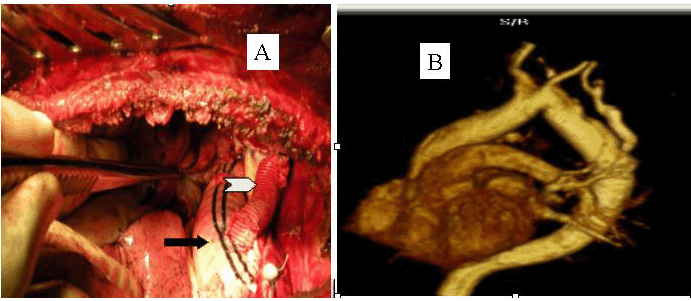
A 46-year-old male presented with back pain and hoarseness of voice for three weeks duration. Patient was on regular treatment for hypertension with amlodopine 5 mg once daily since five years. Clinical examination was unremarkable. Blood pressure in all four limbs was found to be nearly equal at 120/90 mm Hg. All the hematological and biochemical investigations were within normal limits. Chest x-ray performed was within normal limits. In view of persistent hoarseness of voice patient was advised to undergo a Computed tomography (CT) Scan. CT scan showed aneurysm involving distal aortic arch and ectasia of the descending thoracic aorta (DTA). Digital subtraction angiography (DSA) (figure 1A) showed significant pre and moderate post subclavian coarctation of the aorta with aneurysm of distal aortic arch, ectasia of the DTA and aberrant right subclavian artery. After obtaining cardiac fitness for surgery, aneurysm repair was planned. Under general anesthesia, distal aortic arch and DTA was exposed by posterolateral thoracotomy through left 4th intercostal space. After institution of femoro-femoral bypass, main pulmonary artery was cannulated to optimise venous drainage. Patient was cooled to 30°C. This was achieved by actively cooling the patient under cardio-pulmonary bypass with temperature regulation using a water bath. After drainage of one third of patient's blood volume, patient was placed under total circulatory arrest. The blood volume was drained using femoral venous and the main pulmonary artery cannulae (figure 1B, black arrow). Aneurysm was opened under TCA and the coarctation ridge was partially excised. Proximal anastamosis was done using 20 mm coated woven graft (Albograft Edwards Lifesciences) just distal to left common carotid artery. After the completion of proximal anastamosis, 22F cannula inserted into the graft facilitated ante-grade cardio-cerebral perfusion with 200 cc/min at 18°C, thereby protecting heart and brain. During the period of total circulatory arrest (TCA) there was no perfusion to the entire body including brain and the heart. The TCA time was 38 minutes. The temperature was maintained at 18°C during the period of TCA. The distal aorta was perfused through the femoral cannula, thereby limiting the total circulatory arrest time for construction of proximal anastamosis. Attempt was made to carrel the aortic patch bearing both subclavian ostia. Due to insecure suture line, ostium of the aberrant right subclavian artery was suture ligated and 8 mm Dacron graft side limb was sutured to the ostium of left subclavian artery (figure 2A). Distal anastamosis was performed to the normal segment of DTA. Patient was ventilated for 24 hours after completion of the procedure and stayed in the intensive care unit for four days. Patient was discharged on the 12th post-operative day. Patient was asymptomatic with blood pressure measured at 120/80 mm Hg in left upper limb and 30 mm Hg lower in right upper limb. Magnetic resonance imaging done six months after discharge showed intact anastamosis, patent left subclavian artery and aberrant right subclavian artery filling retrogradely from the vertebral artery (figure 2 B). During follow-up at one year, patient enjoys normal health, regaining full activities. |
|
|
|
|
|
Discussion
|
|
Isolated coarctation of aorta remains asymptomatic till subject develops systemic hypertension. Our patient had severe pre-subclavian and moderate post- subclavian coarctation along with aberrant right subclavian artery masking the onset of hypertension till distal arch became aneurismal leading to backache. Presence of aberrant right subclavian artery in the setting of pre-subclavian coarctation of aorta delayed the diagnosis of coarctation since blood pressure measured in all four limbs were nearly equal in contra-distinction to classic post subclavian coarctation of aorta. Significant pre-subclavian coarctation also led to distal arch aneurysm. The classic presentation of cephalo-brachial hypertension, feeble lower limb pulses and brachio-femoral delay was not evident in our patient who had equal blood pressure in all four limbs in the clinical setting of pre-subclavian coarctation with aberrant right subclavian artery. Only when arch aneurysm due to the jet lesion grew in size, patient sought medical help. Although conventionally off pump surgical procedure is feasible for repair of pre subclavian coarctation of aorta, large distal aortic arch aneurysm mandated repair on total circulatory arrest for proximal anastamosis. [1] [2] More over obtaining proximal control close to left common carotid artery is associated with risk of injury to vagus and recurrent laryngeal nerves and pulmonary artery. Following the circulatory arrest period mandated for proximal anastamosis, antegrade cardio-cerebral perfusion was achieved by graft cannulation while distal anastamosis was being performed. Perfusion through femoral cannula provided blood flow to kidneys, gastro intestinal tract and spinal cord while distal anastamosis was being carried out thus protecting system function. Although an attempt was made to carrel both subclavian arteries onto the graft, uneven margins and deeply positioned tissue planes made the attempt unsuccessful. Hence the ostium of aberrant right subclavian artery was suture ligated and a 8 mm Dacron graft side limb was used to reconstruct the left subclavian artery. Our literature search has identified one report of left subclavian artery aneurysm in association with coarctation of aorta, aberrant right subclavian artery and common origin of bilateral carotid arteries [3] and another article with right aortic arch, right subclavian artery aneurysm and aberrant left subclavian artery. [4] This is the first case report in literature describing pre and post subclavian coarctation of aorta with aberrant right subclavian artery and aneurysm of distal aortic arch. Keeping in tune with the surge in endovascular therapeutic modality for thoracic aortic pathology, some centers deploy covered stent across the aortic coarctation , particularly in adults. [5] [6] Stenting the severely narrowed aorta with moderated and staged balloon angioplasty is least stressful in contrast to excision with graft interposition in the setting of adult coarctation. In our patient with pre-subclavian short deployment zone with risk of compromise of flow into the left common carotid artery, distal arch aneurysm, and with varying dimensions of the aorta at the distal arch and post coarctation segment and presence of right aberrant subclavian artery, stent graft deployment was considered unsuitable. Moreover, it would have necessitated bypasses to left common carotid and both subclavian arteries prior to relining the aorta in the present clinical setting. |
|
Conclusion
|
|
We report a case of pre and post-subclavian coarctation of aorta in a 46-year-old male presenting with backache due to distal aortic arch aneurysm along with aberrant right subclavian artery. Judicious use of total circulatory arrest along with tailored surgical strategy provided optimal operating conditions leading to excellent recovery. |
|
References
|
|


|
[HTML Abstract]
[PDF Full Text]
|
|
Author Contributions:
Shivananda Siddappa - Conception and design, Acquisition of data, Analysis and interpretation of data, Drafting the article, Final approval of the version to be published Vikram Patra - Analysis and interpretation of data, Drafting the article, Critical revision of the article, Final approval of the version to be published Srujal N Shah - Conception and design, Drafting the article, Final approval of the version to be published Madathipat Unnikrishnan - Conception and design, Critical revision of the article, Final approval of the version to be published |
|
Guarantor of submission:
The corresponding author is the guarantor of submission. |
|
Source of support:
None |
|
Conflict of interest:
Authors declare no conflict of interest. |
|
Copyright:
© Shivananda Siddappa et. al. 2011; This article is distributed the terms of Creative Commons Attribution License which permits unrestricted use, distribution and reproduction in any means provided the original authors and original publisher are properly credited. (Please see Copyright Policy for more information.) |
|
|