
| Table of Contents |  |
|
Clinical Image
|
| Acute middle cerebral artery thrombus |
| Siva K Talluri1, Siddesh Besur2 |
|
1Clinical assistant professor, Department of Internal Medicine, Michigan State University Internal Medicine residency program, McLaren Regional Medical Center, Flint, Michigan.
2Clinical assistant professor, Department of Internal Medicine, Michigan State University Internal Medicine residency program, McLaren Regional Medical Center, Flint, Michigan. |
|
10.5348/ijcri-2011-10-62-CI-6
|
|
Address correspondence to: Siva K Talluri 401 S. Ballenger Hwy Suite 450 Flint MI 48532 USA Phone: 001-810-342-5805 Fax: 001-810-342-5810 Email: talluri1@msu.edu |
|
[HTML Abstract]
[PDF Full Text]
|
| How to cite this article: |
| Talluri SK, Besur S. Acute middle cerebral artery thrombus. International Journal of Case Reports and Images 2011;2(10):23-24. |
|
Case Report
| ||||||
|
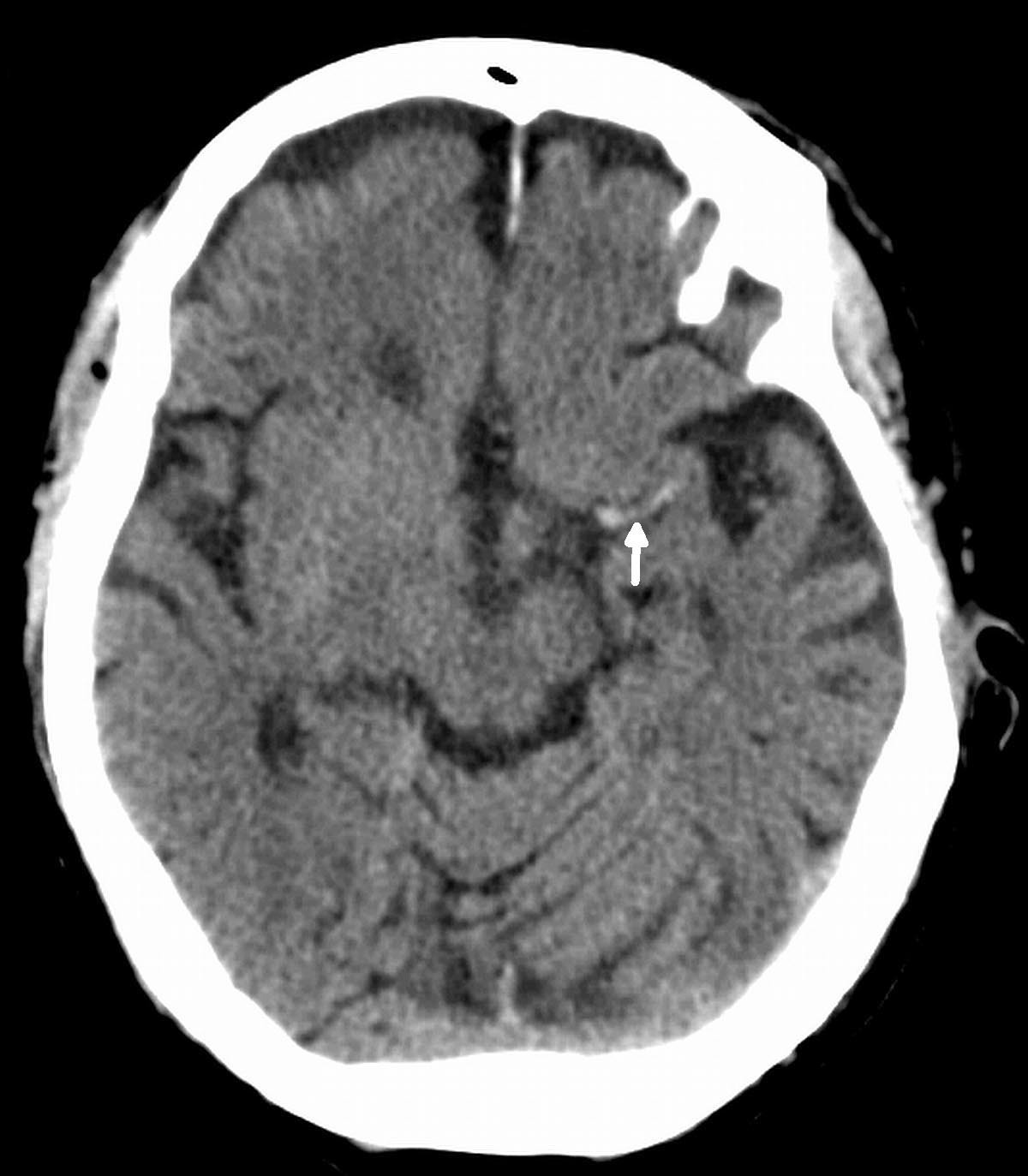
An 87-year-old man presented with sudden onset of right arm and leg weakness associated with difficulty in speech. His past medical history was significant for hypertension and paroxysmal atrial fibrillation. He was afebrile and hemodynamically stable. He was alert and oriented to time, place and person. Neurologic examination revealed global aphasia with right sided inattention and right sided hemiplegia with power of 1/5 in the right arm and leg. Rest of the physical examination was normal. A non-contrast Computed tomography (CT) scan of head done at presentation revealed a hyperdense left middle cerebral artery suggestive of an acute thrombus (Figure 1, arrow). Repeat non-contrast CT scan of the head performed 72 hours later revealed an acute left middle cerebral artery infarct with mild mass effect on the left lateral ventricle (Figure 2, arrow). | ||||||
| ||||||
| ||||||
|
Discussion
| ||||||
|
Non-contrast CT of the head is done in the initial evaluation of patients with stroke like symptoms to exclude intracerebral hemorrhage. An intracerebral infarct may not be visible for 24 hours after the onset of stroke.The hyperdense middle cerebral artery on non-contrast head CT suggests intra-arterial clot in the presence of clinical findings suggestive of stroke. It is most useful and earliest radiological signs of ischemic stroke. [1] It is specific (specificity 100%) [2] but less sensitive (sensitivity 5-50%) [1] [3] and correlates with middle cerebral artery occlusion. [3] Though highly specific, hyperdense middle cerebral artery sign can also be seen in patients with vascular calcification and elevated hematocrit. [4] The other early signs seen in middle cerebral artery occlusion are hypodensity of brain parenchyma and cerebral edema with sulcal effacement. [5] It predicts neurologic deterioration and indicates poor prognosis. [6] Hyperdense middle cerebral artery sign disappeared on a repeat CT scan 22-36 hours after thrombolysis in 48% of the patients. The disappearance of the sign indicates vessel recanalization and better prognosis. [7] | ||||||
|
Conclusion
| ||||||
|
The hyper dense artery sign on non-contrast CT scan of the head is one of the earliest signs of intra-arterial clot and stroke in the presence of clinical findings. | ||||||
|
References
| ||||||
| ||||||


| [HTML Abstract] [PDF Full Text] |
|
Author Contributions:
Siva K Talluri - Substantial contributions to conception and design, Acquisition of data, Analysis and interpretation of data, Drafting the article, Revising it critically for important intellectual content, Final approval of the version to be published Siddesh Besur - Substantial contributions to conception and design, Acquisition of data, Analysis and interpretation of data, Drafting the article, Revising it critically for important intellectual content, Final approval of the version to be published |
|
Guarantor of submission:
The corresponding author is the guarantor of submission. |
|
Source of support:
None |
|
Conflict of interest:
The authors declare no conflict of interests. |
|
Copyright:
© Siva K Talluri et al. 2011; This article is distributed the terms of Creative Commons Attribution License which permits unrestricted use, distribution and reproduction in any means provided the original authors and original publisher are properly credited. (Please see Copyright Policy for more information.) |
|
|