
| Table of Contents |  |
|
Case Report
|
| Intraparotid facial nerve schwannoma: A case report |
| Wasif Mohammad Ali1, Mohammad Aslam1, MH Beg1 |
|
1J.N Medical College, A.M.U, Aligarh, India.
|
|
doi:10.5348/ijcri-2011-08-48-CR-3
|
|
Address correspondence to: Wasif Mohammad Ali Department of Surgery J.N Medical College A.M.U Aligarh India Phone: 91-09897238280 Email: wasifali110@yahoo.com |
|
[HTML Abstract]
[PDF Full Text]
|
| How to cite this article: |
| Ali WM, Aslam M, Beg MH. Intraparotid facial nerve schwannoma: A case report. International Journal of Case Reports and Images 2011;2(8):8-11. |
|
Abstract
|
|
Introduction:
Intraparotid facial nerve schwannoma is a rare tumor accounting for only 0.2 - 1.5 % of all parotid tumors. We present this case because this tumor grows slowly and rarely produces signs and symptoms thus mimicking pleomorphic adenoma which is much more common. When it is diagnosed peroperatively the management differs significantly and is a matter of debate with few favoring complete excision whereas others favoring a more conservative approach avoiding resection and going only with biopsy for histological confirmation.
Case Report: We report a case of a middle aged male with a parotid swelling. The patient was investigated and a diagnosis of pleomorphic adenoma was made. The patient was operated and peroperatively the frozen section biopsy revealed a facial nerve schwannoma. Conclusion: Facial nerve schwannoma though rare should be also considered in the differential diagnoses of the slowly enlarging parotid swellings because most of the time diagnosis is made peroperatively and then the surgeon finds himself in dilemma as to the best plan of management since it is still a matter of debate. We have discussed the various indications for operative management of the facial nerve schwannoma and stressed the importance of the size of the tumor and the patient's preference for operation. | |
|
Key Words:
Intraparotid, Facial nerve, Schwannoma
| |
|
Introduction
| ||||||
|
Schwannomas are benign tumors of neuroectodermal origin as they arise from the schawnn cells. They are generally solitary and well encapsulated. [1] They can arise from any peripheral nerve but 25-45% of them occur in head and neck region. [2] They mostly involve the VIII cranial nerve. Occasionally VII cranial nerve may also be involved. Though it may arise from any part of the facial nerve but the intratemporal part is more commonly involved with rare involvement of the intraparotid part. It is very difficult to preoperatively diagnose intraparotid facial nerve schwannoma (FNS) because it its incidence is rare accounting for only 0.2 - 1.5 % of all parotid tumors and rarely produces any signs and symptoms. [3] Moreover, there is no diagnostic modality that can diagnose it with certainty. Therefore the diagnosis is generally made peroperatively when the surgeon finds difficulty in locating the facial nerve and is then required to make an unexpected decision. We are presenting this case to highlight its rare occurrence and review the literature from previous studies that may help in decision making when any surgeon encounters it peroperatively. | ||||||
|
Case Report
| ||||||
|
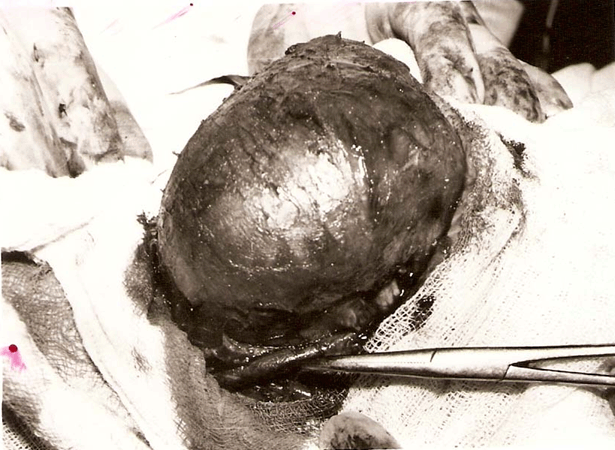
A 41-year-old male presented to the outpatient department with complaints of gradually increasing mass in the parotid region for the last four years. On examination a lump of 10x8 cm was present in the lower part of the parotid gland extending up to the submandibular region as shown in figure 1. It was mobile and firm in consistency. Rest of the head and neck examination was normal. Ultrasonogram (USG) showed a hypoechoeic mass of about 12x8 cm. Fine needle aspiration cytology (FNAC) was suggestive of pleomorphic adenoma. Based on the investigations, a provisional diagnosis of pleomorphic adenoma was made. The case was discussed with the patient and possible facial nerve complications were explained. Peroperatively after superficial parotidectomy the tumor was exposed. It was found to arise from the facial nerve and could not be separated from the main trunk as shown in figure 2. The tumor was removed along with involved segment of the facial nerve and end to end cable graft using greater auricular nerve was done. In the immediate post operative period, the patient had House-Brackmann grade IV palsy which improved to grade III palsy in 12 months. The histopathological examination showed the spindle shaped cells with ill defined cytoplasm arranged in clusters (verocay bodies) as shown in figure 3 and 4. | ||||||
| ||||||
| ||||||
| ||||||
| ||||||
|
Discussion
| ||||||
|
The intraparotid FNS are mostly (75%) asymptomatic. The tumor grows eccentrically pushing the nerve fibers away. The ability of the parotid to accommodate the expanding tumor results in facial nerve palsy in only 20-27% of cases. [4] In some cases radiology may provide preoperative information about FNS but in many cases it mimics pleomorphic adenoma. [5] The CT scan although not the preferred method of imaging shows a smooth and sharply defined mass in the parotid. Gadolinium enhanced MRI is better for visualizing these lesions. It can show the course of the facial nerve and can tell whether the schwannoma is intraparotid or intratemporal. Intraparotid schwannomas are isointense to muscle mass on the T1 weighted image and a target sign with central low and peripheral higher signal intensity areas on T2 weighted image. FNAC is also unreliable for diagnosing these lesions as in most cases results are inconclusive or suggest a pleomorphic adenoma. [6] The diagnosis is therefore generally made peroperatively when the surgeon finds difficulty in identifying the facial nerve and electrical stimulation of the tumor points to diagnoses of FNS. The experience of the M Guzzo et al. shows that 75% of the intraparotid FNS remain undiagnosed preoperatively. [7] Kreeft et al. [8], reported that schwannomas can rarely be separated while preserving the integrity of the facial nerve and most of the patients submitted to any surgical resection present a very poor functional outcome. [7] The best that can be achieved by any means was in House-Brackmann grade III facial palsy. [8] Thus the timing of surgical intervention in FNS is a matter of debate while some favoring early surgical intervention whereas others having a more conservative view. We believe that on encountering the FNS preoperatively surgical intervention should be considered depending upon the, patient's age and preferences, preoperative facial nerve function and extent and biological behavior of the tumor as opinioned by G. Frympas et al. [9] In our case the size of the tumor was quite big and would have involved the facial nerve very soon. Moreover, the patient's preference to get the tumor operated was the main indication for the surgical intervention. The tumor was removed en block with the facial nerve followed by immediate facial nerve reconstruction by end to end cable grafting. Most of the surgeons are of the view that immediate microsurgical reconstruction is mandatory when facial nerve has been resected and the interposed nerve graft is better than the facial hypoglossal crossover technique. [10] | ||||||
|
Conclusion
| ||||||
|
We conclude that the FNS is very rare and most of the time the diagnoses is made peroperatively. The best plan of management is still a matter of debate but the decision should be based on the patient's preference and the best facial nerve functional outcome. | ||||||
|
References
| ||||||
| ||||||



|
[HTML Abstract]
[PDF Full Text]
|
|
Author Contributions:
Wasif Mohammad Ali - Substantial contributions to conception and design, Analysis and interpretation of data, Drafting the article, Final approval of the version to be published Mohammad Aslam - Substantial contributions to conception and design, Drafting the article, Final approval of the version to be published M.H Beg - Substantial contributions to conception and design, Drafting the article, Final approval of the version to be published |
|
Guarantor of submission:
The corresponding author is the guarantor of submission. |
|
Source of support:
None |
|
Conflict of interest:
Authors declare no conflict of interest. |
|
Copyright:
© Wasif Mohammad Ali et al. 2011; This article is distributed the terms of Creative Commons Attribution License which permits unrestricted use, distribution and reproduction in any means provided the original authors and original publisher are properly credited. (Please see Copyright Policy for more information.) |
|
|