
| Table of Contents |  |
|
CLINICAL IMAGE
|
| A dreaded complication of MRSA infection |
| Jason C. Paik1, Mary Elaine Killian1, Jennifer J. Feldhaus1, Carlos Estrada2 |
|
1School of Medicine, The University of Alabama at Birmingham, Birmingham, Alabama, United States.
2Birmingham Veterans Affairs Medical Center, Division of General Internal Medicine, Department of Medicine, The University of Alabama at Birmingham, Birmingham, Alabama, United States. |
|
doi:10.5348/ijcri-2011-03-25-CI-5
|
|
Address correspondence to: Carlos Estrada Division of General Internal Medicine University of Alabama School of Medicine FOT 732, 510, 20th Street South Birmingham, AL 35294 United States Phone: +001(205)934-3007 Fax: +001(205)975-7797 Email: cestrada@uab.edu |
|
[HTML Abstract]
[PDF Full Text]
|
| How to cite this article: |
| Paik JC, Killian ME, Feldhaus JJ, Estrada C. A dreaded complication of MRSA infection. International Journal of Case Reports and Images 2011;2(3):17-20. |
|
Case Report
|
|
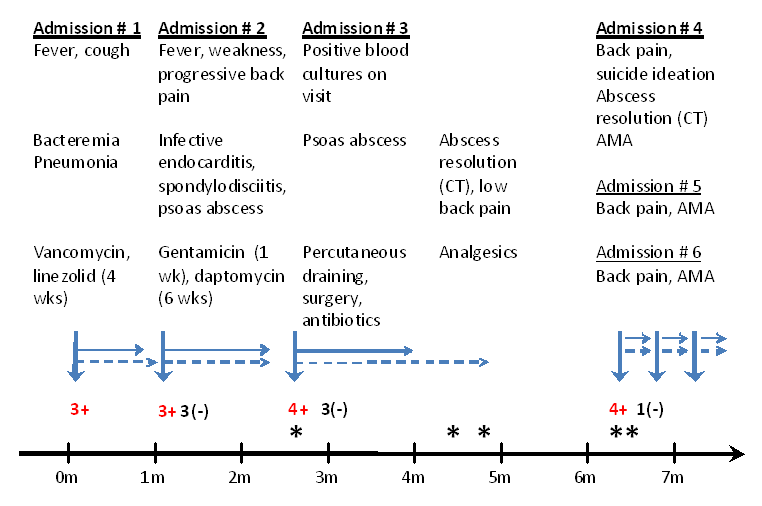
Over a 7-month period, a 54-year-old male with poorly-controlled diabetes mellitus, chronic hepatitis C infection, chronic low-back pain, and active intravenous drug abuse developed Methicillin-resistant Staphylococcus aureus (MRSA) endocarditis, L1-L2 spondylodisciitis with vertebral osteomyelitis, and a psoas abscess (Figure 1, timeline). He initially presented with pneumonia and persistent MRSA bacteremia (Figure 1, Admission #1), for which he received a prolonged course of vancomycin and linezolid. Few days after completing treatment, he presented with recurrence of fever, generalized weakness, and worsening back pain (Figure 1, Admission #2). During this hospitalization, he was found to have infective endocarditis, L1-L2 spondylodisciitis with vertebral osteomyelitis, and a small psoas abscess. The psoas abscess was deemed too small for percutaneous drainage or surgical debridment. He received one week of gentamicin and five-week course of daptomycin at a long-term nursing facility; he declined further antibiotic therapy and left the nursing facility. One week later, he presented to the infectious disease outpatient clinic for routine follow-up. At this time, his chronic low-back pain remained unchanged and he had no fever. He was hospitalized (Figure 1, Admission #3) after routine blood cultures grew MRSA in four sets (within 24 hours). During this hospitalization, a contrast-enhanced T1 magnetic resonance image (MRI) showed a large psoas abscess (Figure 2, panel A, arrow) extending into L1-L2 vertebral bodies (stars). A transverse view showed epidural extension (Figure 2, panel B, arrowhead) and left kidney displacement by the psoas abscess (arrow). During this period, he underwent catheter drainage of the abscess and received vancomycin and gentamycin. Due to continued infection (persistently positive blood cultures), he underwent L1-L2 vertebrectomy, cord decompression, debridement, and spinal reconstruction. A postoperative lateral radiograph shows T10-L4 posterior internal fixation of the spinal cord (Figure 2, panel C, arrows) and installation of a mechanical distractable interbody device (arrowhead). After a prolonged course of antibiotics, although the patient declined them intermittently, he had resolution of the infection. He was hospitalized multiple times (Figure 1, Admissions #4-6) with worsening back pain and suicide ideation. Although he had no fever and the abscess had resolved on repeated tomographic scanning, he had persistent MRSA bacteremia. During these last three hospitalizations, he received intermittent doses of vancomycin (due to patient declining to receive intravenous antibiotics) and trimethoprim-sulfamethoxazole. He left the institution against medical advice several times and eloped from a long-term nursing facility. During the three months after hospital discharge, the institution attempted to contact him ten times, without success. He is lost to follow-up.
|
|
|
|
|
|
Discussion
|
|
MRSA infection is a growing public health problem; it is now the most common pathogen causing skin and soft-tissue infection in many cities in the United States. [1] Furthermore, among injection drug users, MRSA infection is a growing problem [2] and in one study only 13% of isolates of community-acquired MRSA isolates are susceptible to clindamycin. [3] The vertebral complications of S. aureus infection include vertebral osteomyelitis, spondylodisciitis, and epidural abscess. At increased risk are patients with infective endocarditis, injection drug users, patients on hemodialysis or insulin, and patients undergoing invasive procedures. [4] Invasive procedures include intravenous catheters, direct spinal injections, or surgical interventions. Psoas abscess with extension into the epidural space and vertebral bodies is a rare, but known complication of MRSA bacteremia. The management of vertebral complications of MRSA infection requires a multidisciplinary approach to eradicate the infection and to prevent complications. Antibiotic therapy, drainage of abscess, spinal decompression, vertebrectomy, and removal of devitalized tissue and surrounding fluid collections are all alternatives for the appropriate clinical presentation. [5] [6] For patients undergoing extensive surgical debridment, vertebrectomy is sometimes necessary. The spinal instability that results from this approach can be managed with the insertion of autologous bone grafts or mechanical devices as a replacement of the vertebral body. A variety of devices are available for such vertebral body replacement some of which include titanium mesh cage, distractable vertebral cages, and expandable cages. [7] [8] [9] [10] Vertebral body replacement is also used in other patients with spinal instability due to metastatic tumors or burst fractures. Such devices are well known among specialized spine surgeons, however, they are not well known among general practitioners or hospital physicians who may care for these patients. Our patient received a mechanical distractable interbody device. However, his management was complicated by uncontrolled diabetes, non-adherence, continued substance abuse, extensive involvement of musculoskeletal structures, and prolonged operation with installation of hardware.
|
|
Conclusion
|
|
Patients with ongoing substance abuse illustrate the difficulties in managing complex infections. The introduction of foreign bodies further increases the risk of infection in non-adherent patients. Finally, general practitioners and hospital physicians may need to be aware of the existence of mechanical devices for vertebral replacement; the management of pain and infections is complex..
|
|
References
|
|


| [HTML Abstract] [PDF Full Text] |
|
Acknowledgement:
We thank Dr. Daniel Allendorf for critical revisions of the manuscript. |
|
Author Contributions:
Jason C. Paik - Conception and design, Acquisition of data, Analysis and interpretation of data, Drafting the article, Critical revision of the article, Final approval of the version to be published Mary Elaine Killian - Conception and design, Acquisition of data, Analysis and interpretation of data, Drafting the article, Critical revision of the article, Final approval of the version to be published Jennifer J. Feldhaus - Conception and design, Acquisition of data, Analysis and interpretation of data, Drafting the article, Critical revision of the article, Final approval of the version to be published Carlos Estrada - Conception and design, Acquisition of data, Analysis and interpretation of data, Drafting the article, Critical revision of the article, Final approval of the version to be published |
|
Guarantor of submission:
The corresponding author is the guarantor of submission. |
|
Source of support:
None |
|
Conflict of interest:
The author(s) declare no conflict of interests |
|
Copyright:
© Jason C. Paik et. al. 2010; This article is distributed the terms of Creative Commons Attribution License which permits unrestricted use, distribution and reproduction in any means provided the original authors and original publisher are properly credited. (Please see Copyright Policy for more information.) |
|
|