
| Table of Contents |  |
|
CASE REPORT
|
| Severe rheumatic mitral stenosis in a young caucasian man: A forgotten entity |
| Prashanth Raju1, Gopala Krishna Rao1, Lindsay Morrison2, Robert S. Hornung1 |
|
1Aintree Cardiac Centre, University Hospital Aintree, Liverpool, L9 7AL, UK.
2Liverpool heart and chest hospital, Liverpool, L14 3PE, UK. |
|
doi:10.5348/ijcri-2011-03-23-CR-3
|
|
Address correspondence to: Dr. Prashanth Raju 309 Osler house, Kings Drive Eastbourne BN21 2YT United Kingdom Phone: 01323410266 Email: dr_prashanthraj@yahoo.com |
|
[HTML Abstract]
[PDF Full Text]
|
| How to cite this article: |
| Raju P, Rao GK, Morrison L, Hornung RS. Severe rheumatic mitral stenosis in a young caucasian man: A forgotten entity. International Journal of Case Reports and Images 2011;2(3):9-11. |
|
Abstract
|
|
Introduction:
Rheumatic mitral stenosis is considered to be a disease of the past, especially in young population in developed countries.
Case Report: We came across a young 30-year-old male Caucasian presenting with severe rheumatic mitral stenosis associated with pulmonary hypertension in unusually short span of time. Conclusion: Our case illustrates that rheumatic heart disease although declining in incidence in the UK, may still present at a relatively young age. Consequently, we should remain vigilant and be aware of the presenting symptoms and signs of rheumatic fever. | |
|
Key Words:
Severe mitral stenosis, Rheumatic fever, Valvular heart disease
| |
|
Introduction
| ||||||
|
Rheumatic mitral stenosis is considered to be a disease of past, especially in younger population in developed countries. [1] We came across a young Caucasian who presented with severe rheumatic mitral stenosis associated with pulmonary hypertension; indicating that rheumatic heart disease although declining in incidence in the United Kingdom, may still present at a relatively young age. In underdeveloped countries the incidence of rheumatic heart disease is still numerous. [2]
| ||||||
|
Case Report
| ||||||
|
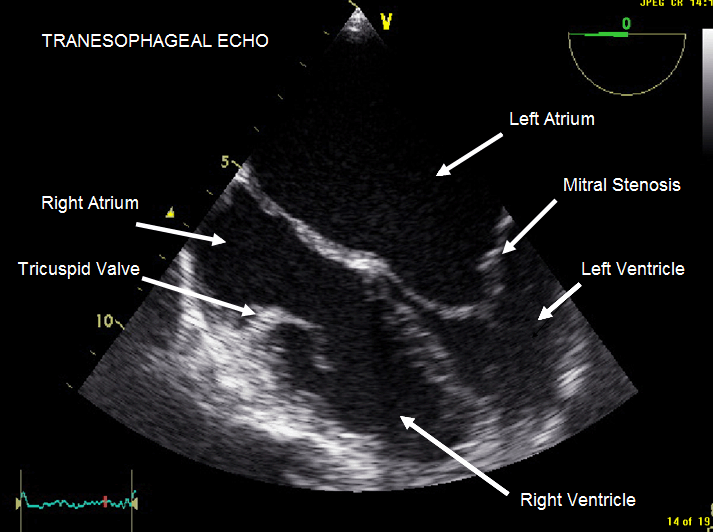
A 30-year-old Caucasian male from a low socioeconomic background was seen in the clinic with one year history of worsening exertional dyspnoea and orthopnoea. He was not an immigrant from any underdeveloped country nor had lived in underdeveloped country during childhood or teenage. He had no recollection of any previous symptoms of rheumatic fever. No other past medical illness of note apart from mild asthma. He admitted to intravenous drug abuse in the past. On clinical examination, he was slim built with a normal blood pressure and a regular pulse. No evidence of peripheral oedema was present. Jugular venous pressure was not raised. Cardiovascular examination revealed a loud first heart sound, opening snap and mid diastolic murmur with presystolic accentuation. Electrocardiograph demonstrated sinus rhythm with right bundle branch block along with evidence of left atrial enlargement. Transthoracic and transoesophageal echocardiography (Figure 1) confirmed severe rheumatic mitral stenosis with thickening and fusion of the commissures, mitral valve area of 0.7-0.9 cm2 measured by planimetry method, mild mitral regurgitation and left atrial dilatation. There was also marked pulmonary hypertension, with a systolic pulmonary artery pressure estimated to be 70 mmHg. These findings were confirmed at cardiac catheterisation together with normal appearance of coronary arteries. The clinical and biochemical markers were not suggestive of infective endocarditis, given his intravenous drug abuse. He underwent percutaneous balloon mitral valvuloplasty successfully. Post-operative echocardiogram showed an increase in the mitral valve area to 1.4 cm2 (pressure half-time method) and regression of left atrial pressure. Subsequent patient follow up in the clinic showed symptomatic improvement.
| ||||||
| ||||||
|
Discussion
| ||||||
|
Rheumatic mitral stenosis in young population is now considered to be rare in developed countries with an incidence of less than 1 per 100,000 population [1] and relates to the decline of rheumatic fever. A similar condition occasionally occurs in association with other diseases such as systemic lupus or infective endocarditis. [3] However, our case report highlights that rheumatic mitral stenosis in young from low socioeconomic background, still exists and is a cause of concern in the United Kingdom. Consequently, we should remain vigilant and be aware of the presenting symptoms and signs of rheumatic fever and rheumatic heart disease. [4] Another interesting feature to note in this case is the marked degree of pulmonary hypertension secondary to mitral stenosis, which is particularly uncommon in this age group, as it has been estimated that progression from mild to severely disabling symptoms usually takes up to 10 years. [5] From United Kingdom experience, in the year 2006, a total of 153 of percutaneous mitral valvuloplasty procedures were performed. [6] In the north west region of UK, where this patient came from, there were none in this age group in the last seven years.
| ||||||
|
Conclusion
| ||||||
|
Our case emphasises that despite the decline in the incidence of rheumatic heart disease in the UK, severe mitral stenosis may still occur even in young population in their third decade. Consequently, we should remain vigilant and be aware of the presenting symptoms and signs of rheumatic fever and rheumatic heart disease.
| ||||||
|
References
| ||||||
| ||||||

| [HTML Abstract] [PDF Full Text] |
|
Author Contributions:
Prashanth Raju - Substantial contributions to conception and design, Acquisition of data, Drafting the article, Revising it critically for important intellectual content, Final approval of the version to be published Gopala Krishna Rao - Substantial contributions to conception and design, Analysis and interpretation of data, Drafting the article, final approval of the version to be published Lindsay Morrison - Substantial contributions to conception and design, Drafting the article, Revising it critically for important intellectual content, Final approval of the version to be published Robert S. Hornung - Substantial contributions to conception and design, Drafting the article, Revising it critically for important intellectual content, Final approval of the version to be published |
|
Guarantor of submission:
The corresponding author is the guarantor of submission. |
|
Source of support:
None |
|
Conflict of interest:
The author(s) declare no conflict of interests |
|
Copyright:
© Prashanth Raju et. al. 2010; This article is distributed the terms of Creative Commons Attribution License which permits unrestricted use, distribution and reproduction in any means provided the original authors and original publisher are properly credited. (Please see Copyright Policy for more information.) |
|
|