
| Table of Contents |  |
|
CASE REPORT
|
| Kikuchi's disease: A case report from south India |
| Sudhakar MK1, Sathyamurthy P2, Indhumathi E3, Amarabalan Rajendran4, Bavya Vivek5 |
|
1Professor, Department of Medicine, Sri Ramachandra University, Chennai, Tamilnadu, India.
2Assistant Professor, Department of Medicine, Sri Ramachandra University, Chennai, Tamilnadu, India. 3Associate Professor, Department of Medicine, Sri Ramachandra University, Chennai, Tamilnadu, India. 4Medical Officer, Department of Endocrinology Diabetes & Metabolism, Sri Ramachandra University, Chennai, Tamilnadu, India. 5Post Graduate student, Department of Medicine, Sri Ramachandra University, Chennai, Tamilnadu, India. |
|
doi:10.5348/ijcri-2011-02-20-CR-4
|
|
Address correspondence to: Dr. Amarabalan Rajendran No.99, Madam Street Pillayar palayam, Kanchipuram Tamilnadu - 631501, INDIA. Ph: +919940412624 Email: amarabalan@gmail.com |
|
[HTML Abstract]
[PDF Full Text]
|
| How to cite this article: |
| Sudhakar M K, Sathyamurthy P, Indhumathi E, Rajendran A, Vivek B. Kikuchi's disease: A case report from south India. International Journal of Case Reports and Images 2011;2(2):15-18. |
|
Abstract
|
|
Introduction: Kikuchi-Fujimoto disease (KFD), or histiocytic necrotizing lymphadenitis, is a rare benign, self-limiting cervical lymphadenitis of unknown etiology. It predominantly affects young women and can closely mimic infective and immunological disorders.
| |
|
Key Words:
Kikuchi-Fujimoto disease, Histiocytic Necrotizing Lymphadenitis, Systemic Lupus Erythematosus, Immunohistochemistry, Karyorrhexis
| |
|
Introduction
| ||||||
|
Kikuchi-Fujimoto disease (KFD) or histiocytic necrotizing lymphadenitis is an uncommon, idiopathic, generally self-limited cause of lymphadenitis. [1] [2] Kikuchi first described the disease in 1972 in Japan. Fujimoto and colleagues independently described Kikuchi's disease in the same year. The cause of Kikuchi-Fujimoto disease is unknown. Some kind of viral or post viral etiology has been proposed. There have also been reports of a possible link between KFD and systemic lupus erythematosus (SLE). Kikuchi-Fujimoto disease is an extremely rare disease. Its incidence has been reported worldwide with a higher prevalence among Japanese and other Asiatic individuals. KFD is more common in females compared to males with a male to female ratio of 1:4. People under 30 years of age are more affected by this disease than any other age group. [3] | ||||||
|
Case Report
| ||||||
|
A 25-year-old female of south Indian origin presented to us with multiple neck swellings, fever, and polyarthritis of 15 days duration. There was no weight loss. There was no previous history of tuberculosis or contact with tuberculosis. She did not have history of any drug intake or atopy. She did not have any other significant medical problems.
| ||||||
|
| ||||||
| ||||||
| ||||||
|
Discussion | ||||||
|
Kikuchi's disease most often presents with cervical lymphadenopathy which may be tender and can be accompanied by fever, upper respiratory tract symptoms. Less common symptoms include arthralgia, skin rashes, weakness and night sweats. Weight loss, diarrhea, anorexia, chills, nausea, vomiting, chest and abdominal pain have also been reported. Some patients may also have hepatosplenomegaly. The exact etiology of Kikuchi's disease is not known. Viral agents such as Epstein barr virus (EBV), Human immunodeficiency virus (HIV), Herpes simplex virus, dengue virus, Human T lymphotrophic virus 1 (HTLV1) and Parvovirus B19 have been suggested as possible etiological agents, but none have been confirmed so far. Toxoplasma and other bacterial agents like Yersinia enterocolitica, Bartonella, Brucella have also been implemented. [4] An autoimmune mechanism has also been proposed because KFD is seen in conjunction with systemic lupus erythematosus (SLE). There are several reports suggesting an association between Kikuchi's disease and systemic lupus erythematosus (SLE). However no convincing evidence is available to confirm such association. The pathogenesis of Kikuchi's disease is still not fully understood. It is supposed that the primary event may be the activation of T lymphocytes and histiocytes. Proliferating T cells enter the cycle of apoptosis, which may form the areas of necrosis in lymph nodes and then the cellular debris is removed by histiocytes. [5]
| ||||||
|
Conclusion
| ||||||
|
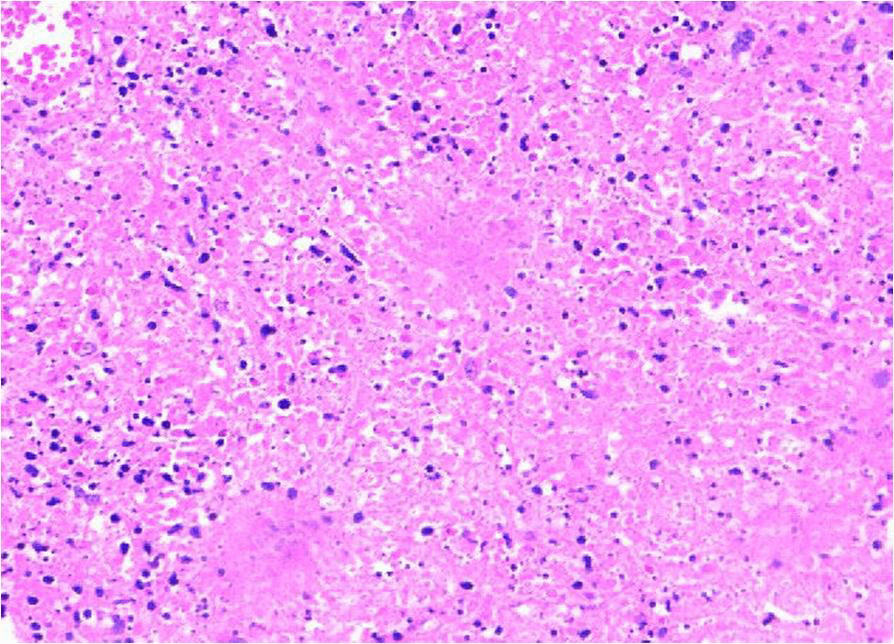
Although the incidence of Kikuchi-Fujimoto disease is rare, this disorder must be considered among the differential diagnosis when a young female patient presents with fever and cervical lymphadenopathy. Clinically Kikuchi's disease may mimic lymphoma or systemic lupus erythematosus (SLE). Therefore a careful histopathological examination is necessary in arriving at the diagnosis. Early recognition of the disease is of crucial importance in minimizing potentially harmful and unnecessary evaluations and treatments. | ||||||
|
References
| ||||||
| ||||||


| [HTML Abstract] [PDF Full Text] |
|
Author Contributions:
Sudhakar M K - Conception and design, Analysis and interpretation of data, Critical revision of the article, Final approval of the version to be published Sathyamurthy P - Acquisition of data, Drafting the article, Final approval of the version to be published Indhumathi E - Acquisition of data, Drafting the article, Final approval of the version to be published Amarabalan Rajendran - Analysis and interpretation of data, Drafting the article, Critical revision of the article, Final approval of the version to be published Bavya Vivek - Acquisition of data, Drafting the article, Final approval of the version to be published |
|
Guarantor of submission:
The corresponding author is the guarantor of submission. |
|
Source of support:
None |
|
Conflict of interest:
The author(s) declare no conflict of interests. |
|
Copyright:
© Amarabalan Rajendran et. al. 2011; This article is distributed the terms of Creative Commons Attribution License which permits unrestricted use, distribution and reproduction in any means provided the original authors and original publisher are properly credited. (Please see Copyright Policy for more information.) |
|
|