

|
 |
|
Clinical Image
| ||||||
| Acquired cystic kidney disease: A benign yet potentially fatal condition | ||||||
| Vikrampal Bhatti1, Abhilash Koratala1, Ashutosh M. Shukla1 | ||||||
|
1University of Florida, Gainesville, USA
| ||||||
| ||||||
|
[HTML Abstract]
[PDF Full Text]
[Print This Article]
[Similar article in Pumed] [Similar article in Google Scholar] 
|


| How to cite this article |
| Bhatti V, Koratala A, Shukla AM. Acquired cystic kidney disease: A benign yet potentially fatal condition. Int J Case Rep Images 2017;8(8):561–563. |
|
CASE REPORT
| ||||||
|
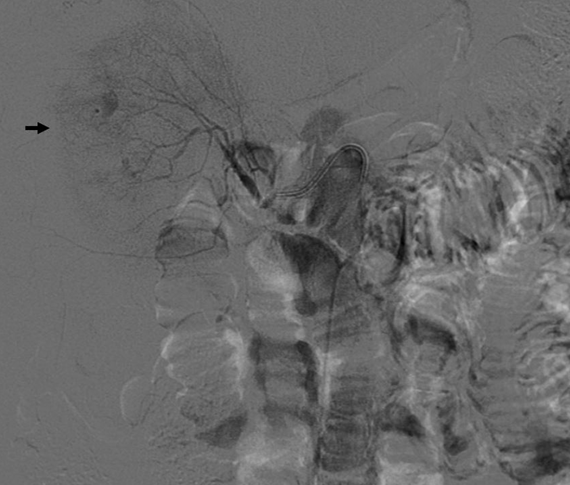
A 48-year-old African-American male with end stage renal disease (ESRD) on hemodialysis for 14 years developed acute abdominal pain during his outpatient dialysis session and was sent to the emergency room. The patient was found to be hypotensive with a blood pressure of 93/72 mmHg requiring fluid resuscitation, which later deteriorated further requiring vasopressors. He was found to have acute anemia with a hemoglobin level of 7.5 g/dL. Abdominal computed tomography (CT) scan revealed large hemoperitoneum with a right perinephric sentinel clot, bilateral multiple renal cysts and features suspicious of bleeding originating from the upper anterior pole of right kidney (Figure 1). The largest of the cysts measured ~3.2 cm in diameter. Renal angiogram showed active ongoing extravasation from multiple branches of the right renal artery (Figure 2). Selective right renal artery embolization was unsuccessful. An emergent laparotomy revealed a torn right renal capsule with subcapsular hemorrhage and a 1.4 cm ragged defect in the inferior portion of the kidney. He underwent right nephrectomy and pathology was negative for malignancy. It essentially showed end stage kidney with arteriolonephrosclerosis, tubular atrophy, interstitial fibrosis, thyroidization, cysts and chronic interstitial inflammation with associated intra-parenchymal and perirenal hemorrhage. Patient refused blood transfusion because of religious reasons and unfortunately died of hemorrhagic shock after the surgery. | ||||||
|
| ||||||
| ||||||
|
DISCUSSION
| ||||||
|
Acquired cystic kidney disease (ACKD) in patients with advanced chronic kidney disease (CKD) and end stage renal disease, unlike other forms of cystic renal diseases, is largely considered a benign pathology with no clear recommendations for follow-up care. Our case represents a rare but fatal complication of ACKD. Definition of ACKD usually requires three or more cysts in each kidney in a patient with CKD or end stage renal disease who does not have a hereditary cause of cystic disease such as autosomal-dominant polycystic kidney disease or tuberous sclerosis [1]. It is estimated that hemorrhagic cysts are seen in approximately 50% of the patients with ACKD and perinephric hematomas in about 13% of patients [2], which can generally be managed conservatively. Severe bleeding can be fatal and may require interventions such as transcatheter embolization or surgery. More studies are needed to determine the benefit of periodic screening in patients with ACKD to prevent potentially fatal complications. Without clear guidelines for follow-up and majority of the studies on cystic renal diseases excluding patients with ACKD, the true incidence of complications in these patients is not known. We believe an observational cohort study on the lines of Bosniak classification, in patients with advanced CKD and end stage renal disease should be considered such that natural history of this condition, including potential complications e.g. malignancy [3] and bleeding can be better predicted. | ||||||
|
CONCLUSION
| ||||||
|
Acquired cystic kidney disease (ACKD) is characterized by development of numerous cysts in both the kidneys in individuals without history of hereditary cystic disease. Hemorrhagic cysts can sometimes lead to severe bleeding that can be life-threatening. High index of suspicion is required for this condition when end stage renal disease patients present with abdominal pain and drop in hemoglobin. Until clear guidelines are established, it would be prudent to monitor ACKD patients with periodic renal imaging. Keywords: Acquired cystic kidney disease, Hemoperitoneum, Renal disease | ||||||
|
REFERENCES
| ||||||
| ||||||


|
[HTML Abstract]
[PDF Full Text]
|
|
Author Contributions
Vikrampal Bhatti – Substantial contributions to conception and design, Acquisition of data, Analysis and interpretation of data, Drafting the article, Revising it critically for important intellectual content, Final approval of the version to be published Abhilash Koratala – Analysis and interpretation of data, Revising it critically for important intellectual content, Final approval of the version to be published Ashutosh M. Shukla – Analysis and interpretation of data, Revising it critically for important intellectual content, Final approval of the version to be published |
|
Guarantor
The corresponding author is the guarantor of submission. |
|
Source of support
None |
|
Conflict of interest
Authors declare no conflict of interest. |
|
Copyright
© 2017 Vikrampal Bhatti et al. This article is distributed under the terms of Creative Commons Attribution License which permits unrestricted use, distribution and reproduction in any medium provided the original author(s) and original publisher are properly credited. Please see the copyright policy on the journal website for more information. |
|
|