|
|
|
|
Case Series
| ||||||
| Throat discomfort: A harbinger of a lethal diagnosis | ||||||
| Kevin Rajakariar1, Anoop Koshy1, Jithin Sajeev1, George Proimos1 | ||||||
|
Department of Cardiology, Box Hill Hospital, Eastern Health, Victoria
| ||||||
| ||||||
|
[HTML Abstract]
[PDF Full Text]
[Print This Article] [Similar article in Pumed] [Similar article in Google Scholar] 
|
| How to cite this article |
| Rajakariar K, Koshy A, Sajeev J, Proimos G. Throat discomfort: A harbinger of a lethal diagnosis Int J Case Rep Images 2017;8(8):510–513. |
|
ABSTRACT
|
|
Atypical presentations of acute aortic dissection are associated with delayed diagnosis and increased mortality rates. We describe two cases of isolated throat discomfort as the only symptom of a Stanford type A aortic dissection. In the first case, a 77-year-old male presented with isolated throat discomfort. After delayed recognition of aortic dissection, computed tomography (CT) aortography confirmed type A aortic dissection extending into the great vessels. He suffered a cardiac arrest and died. In second case, a 57-year-old male who described chest pain and a coronary angiogram was unremarkable. Post-procedure, he complained of severe throat pain and due to early suspicion of aortic dissection, an urgent CT aortography confirmed the diagnosis. He subsequently underwent successful graft replacement. The contrasting case series illustrates the importance of considering throat discomfort as an early manifestation of aortic dissection. Keywords: Aortic dissection, Sore throat, Throat discomfort, Type A |
|
INTRODUCTION
|
|
Clinical diagnosis of acute aortic dissection (AAD) is often challenging in the emergency room. Classical symptoms are uncommon and atypical presentations are associated with delayed diagnosis and an incremental rise in mortality approaching 2% for every hour following the onset of symptoms [1]. Acute aortic syndromes typically present with sudden onset of ‘tearing’ chest, abdominal or back pain [2]. In a real-world setting, however, absence of these pathognomonic symptoms can make AAD a ‘clinical chameleon’. Awareness of atypical symptoms and early diagnosis correlated with improved clinical outcomes [2][3]. A review by the European Society of Cardiology found 30% of patients to be misdiagnosed prior to the discovery of aortic dissection [4], and almost half of these were labeled and treated as an acute coronary syndrome [5]. Numerous atypical symptoms have been described, including trapezius ridge pain, fever, paresthesia and hiccups [6][7][8][9]. In this case series, we describe two reports of Stanford type A aortic dissection presenting with isolated throat discomfort. |
|
CASE SERIES
|
|
Case 1 |
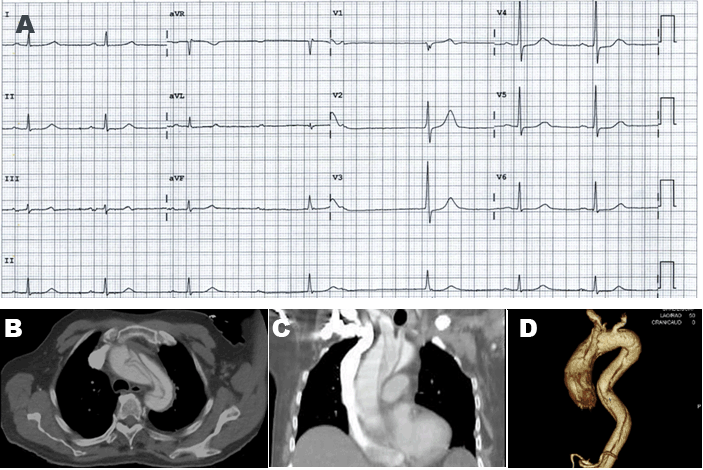
| A previously healthy 77-year-old male, presenting with isolated sudden onset throat discomfort. He had no history of hypertension, relevant family history or other cardiovascular risk factors. Examination demonstrated bradycardia at a rate of 38 beats per minute with no radio-radial delay and although mildly hypertensive, there was no clinically significant brachial blood pressure difference. An ECG showed transient high grade atrioventricular block and serial troponins were within normal limits (Figure 1A). A transthoracic echocardiogram (TTE) was performed later that day which demonstrated a dilated 5.9 cm ascending aorta, subsequently an urgent computed tomography (CT) aortography revealed an extensive type a aortic dissection into the brachiocephalic, left common carotid and subclavian arteries in addition to bilateral external iliac, common iliac, and common femoral arteries. He progressed to acute aortic rupture and died as a result of hemorrhagic shock following the CT scan (Figure 1B). |
| Case 2 |
|
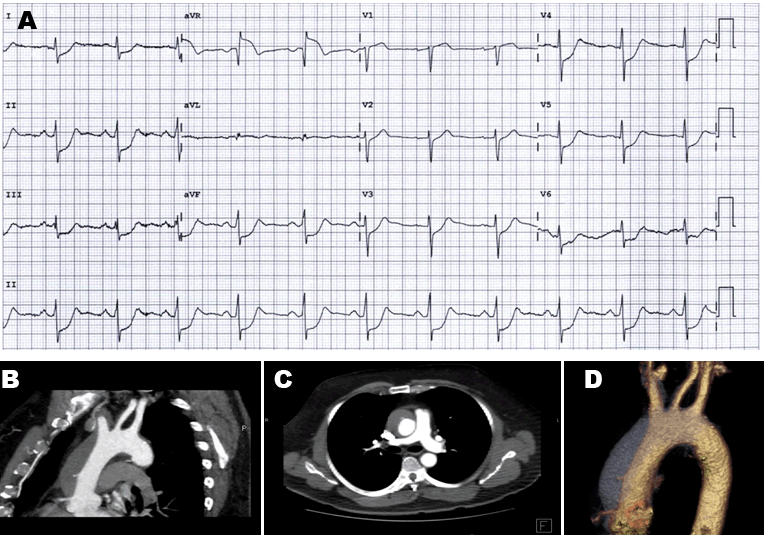
A 57-year-old male presented with bilateral arm paresthesia on a background of known hypertension and hypercholesterolemia, treated with irbesartan, hydrochlorothiazide and simvastatin. He had no family history of aortic syndromes or vasculitis. Blood pressure reading was elevated at 150/90, but was equal bilaterally, and an ECG demonstrated ST elevation in aVR with reciprocal ST depression in the anterior, inferior, and lateral leads (Figure 2A). High sensitivity troponin was mildly elevated at 20 ng/L (normal range <14 ng/L). He underwent urgent transradial coronary angiography which showed no flow limiting coronary artery stenosis, but was commenced on dual anti-platelets without heparinization. Following the procedure, his symptoms and ECG changes resolved, however he developed intense throat discomfort. The possibility of aortic dissection was raised and CT aortography confirmed type A aortic dissection from the aortic cusps extending into the brachiocephalic, left common carotid and subclavian arteries (Figure 2B). He subsequently underwent a successful aortic graft replacement. |
|
|
|
|
|
DISCUSSION
|
|
Branch vessel occlusion ischemia typically causes chest and back pain. However, up to 10% of patients with aortic dissection lack these cardinal features [5]. An incremental mortality rate following the onset of symptoms highlights the importance of making an early diagnosis in patients with acute aortic syndromes [3]. In a subset of the patients, throat pain may be the sole feature to prompt consideration of AAD. This has only been reported twice in literature [8][9]. The throat discomfort is likely attributable to propagation of the dissection plane to the great vessels, as was the case in both patients. Other possible pathophysiological mechanisms may include lower cranial nerve irritation of the cardiac branch of the left vagus nerve secondary to supra-aortic vessel compression [10]. Throat discomfort is a clinically significant symptom that could aid in early diagnosis of acute aortic dissection in a patient where other typical symptoms are absent. This is particularly significant in cases where patients are misdiagnosed as an acute coronary syndrome, as a combination of antiplatelet pre-loading and heparinization in the emergency department, followed by a coronary angiogram can often be fatal due to the risk of guidewire induced extension of the dissection plane. While not all throat pain equates to an aortic dissection, in the clinical situation where the symptom does not match the overall clinical state warrants consideration of the diagnosis. |
|
CONCLUSION
|
|
In the clinical situation where the symptom does not match the overall clinical state warrants consideration of the diagnosis, while not all throat pain equates to aortic dissection. |
|
REFERENCES
|
|
|
[HTML Abstract]
[PDF Full Text]
|
|
Acknowledgements
We would like to thank the patients for allowing us to use these cases to help widen our knowledge. No financial assistance was provided for the study. |
|
Author Contributions
Kevin Rajakariar – Substantial contributions to conception and design, Acquisition of data, Analysis and interpretation of data, Drafting the article, Revising it critically for important intellectual content, Final approval of the version to be published Anoop Koshy – Analysis and interpretation of data, Revising it critically for important intellectual content, Final approval of the version to be published Jithin Sajeev – Analysis and interpretation of data, Revising it critically for important intellectual content, Final approval of the version to be published George Proimos – Analysis and interpretation of data, Revising it critically for important intellectual content, Final approval of the version to be published |
|
Guarantor
The corresponding author is the guarantor of submission. |
|
Source of support
None |
|
Conflict of interest
Authors declare no conflict of interest. |
|
Copyright
© 2017 Kevin Rajakariar et al. This article is distributed under the terms of Creative Commons Attribution License which permits unrestricted use, distribution and reproduction in any medium provided the original author(s) and original publisher are properly credited. Please see the copyright policy on the journal website for more information. |
|
|