
  |

|
 |
|
Case Report
| ||||||
| Pseudo–Mirizzi syndrome resulting from traumatic hematoma of the duodenum: A case report | ||||||
| Adam Colton1, Pawanjit Dhillon1, Delphine Engel1, Mumtaz Tabbaa1, Andrew McCague1 | ||||||
|
1Natividad Medical Center, Colton, CA.
| ||||||
| ||||||
|
[HTML Abstract]
[PDF Full Text]
[Print This Article]
[Similar article in Pumed] [Similar article in Google Scholar] 
|


| How to cite this article |
| Colton A, Dhillon P, Engel D, Tabbaa M, McCague A. Pseudo–Mirizzi syndrome resulting from traumatic hematoma of the duodenum: A case report. Int J Case Rep Images 2016;7(6):413–415. |
|
Abstract
|
|
Introduction:
Traumatic hematoma of the duodenum is a rare occurrence. This case represents a rare case of an extramural duodenal hematoma leading to compression on the common bile duct and a Pseudo–Mirizzi syndrome.
Case Report: A 28-year-old male developed a duodenal hematoma after his all-terrain vehicle collided with a tree. He later developed hyperbilirubinemia attributed to a Pseudo–Mirizzi syndrome caused by the hematoma. Conclusion: This is a rare case of a traumatic duodenal hematoma causing a Pseudo–Mirizzi syndrome. | |
|
Keywords:
Duodenal hematoma, Pseudo–Mirizzi syndrome, Trauma, Vehicle collide
| |
|
Introduction
|
|
Traumatic hematoma of the duodenum is a rare occurrence [1] [2]. It is thought that the retroperitoneal location of this organ may offer a greater amount of protection when faced with blunt abdominal trauma [3]. Cases described in literature occur predominantly in children and most involve the diagnosis of intramural hematomas of the duodenum which cause patients to present because of onset of gastrointestinal symptoms consistently with gastric outlet obstruction such as abdominal pain, nausea and vomiting [4]. The case presented here varies from the typical presentation, in that an extramural duodenal hematoma lead to elevation in bilirubin in an otherwise healthy adult male. Reports of traumatic hematoma causing external compressive forces on adjacent structures such as the pancreas and biliary tree are sparsely found in trauma literature and will be discussed here. |
|
Case Report
|
|
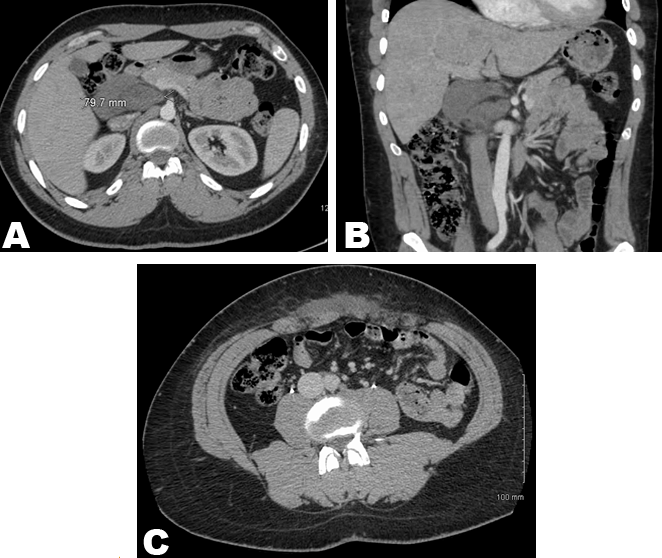
A 28-year-old male was admitted to our institution two days after an all-terrain vehicle (ATV) accident where the patient struck a tree and was hit in the abdomen by his handle bars. There was no loss of consciousness at the time of the incident and the patient remained ambulatory at the scene. He presented to the emergency department complaining of abdominal ecchymosis that was getting progressively worse. On admission, the patient denied any abdominal pain, distention, nausea or vomiting and was reporting good appetite with normal bowel movements. On examination, the patient was found to have dark periumbilical ecchymosis (presumed to have a positive "Cullen's sign") but abdomen was soft, tender and non-distended with bowel sounds present in all four quadrants. His white blood cell count was 9,200 cells/mm3, hemoglobin 14.3 mg/dl, and platelets 195,000/mL. Complete metabolic panel showed elevated total bilirubin level of 1.5 mg/dL but otherwise unremarkable findings with lipase of 54 U/L. Radiographic results demonstrated evidence of a large hematoma in the peripancreatic/periduodenal region extending into the mesentery on computed tomographic (CT) scan which was treated conservatively (Figure 1). Serial lab investigations were obtained later that morning showing a total bilirubin level further elevated to 1.9 mg/dL. At this point, our gastroenterologist was consulted for further assessment. The patient underwent an ERCP with sphincterotomy and stent placement later that day. Follow-up laboratory findings showed further elevation of total bilirubin level to 2.5 mg/dL with elevated lipase to 10,203 U/L (normal range 23–300 U/L) suggesting post-ERCP pancreatitis. However, the patient remained asymptomatic. Serial lipase levels showed down-trending over the next 24 hours to 1,631 U/L at time of discharge the following day. At one year follow-up, the patient had no additional episodes of biliary obstruction. |
|
|
|
Discussion
|
|
In the present patient, computed tomography scan showed evidence of a large duodenal hematoma. Initial concern for expanding traumatic hematoma causing obstruction of the common bile duct, leading to worsening hyperbilirubinemia and subsequent cholestastic complications such as obstructive jaundice, was supported by serial bilirubin levels trending upward. This led to gastroenterology consultation and subsequent ERCP with stent placement to ensure patency of biliary tree. Studies on duodenal hematomas have tended towards those "intramural" which often present with symptoms of abdominal pain, vomiting and other symptoms typical of obstructive gastropathy [3] [4]. However, very little research has been done on indications for preventative stent placement in the case of traumatic extramural duodenal hematoma as is seen in this case [5]. It may be postulated that conservative management may have been sufficient in this patient, given his lack of overt symptomatology [6]. Larger discussion of the role of conservative management in this type of case may be warranted. Consideration for serial CT scans to assess for expansion of extramural duodenal hematomas may be a reasonable option in this scenario, especially in settings without readily available ERCP capabilities [7]. Further, in event that follow-up imaging yields signs of rapid hematoma expansion, surgical intervention would likely take precedent over attempts at endoscopy guided procedural stenting, so the role of non-surgical intervention may be limited [8]. It may be important for trauma surgeons to weigh the risks, benefits and costs of preventative use of biliary stenting in cases of non-intramural duodenal hematomas resulting in asymptomatic hyperbilirubinemia. |
|
Conclusion
|
|
Here we presented a rare case of an extramural traumatic duodenal hematoma leading to extrinsic compression on the common bile duct and likely pancreatic duct leading to obstructive hyperbilirubinemia. Though duodenal hematomas are not uncommon in trauma, the Pseudo–Mirizzi syndrome presented in this patient makes this a rare case. Conservative management should be attempted unless signs of ongoing bleeding or prolonged obstruction are seen. |
|
References
|
|

|
[HTML Abstract]
[PDF Full Text]
|
|
Author Contributions
Adam Colton – Substantial contributions to conception and design, Acquisition of data, Analysis and interpretation of data, Revising it critically for important intellectual content, Final approval of the version to be published Pawanjit Dhillon – Analysis and interpretation of data, Revising it critically for important intellectual content, Final approval of the version to be published Delphine Engel – Analysis and interpretation of data, Revising it critically for important intellectual content, Final approval of the version to be published Mumtaz Tabbaa – Analysis and interpretation of data, Revising it critically for important intellectual content, Final approval of the version to be published Andrew McCague – Analysis and interpretation of data, Revising it critically for important intellectual content, Final approval of the version to be published |
|
Guarantor of submission
The corresponding author is the guarantor of submission. |
|
Source of support
None |
|
Conflict of interest
Authors declare no conflict of interest. |
|
Copyright
© 2016 Adam Colton et al. This article is distributed under the terms of Creative Commons Attribution License which permits unrestricted use, distribution and reproduction in any medium provided the original author(s) and original publisher are properly credited. Please see the copyright policy on the journal website for more information. |
|
|