| |
|
|
|
Clinical Image
| ||||||
| Superior semicircular canal dehiscence syndrome: A rare cause for dizziness | ||||||
| Han-Kuang Chen | ||||||
|
MBBS, Surgical Resident, Medical Department, St John of God Subiaco Hospital, Subiaco, WA, Australia.
| ||||||
| ||||||
|
[HTML Abstract]
[PDF Full Text]
[Print This Article]
[Similar article in Pumed] [Similar article in Google Scholar] 
|
| How to cite this article |
| Chen Han-Kuang. Superior semicircular canal dehiscence syndrome: A rare cause for dizziness. Int J Case Rep Images 2015;6(6):387–388. |
|
Case Report
| ||||||
|
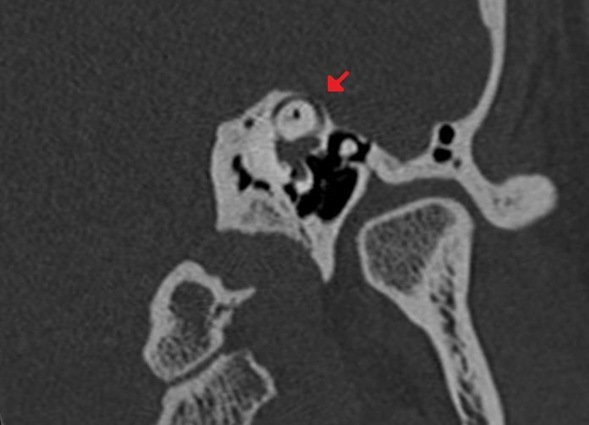
A 35-year-old female presented with a 18-month history of intermittent dizziness triggered by hearing loud sound and symptoms resolve as soon as sound stops. She saw her general practitioner 12 months ago and was diagnosed with benign paroxysmal vertigo. However, patient's symptom gradually worsened. She described that, in recent months, her dizziness symptom could be triggered just by putting a mug on a table or talking too loudly. She also described hearing her eyeball movements at night when the surroundings were quiet. Her worsening symptoms severely affected her quality of life. She was otherwise healthy and had no medical or surgical history. The patient was referred to an ENT specialist for further investigations. A high resolution CT scan of the left temporal bone was performed and it showed 1 mm dehiscence of the superior semicircular canal antero-superiorly; consistent with superior semicircular canal dehiscence (Figure 1). Patient subsequently underwent an elective surgery to repair the superior semicircular canal dehiscence. The surgery was done by middle cranial fossa approach and the area of dehiscence was occluded with bone pâté and covered with fascia. Postoperatively, patient was admitted to intensive care unit for overnight observation and was transferred to ENT ward on day-1. Initially, her cranial examination revealed nystagmus on lateral gazes but it resolved on day-3. Patient continued to make a good recovery and was discharged on day-4 postoperatively. At fourth week follow-up, she had complete resolution of the symptoms and she was able to perform any activities of daily living without problems. | ||||||
| ||||||
|
Discussion
| ||||||
|
Superior semicircular canal dehiscence syndrome (SSCDS) is a rare condition which is characterized by sound or pressure induced vestibular symptoms. It is caused by dehiscence of the bone overlying the superior canal and the prevalence is estimated to be 0.5–0.6% [1]. It is postulated that the dehiscence creates a third mobile window into the inner ear. As a result, external sound and pressure can cause changes in the middle ear pressure, resulting in vertigo and oscillopsia [2]. The evoked eye movements in this syndrome align with the plane of the dehiscent superior canal. Patients may also experience hyperacusis to bone-conducted sounds. The diagnosis is best established upon clinical findings and imaging, include the following [2]:
In terms of management, SSCDS can be treated by surgically occluding the dehiscence and it can effectively alleviate symptoms [3]. In our case, the patient had full resolution of her symptoms after receiving the surgery. On review of literature, only a small number of SSCDS cases have been reported. The majority of the patients experienced similar sound or pressure induced vestibular symptoms as observed in this case. Fortunately, all of the patients had good symptom control if not full resolution after surgical treatment. | ||||||
|
Conclusion
| ||||||
|
Superior semicircular canal dehiscence syndrome (SSCDS) is characterised by vestibular symptoms induced by sound or pressure. Although uncommon, this condition can significantly affect quality of life. Awareness of this rare cause of dizziness is essential for timely diagnosis and intervention. | ||||||
|
References
| ||||||
| ||||||
|
[HTML Abstract]
[PDF Full Text]
|
|
Author Contributions
Han-Kuang Chen – Substantial contributions to conception and design, Acquisition of data, Analysis and interpretation of data, Drafting the article, Revising it critically for important intellectual content, Final approval of the version to be published |
|
Guarantor of submission
The corresponding author is the guarantor of submission. |
|
Source of support
None |
|
Conflict of interest
Authors declare no conflict of interest. |
|
Copyright
© 2015 Han-Kuang Chen. This article is distributed under the terms of Creative Commons Attribution License which permits unrestricted use, distribution and reproduction in any medium provided the original author(s) and original publisher are properly credited. Please see the copyright policy on the journal website for more information. |
|
|